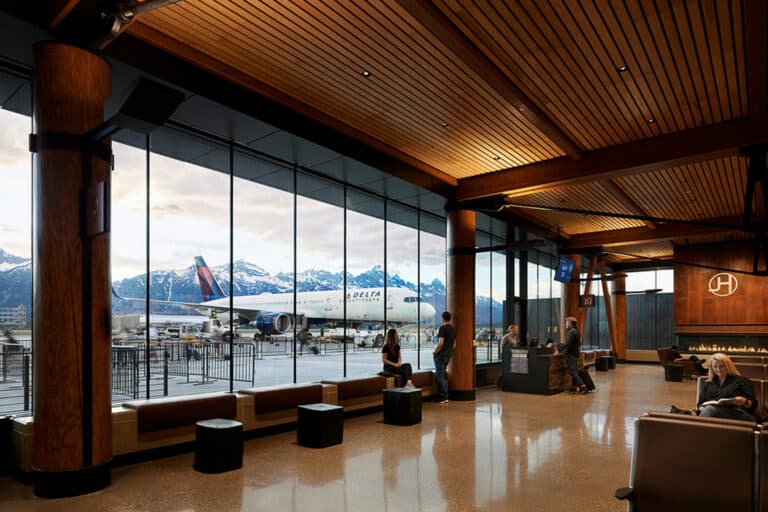
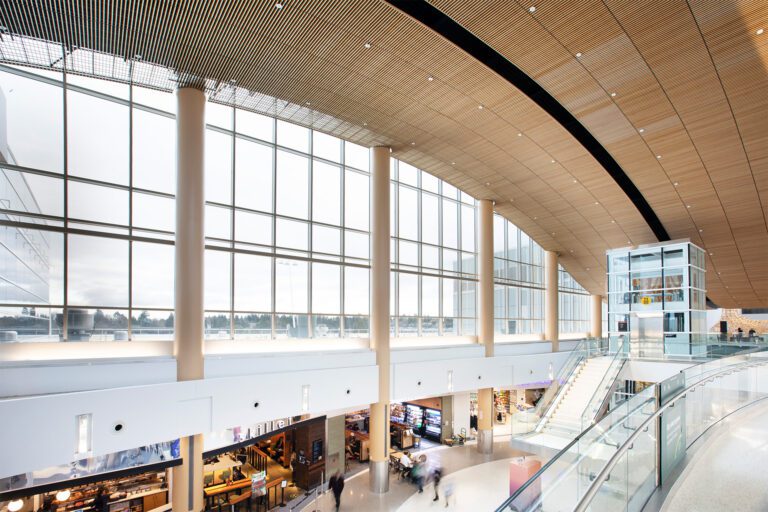
Train stations, bus terminals, transit authority facilities, and people mover systems share a design challenge that is distinct from every other building type in commercial architecture. These are public infrastructure environments – built to last decades, funded through public procurement, used continuously by tens of thousands of people every day – and they have to work at a level of performance and durability that private commercial buildings rarely require.
Wood baffle ceiling systems are increasingly the answer that transit architects and facility planners working across airports and transit terminals are reaching for, and the reasons go well beyond aesthetics.
The Design Challenge Unique to Transit Hubs
Transit hub design presents a combination of requirements that pushes ceiling materials further than most commercial environments:
- Extreme and sustained foot traffic: Transit facilities operate continuously across long daily hours, with peak-period loads that concentrate thousands of people in concourses, platforms, and waiting areas simultaneously. The ceiling material must maintain its performance and appearance under this level of sustained use without the renovation cycles that commercial interiors expect.
- Wayfinding complexity: Transit hubs often involve multiple lines, platforms, and connections that must be legible to users navigating in real time, often under time pressure. The ceiling material and geometry play a meaningful role in how passengers read, orient, and move through the space.
- Variable environmental conditions: Transit environments introduce moisture, humidity from platform activity and weather infiltration, mechanical system exhaust, and in underground stations, the pressure effects of train movement through enclosed volumes. Standard interior ceiling systems are not designed for these conditions.
- Public authority procurement: Transit projects are publicly funded and subject to procurement frameworks that prioritize documented performance, long-term maintenance cost, and verifiable material credentials. Certification documentation carries more weight in this procurement environment than in private commercial projects.
- Long service life expectations: Commercial interiors are typically expected to perform for 10 to 15 years before renovation. Transit infrastructure carries service life expectations of 30 to 50 years or more. The ceiling specification must reflect that horizon.
Why Wood Works in Transit Environments
The instinctive objection to specifying wood in a high-traffic transit environment is durability — wood feels fragile relative to metal, concrete, or manufactured ceiling tile. The reality of engineered wood ceiling systems is different.
Rulon’s wood ceiling systems are manufactured from real wood — available in solid wood or wood veneer constructions depending on the product and species selected, across more than 150 wood species. The result is a system that delivers the warmth and authenticity of natural wood while meeting the performance and durability requirements that transit environments demand.
ASTM E84 Class A fire rating applies across Rulon’s wood ceiling product line. Transit facilities are public assembly occupancies with the same fire code requirements as convention centers and civic buildings. Wood ceiling systems certified to ASTM E84 Class A meet these requirements without exception.
LBC Red List Free certification confirms that Rulon products contain none of the chemicals of concern identified by the Living Future Institute’s Red List. For transit authorities pursuing healthy building standards or operating under procurement frameworks that require chemical transparency, this certification provides the documentation needed to satisfy those requirements without additional testing or third-party evaluation.
The warmth of wood in a transit environment has a measurable effect on the quality of the passenger experience. Research on biophilic design in high-traffic public spaces consistently links natural material presence — including wood — to reduced perceived wait time, lower reported stress levels, and improved overall environment ratings. In an era where transit authorities are competing with ride-share and personal vehicle alternatives for ridership, the design quality of the environment is a legitimate retention factor.
Wood Baffle Ceiling Systems for Open Transit Environments
Many transit environments — covered platforms, transit concourses, open-ceiling ticketing halls — are not suited to a conventional suspended ceiling plane. The ceiling height may be too great, the mechanical clearances too constrained, or the architectural intent too committed to an open-structure aesthetic to accommodate a full ceiling field.
Wood Baffle ceiling systems address this condition directly. Rulon’s suspended wood baffles are designed to be installed in arrays from exposed structure, providing acoustic absorption through vertical surfaces that intercept sound waves traveling horizontally across the space — precisely the path that crowd noise, PA announcements, and transit system sounds take in open transit environments.
Suspended wood ceiling baffles are particularly effective in:
- Covered platforms where train movement generates sustained broadband noise that needs absorption without a closed ceiling
- Transit concourses with exposed structural systems where a full ceiling plane would conflict with the architectural language
- Underground station environments where mechanical clearances above the structural slab limit suspended ceiling depth
- Connector corridors between transit lines where ceiling heights are low and horizontal sound propagation is the primary acoustic challenge
Wood baffles also provide visual warmth in environments that would otherwise read as entirely industrial — structural steel, precast concrete, and mechanical systems overhead. Even a modest suspended baffle installation changes the character of the space in ways that passengers register immediately, if not consciously.
Durability Considerations for Transit Environments
Specifying wood ceiling systems for transit hubs requires addressing the durability variables that standard commercial specifications do not encounter:
Moisture and Humidity
Underground stations, covered platforms, and transit hubs with connections to exterior conditions introduce moisture and humidity levels that standard wood ceiling systems are not rated to handle. For these applications, Rulon’s Endure Linear system, a uPVC linear ceiling engineered specifically for corrosive and high-humidity environments, provides the same aesthetic as Rulon’s wood Linear system in conditions where wood would not perform long-term. Endure Linear carries ASTM E84 Class A rating and is the correct specification for underground transit environments, exterior canopy applications, and any environment where sustained moisture exposure is expected.
Maintenance Access
Transit maintenance teams require more frequent plenum access than commercial building maintenance such as signage systems, lighting controls, mechanical equipment, and security systems above transit ceilings all require periodic service. Access panel configurations allow individual elements to be replaced without damaging adjacent panels or requiring specialized tools, an important consideration for transit facilities where maintenance access is frequent and downtime is costly.
Seismic Performance
Transit infrastructure in seismic zones — including the major transit systems in the San Francisco Bay Area, Los Angeles, and the Pacific Northwest — requires ceiling attachment systems that meet seismic code requirements. Rulon’s engineering team provides project-specific seismic attachment details for review by the authority having jurisdiction.
Certifications for Transit Procurement
Transit authority procurement frameworks typically require documented material credentials. The following Rulon certifications are directly relevant to transit hub specifications:
- ASTM E84 Class A — fire performance, applicable to all Rulon wood ceiling products
- FSC Chain of Custody (FSC C103284) — sustainable forestry certification, supports sustainability mandates in public procurement
- LBC Red List Free — chemical transparency certification, supports healthy building requirements and material transparency frameworks in public sector projects
Documentation for all certifications is available at rulonco.com/sustainability.
Transit hubs are long-term infrastructure investments. The ceiling specification made in design documentation today will be in service for decades. Wood baffle ceiling systems — engineered for the specific conditions of transit environments, certified to the standards that public procurement requires, and designed to improve the daily experience of thousands of passengers — are a specification that performs across that entire horizon.
For a specification-focused look at how these systems apply specifically to terminal environments, see our guide to wood ceiling systems for airport terminals.