Most people don’t think to look up when entering a commercial building. Yet the ceiling system above plays a critical role, balancing acoustics, infrastructure, code requirements, sustainability goals, and the overall feel of the room.
For architects and interior designers, selecting the right types of ceilings represents a complex balancing act. Budget constraints push in one direction. Acoustic requirements pull another. Building codes draw hard lines. And somewhere in the middle sits the design vision you’re trying to bring to life.
This guide walks through the full spectrum of commercial ceiling types and materials available today. You’ll understand performance differences, see where each system excels, and gain the clarity needed to make confident specifications that satisfy both practical requirements and design ambitions.
Understanding Commercial Ceiling Categories
Commercial ceiling and wall systems fall into several broad categories, each with distinct characteristics and ideal applications. The lines between categories sometimes blur—a wood linear system can be either open or closed, for instance—but understanding these foundational groupings helps narrow your options quickly.
Suspended Grid Systems hang below the structural deck on a metal grid framework. Traditional acoustic ceiling tile (ACT) is the most common example. The grid typically sits 4–12 inches below the deck, creating a plenum space that conceals electrical conduit, plumbing, and fire suppression lines. Individual tiles or panels rest in or attach to the grid, allowing easy access for maintenance.
Modern grid systems have evolved far beyond the institutional 2×4 tiles of decades past. Contemporary acoustic ceiling tiles now include integrated lighting, smart sensors, and biophilic designs that blur the line between function and art.
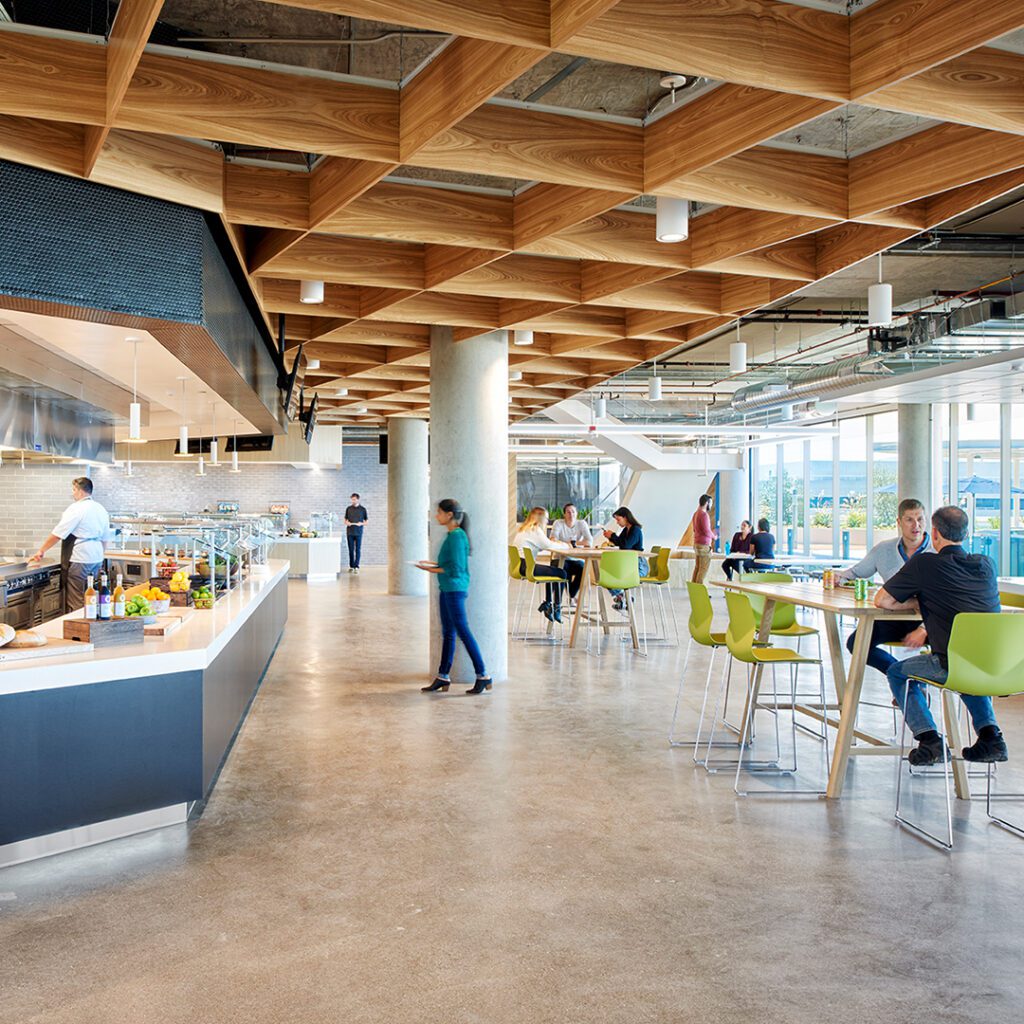
Open-Cell Ceiling Systems. Open-cell designs—sometimes called linear open or baffle systems—create visual interest while maintaining acoustic performance. These systems feature spaced elements with gaps between them, allowing sound to pass through to absorptive material above. Rulon’s Linear Open system exemplifies this category, with wood planks arranged to show clean linear runs while absorbing sound.
The open architecture provides several benefits. Air circulates freely through the ceiling plane. Sprinkler heads and lighting integrate easily. The dimensional quality adds depth and texture that flat ceilings can’t replicate.
Closed-Cell Ceiling Systems provide full visual coverage of the plenum above. This category includes everything from traditional drywall to wood linear closed systems that create monolithic appearances with shiplap profiles.
These ceilings excel when you need complete concealment of infrastructure or when the structural deck above isn’t finished to an acceptable standard. They also deliver stronger performance for certain acoustic goals, like blocking sound transmission between floors.
Specialty and Architectural Systems. This broad category captures everything that doesn’t fit neatly elsewhere. Curved ceiling panels that follow organic forms. Grille systems with ladder-like arrangements of wood blades. Vertical baffles that hang from above. Coffered designs that add classical detailing. Many of these systems also translate to wall applications, creating cohesive material continuity from ceiling to wall within the same space.
These systems typically serve specific architectural visions or solve unique acoustic challenges. They represent the creative end of the ceiling and wall spectrum, where performance requirements meet purposeful design.
Material Options and Performance Characteristics
The material you select defines everything from acoustic behavior to maintenance requirements to environmental impact. Each material brings its own set of strengths and limitations.
Wood Ceiling and Wall Systems
Wood introduces an organic character and tactile richness that other materials struggle to achieve. Beyond aesthetics, wood ceiling and wall systems offer genuine performance benefits when properly engineered.
Acoustic Performance. Wood ceiling systems with perforations or spacing achieve impressive acoustic results. Linear open systems with backing material can reach NRC ratings of 0.55 or higher. Perforated wood panels like Rulon’s Aluratone line deliver NRC values up to 0.85, rivaling the best mineral fiber tiles.
The secret lies in the system design, not just the material itself. Open spacing between planks allows sound to reach absorptive material behind the visible surface. Micro-perforations create thousands of tiny pathways for sound waves to enter and dissipate. Grooved patterns increase surface area and create sound traps.
At the University of South Florida Judy Genshaft Honors College, the design team specified Aluratone 900 and 950 acoustic paneling alongside Grille wall systems throughout the first floor to manage noise across open study areas and collaborative spaces—demonstrating how ceiling and wall treatments work together to shape the acoustic environment of educational facilities.
Fire Rating Considerations. Wood’s combustibility raises questions, but modern treatment processes address these concerns. Class A fire ratings—the highest level—can be achieved with proper fire-retardant treatments. The Class A designation means a flame spread index of 0–25 and a smoke developed index of 0–450, meeting the stringent requirements for commercial applications.
Fire rating requirements vary by building occupancy type, so understanding your specific code obligations is essential. Working with manufacturers who provide comprehensive fire testing documentation simplifies the specification and approval process. For detailed guidance on fire testing standards and compliance, the Ceiling & Interior Systems Construction Association (CISCA) publishes Wood Ceilings Technical Guidelines that serve as a reliable reference for architects and contractors.
Sustainability Profile. Wood ceilings and walls can contribute significantly to green building goals when sourced and manufactured responsibly. FSC-certified wood verifies sustainable forest management. Products with no added formaldehyde (NAF) or ultra-low emitting formaldehyde (ULEF) cores improve indoor air quality. Third-party certifications like Indoor Advantage Gold provide additional assurance. Explore Rulon’s sustainability commitments for specifics on responsible sourcing and certifications.
For LEED® projects, wood ceilings and wall systems can contribute toward multiple LEED v4 and v4.1 credits, depending on project goals and documentation requirements. These rating systems emphasize material transparency, responsible sourcing, and environmental performance—areas where wood products can play a meaningful role. With increasing industry focus on embodied carbon, renewable materials like wood are often considered advantageous due to the biogenic carbon stored within the material. Compared to more carbon-intensive materials such as aluminum or steel, wood can support sustainability objectives when properly specified and documented.
Engineered Polymer Alternatives. Not every project calls for natural wood. Rulon’s Endure™ Linear and Endure™ Direct Attach product lines offer an engineered polymer alternative that delivers a consistent wood-like appearance with added resilience in moisture-prone or high-traffic environments. When the Mott Branch Library originally specified Black Locust lumber for its indoor/outdoor transitional ceiling, the design team ultimately switched to the Endure™ Linear system for its material consistency, lower cost, and ability to handle complex installation conditions—including varied as-built conditions and radiused trim at interior columns.
Metal Ceiling Systems
Metal ceilings deliver durability and a distinctive aesthetic. Aluminum dominates commercial applications due to its light weight, corrosion resistance, and finish flexibility.
Types of Metal Systems. Aluminum linear systems create clean, modern lines. Perforated metal panels provide acoustic absorption. Open-cell metal designs offer an industrial aesthetic with technical performance. Metal tiles integrate into standard grid systems for economical installations.
The material’s strength allows for long spans and dramatic cantilevers that would challenge other materials. Metal doesn’t warp, doesn’t support mold growth, and handles moisture exposure that would damage wood or gypsum.
Acoustic Capabilities. Solid metal reflects sound rather than absorbing it, making unmodified metal ceilings acoustically harsh. Perforations address this limitation. Micro-perforated metal achieves absorption through small holes (typically 0.5–3mm diameter) that allow sound to pass through to the backing material.
The percentage of open area, hole diameter, and hole spacing all affect acoustic performance. Higher perforation percentages generally improve absorption but may compromise the visual appearance. Backing materials (mineral wool, fiberglass, or polyester) complete the acoustic assembly.
Finish Options and Durability. Powder coating provides durable, uniform color in virtually any hue. Anodizing offers a natural metallic appearance with excellent abrasion resistance. Brushed or polished finishes create distinctive looks but may show fingerprints and scratches more readily.
Metal ceilings rarely need replacement. They maintain appearance and performance for decades. This longevity partially offsets higher initial costs, though lifecycle cost analysis should account for the project’s expected lifespan and potential for future modifications.
Mineral Fiber and Fiberglass Tiles
These materials form the backbone of commercial ceiling installations, offering reliable performance at competitive prices.
Mineral Fiber Composition. Mineral fiber tiles contain a blend of mineral wool (slag wool or rock wool), perlite, clay, and binding agents. The porous structure traps sound waves, providing absorption across a broad frequency range. NRC ratings typically range from 0.55 to 0.75, with premium products reaching 0.80 or higher.
Manufacturing processes create various surface textures. Fine, fissured patterns offer subtle texture. Smooth surfaces provide a clean, contemporary look. Textured surfaces can hide imperfections and age more gracefully than smooth finishes.
Fiberglass Performance. Fiberglass ceiling tiles use glass fibers bonded with resins. The resulting panels typically weigh less than mineral fiber equivalents and resist sagging in humid conditions. Sound absorption can be exceptional, with premium fiberglass products achieving NRC values up to 0.95.
The material’s light weight simplifies installation and reduces load on the suspension system. This matters more than you might think when working with existing buildings, where adding dead load could trigger structural evaluations.
Code Compliance and Fire Performance. Nearly all mineral fiber and fiberglass tiles manufactured for commercial use meet Class A fire ratings. They won’t contribute fuel to a fire and produce minimal smoke. This predictable fire performance makes the specification straightforward.
Some products go further, achieving fire-rated assembly status. These systems (ceiling panel, grid, and any penetrations) receive ratings like one-hour or two-hour fire resistance. Projects with specific fire separation requirements between floors benefit from these tested assemblies.
Gypsum Board Ceilings
Drywall ceilings create smooth, monolithic surfaces that can be finished to match walls. This material choice makes sense when you want visual continuity throughout a space or need a surface for paint color coordination.
Installation Methods. Gypsum board attaches directly to ceiling joists or furring strips. For suspended applications, a metal framework supports the board below the structural deck. Joints receive tape and multiple coats of joint compound, then are sanded to create seamless transitions.
The labor-intensive installation process represents both a cost consideration and a limitation. Accessing concealed systems requires cutting through the finished ceiling, patching, and refinishing. This makes gypsum less suitable for spaces with frequently changing utilities.
Acoustic Treatments. Standard gypsum board reflects sound rather than absorbing it. Acoustic gypsum board incorporates perforations or surface treatments to improve absorption. Sound isolation depends more on the assembly—including insulation above the board and resilient mounting—than the board itself.
Gypsum ceiling assemblies can achieve excellent STC (Sound Transmission Class) ratings when properly detailed, making them effective barriers between vertically adjacent spaces.
Fire Resistance. Type X gypsum board contains glass fibers for enhanced fire resistance, achieving one-hour fire ratings at 5/8-inch thickness. Type C (enhanced) gypsum board provides even better fire performance. Multiple layers can achieve two-hour or greater fire ratings when required.
The material’s non-combustible core makes it a reliable choice for fire-rated construction. Gypsum releases water vapor when exposed to high heat, which slows the temperature rise on the unexposed side of the assembly.
Acoustic Performance: What the Numbers Mean
Ceiling specifications often cite NRC, CAC, and STC values. Understanding these metrics helps you select systems that deliver the acoustic environment your project needs.
Noise Reduction Coefficient (NRC). NRC measures how much sound a material absorbs rather than reflects. The scale runs from 0 (perfect reflection) to 1.0 (perfect absorption), though some specialized products exceed 1.0 through three-dimensional geometry that captures sound effectively.
An NRC of 0.70 means the material absorbs 70% of sound energy hitting its surface. Different NRC ranges serve different needs. Basic offices function adequately with NRC 0.50–0.60. Conference rooms and classrooms benefit from 0.70–0.80. Critical listening spaces like music halls may specify 0.85 or higher.
Ceiling Attenuation Class (CAC). CAC quantifies how well a ceiling system blocks sound transmission through the plenum from one room to adjacent rooms. Higher numbers indicate better sound blocking. CAC 35 or greater provides good speech privacy. CAC 40+ delivers excellent isolation.
This metric matters tremendously in open-plan offices, schools, medical facilities, and anywhere confidential conversations occur. A ceiling with high NRC but low CAC will control sound within a space but won’t prevent conversations from traveling to neighboring rooms through shared plenum spaces.
Sound Transmission Class (STC). STC rates entire assemblies (floor/ceiling or ceiling/roof combinations) for their ability to block sound transmission vertically. It’s less about the ceiling material itself and more about the complete assembly, including insulation, air gaps, and mounting methods.
Residential applications typically specify STC 50–55 between units. Commercial spaces benefit from similar or higher ratings between floors, depending on the occupancy types above and below.
Balancing Multiple Acoustic Goals. The ideal ceiling system depends on your specific acoustic challenges. Open-plan offices need both absorption (high NRC) and blocking (high CAC). Restaurants and cafes prioritize absorption to control reverberation. Theaters and performance venues require precisely tuned combinations of absorption, reflection, and diffusion.
Understanding which acoustic metrics matter most for your project type allows you to weight selection criteria appropriately. A conference center makes different acoustic demands than a retail store, even though both are “commercial” spaces.
Fire Rating Requirements and Code Compliance
Building codes establish minimum fire performance requirements for ceiling systems based on occupancy classification, building height, and construction type. Getting this wrong delays projects and creates costly change orders.
Understanding Fire Ratings
Fire ratings measure different aspects of material and assembly behavior during fire exposure.
Surface Burning Characteristics. ASTM E84 testing (the Steiner Tunnel Test) measures flame spread index (FSI) and smoke developed index (SDI). Results classify materials as Class A (FSI 0–25, SDI 0–450), Class B (FSI 26–75), or Class C (FSI 76–200).
Most commercial ceiling materials need Class A ratings. Building codes typically mandate this for interior finishes in most occupancy types. Understanding your specific jurisdiction’s requirements is critical, as local amendments can create variations from model codes. CISCA’s technical publications provide detailed guidance on ceiling system code compliance across occupancy types.
Fire-Rated Assemblies. Some projects require fire-rated floor/ceiling or roof/ceiling assemblies. These assemblies carry ratings like one-hour or two-hour fire resistance, indicating how long the assembly prevents fire spread and maintains structural integrity.
Fire-rated assemblies include all components: the ceiling material, suspension system, and any penetrations for lights or sprinklers. Substituting components—even seemingly minor ones like hanger wire—can void the rating.
Material-Specific Fire Considerations
Wood Ceilings. Wood’s natural combustibility requires treatment for commercial applications. Fire-retardant treatments penetrate wood fibers and react when exposed to heat, releasing gases that inhibit combustion. Properly treated wood achieves Class A ratings while maintaining workability and appearance.
Treatment effectiveness depends on wood species, thickness, and application method. Manufacturers provide documentation showing test results for specific products and configurations. This documentation must match your specification.
Metal Ceilings. Most metals used in ceilings (aluminum, steel) are inherently non-combustible. They automatically meet Class A requirements without additional treatment. However, coatings and finishes require verification. Some decorative finishes might not meet Class A standards.
Tile Systems. Mineral fiber and fiberglass tiles consistently achieve Class A ratings. Their manufacturing process incorporates binders and additives that limit combustibility and smoke production. This predictable performance makes them reliable choices for code compliance.
Sprinkler Interaction
Sprinkler systems and ceiling types interact in ways that affect fire safety strategies. Some jurisdictions allow reduced fire ratings when buildings have complete sprinkler coverage. Understanding these tradeoffs can reveal opportunities for cost savings or design flexibility.
Certain ceiling types—particularly closed systems—can delay sprinkler activation by shielding heat detectors and sprinkler heads from fire below. Open-cell systems avoid this limitation, allowing heat to rise freely to sprinklers above.
Sustainability and Green Building Contribution
Ceiling and wall systems represent a significant material volume in commercial projects. Their environmental impact and contribution to green building certifications deserve careful consideration—not only for the planet, but for the immediate returns they deliver to building owners.
LEED Certification: How and Why It Matters
With LEED v5 certification now open and new tools available through the Arc platform, the pathway to green building certification has become more accessible. But the question for building owners isn’t just how to earn credits—it’s why the investment matters right now.
The Business Case for Certification. Projects that invest in LEED certification see measurable short-term returns. According to a Cushman & Wakefield report cited by USGBC, certified buildings command higher asset values, increased occupancy rates, and premium rents compared to non-certified equivalents. Tenants increasingly seek certified spaces as part of their own ESG commitments, creating competitive advantage in leasing. As Felipe Flores, administrator of the LEED v5 Platinum-certified Torre Diana in Mexico City, noted, certification generates trust among visitors, users, and industry leaders—and tenants develop stronger belonging that translates into more stable, lasting relationships.
For building owners weighing upfront costs, the calculus is clear: LEED certification isn’t an expense—it’s an asset strategy. And ceiling and wall material selections are among the most straightforward paths to earning those credits.
Materials and Resources Credits. Ceiling and wall systems can contribute through multiple strategies. Building product disclosure and optimization credits reward Environmental Product Declarations (EPDs), Health Product Declarations (HPDs), and material ingredient reporting.
Products with third-party certifications like FSC chain-of-custody or Cradle to Cradle earn additional recognition. Recycled content (particularly post-consumer) provides another pathway for contribution.
Indoor Environmental Quality Credits. Low-emitting materials improve indoor air quality and support occupant health. Products certified to Indoor Advantage Gold standards have undergone rigorous testing for VOC emissions. This certification aligns with LEED requirements and provides documentation that streamlines the review process.
Acoustic comfort contributes to IEQ credits as well. Adequate sound absorption and speech privacy affect productivity, learning outcomes, and patient recovery in healthcare settings. Specifying ceiling and wall systems with appropriate NRC and CAC values supports these credit pathways.
Innovation Credits. Projects pushing sustainability boundaries can earn innovation points through exceptional performance in existing credit categories or by addressing emerging issues. Ceiling and wall systems using bio-based materials, demonstrating circular economy principles, or incorporating living systems (like moss panels) might qualify.
Lifecycle Considerations
True sustainability extends beyond initial material selection to encompass the entire service life.
Durability and Maintenance. Products lasting 30–50 years avoid the environmental cost of premature replacement. Metal ceilings rarely need replacement. Wood ceilings with proper finishes serve for decades. Even tile systems can provide 20+ years of service with minimal maintenance.
Maintenance requirements affect lifecycle sustainability, too. Cleanable surfaces reduce the need for replacement due to staining. Materials resistant to microbial growth maintain performance in humid environments without biocide treatments.
End-of-Life Management. What happens when a ceiling system reaches the end of its service? Can materials be recycled? Can components be salvaged for reuse? Cradle-to-cradle thinking considers these questions upfront rather than treating them as afterthoughts.
Some metal ceiling manufacturers accept returned materials for recycling. Wood ceiling components can be reclaimed for other uses. Tile systems increasingly incorporate recycled content, creating markets for post-use material.
Lead Times, Cost Differentials, and Project Planning
One of the most practical decisions facing project teams is the gap between standard ceiling systems and custom architectural ceilings—both in cost and timeline.
Standard Systems. Grid-based mineral fiber or fiberglass tile systems represent the most economical and quickest path to a finished ceiling. These products ship from stock in days or weeks, and installation follows familiar workflows that keep labor costs predictable.
Custom Architectural Systems. Custom wood, metal, or curved ceiling and wall systems require engineering, shop drawings, and fabrication time. Lead times for fully custom systems typically range from 8 to 14 weeks depending on complexity, material selection, and finish requirements. The cost premium over standard tiles can be significant—often two to five times the material cost—but the performance and design impact may justify the investment for high-visibility spaces.
Quick-Ship Options. For projects on tight timelines that still want the character of architectural ceilings, Rulon’s Select-N-Ship program offers pre-configured wood ceiling and wall systems with accelerated lead times. This bridges the gap between stock tile and full custom by providing architectural quality without the extended wait.
Budget Strategy. Many successful projects blend approaches—using standard tile systems in back-of-house areas and investing in architectural ceilings and walls for lobbies, common areas, and public-facing spaces. This targeted approach maximizes design impact per dollar spent.
Selection Criteria by Building Type
Different building types create different ceiling and wall requirements. Understanding these patterns helps narrow your options quickly.
Edificios de oficinas
Modern offices balance open collaboration zones with focus areas requiring concentration. This creates conflicting acoustic needs that the ceiling and wall design must address.
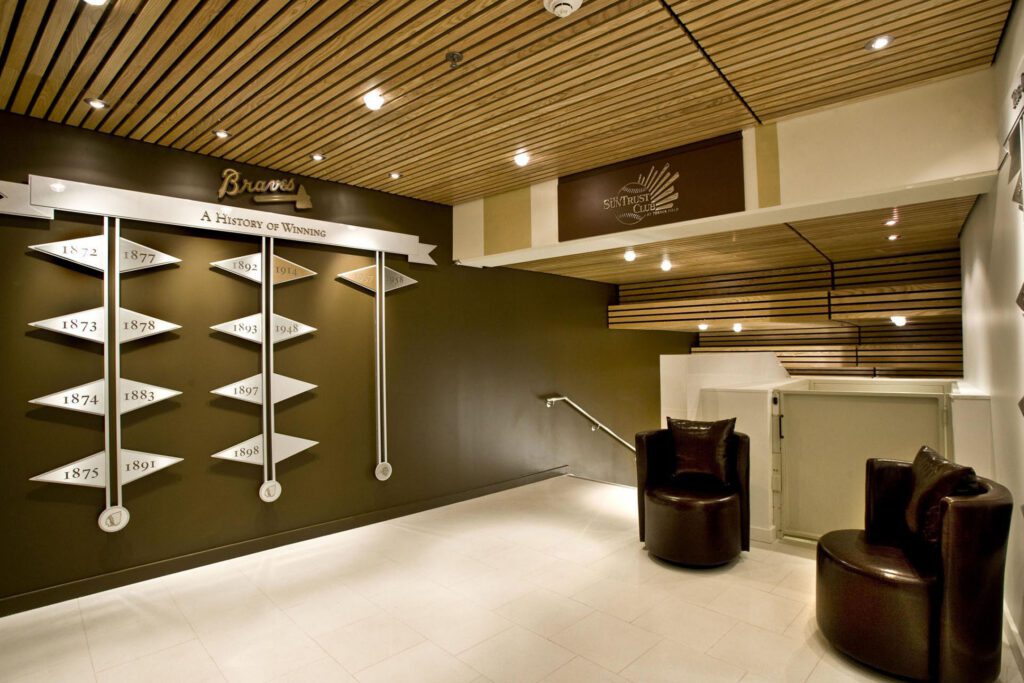
Open-plan spaces benefit from high NRC and CAC values. Private offices and conference rooms need sound isolation. The shift toward activity-based working—where employees move between different settings—means ceiling and wall systems must adapt to varied functional zones within a single floor plate.
Flexibility matters too. Office layouts change frequently. Ceiling systems that accommodate easy modification—like grid systems or panelized products—minimize disruption during tenant improvements. Access to plenum services simplifies adding new electrical circuits or data cabling. Wall treatments with clip-rail attachments, like Endure™ Direct Attach, allow reconfiguration without demolishing finished surfaces.
Healthcare Facilities
Hospitals and clinics face stringent requirements around infection control, acoustic performance, and code compliance.
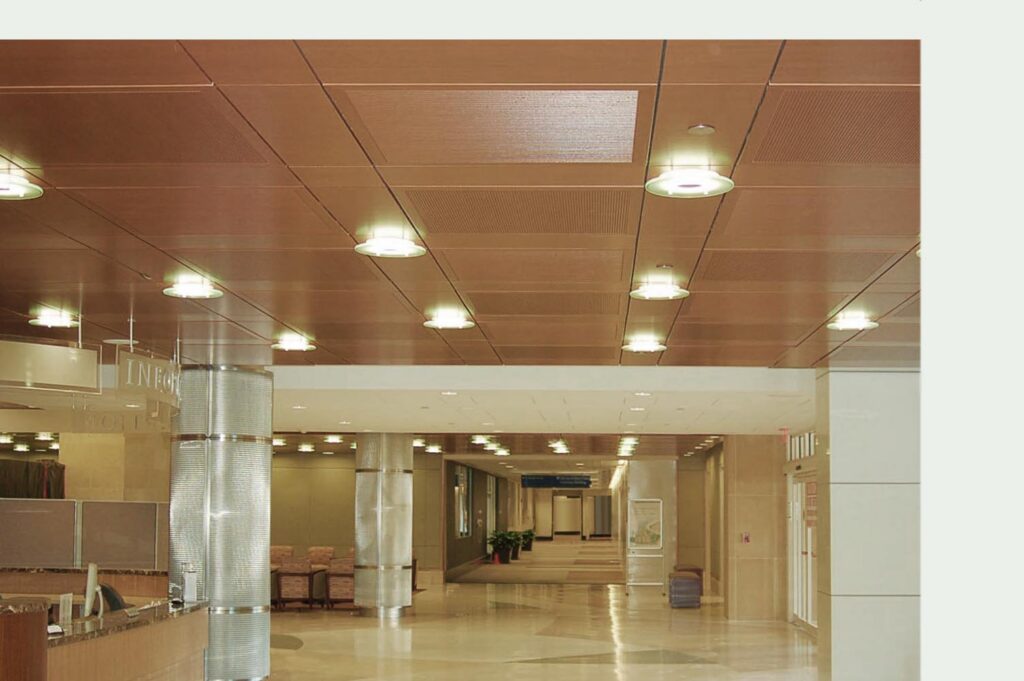
Cleanability is paramount. Ceiling and wall materials must tolerate regular disinfection without degrading. Non-porous surfaces resist microbial colonization. Smooth or slightly textured finishes are easier to clean than heavily textured products.
Acoustic performance directly affects patient outcomes. Studies link reduced noise levels to faster recovery times, reduced medication needs, and better sleep quality. Speech privacy matters for HIPAA compliance and patient dignity.
Some healthcare spaces (operating rooms, certain diagnostic areas) require specialized ceilings that integrate specialized lighting and equipment booms. Understanding these unique requirements helps determine when standard solutions work and when custom approaches become necessary.
Educational Facilities
Schools and universities need ceilings and walls that support learning while handling the acoustic challenges of high occupancy and varied activities.
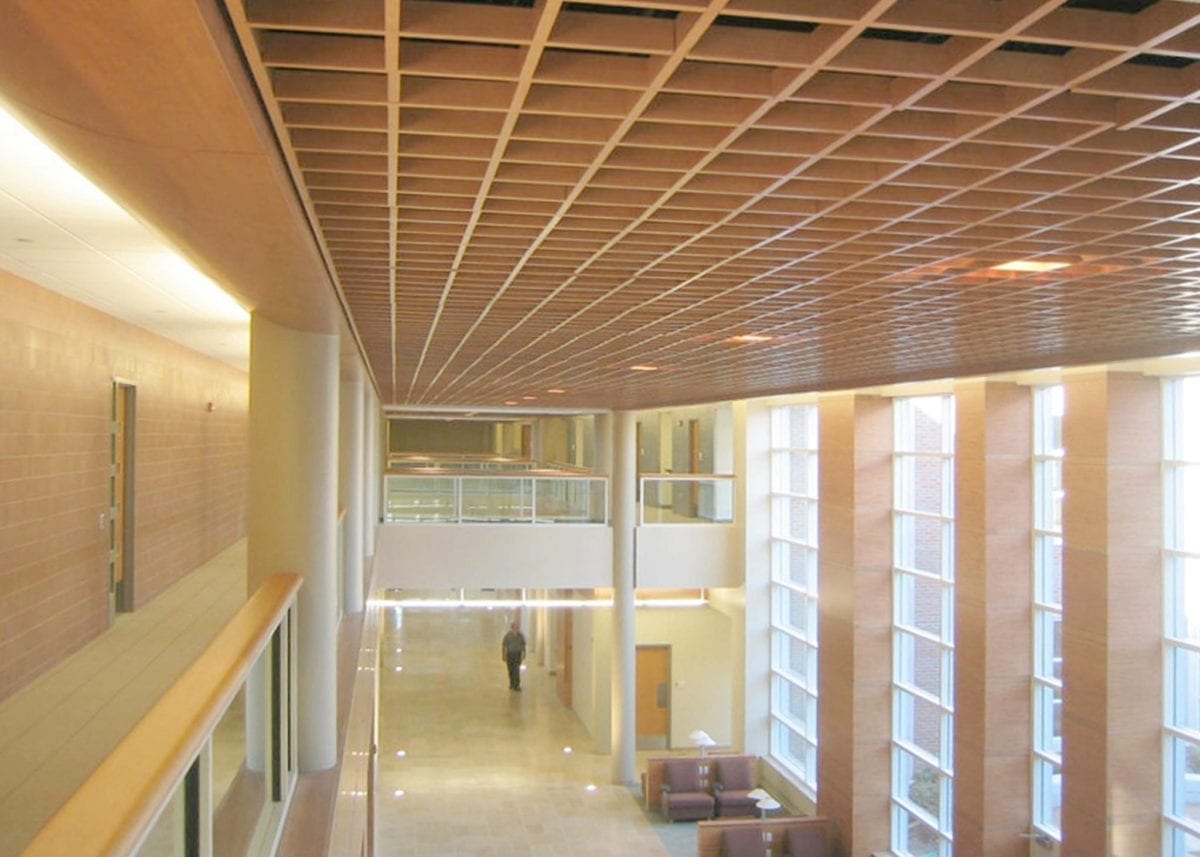
Classrooms benefit from shorter reverberation times that improve speech intelligibility. High NRC values (0.70–0.85) help achieve this. Cafeterias and gymnasiums need even more aggressive acoustic treatment to remain functional despite hard surfaces elsewhere in the room.
The University of South Florida Judy Genshaft Honors College illustrates a layered approach: the design team used Aluratone acoustic panels on the first floor and Grille wall treatments in the atrium to create distinct acoustic zones within a single building—quiet study spaces adjacent to active collaborative areas—all while earning LEED Silver certification.
Durability matters in educational settings. Ceiling and wall systems must survive impact and resist damage from maintenance activities. Life-cycle cost analysis should account for the hard use these facilities endure.
Retail and Hospitality
These spaces use ceilings and walls to reinforce brand identity and create specific atmospheric effects.
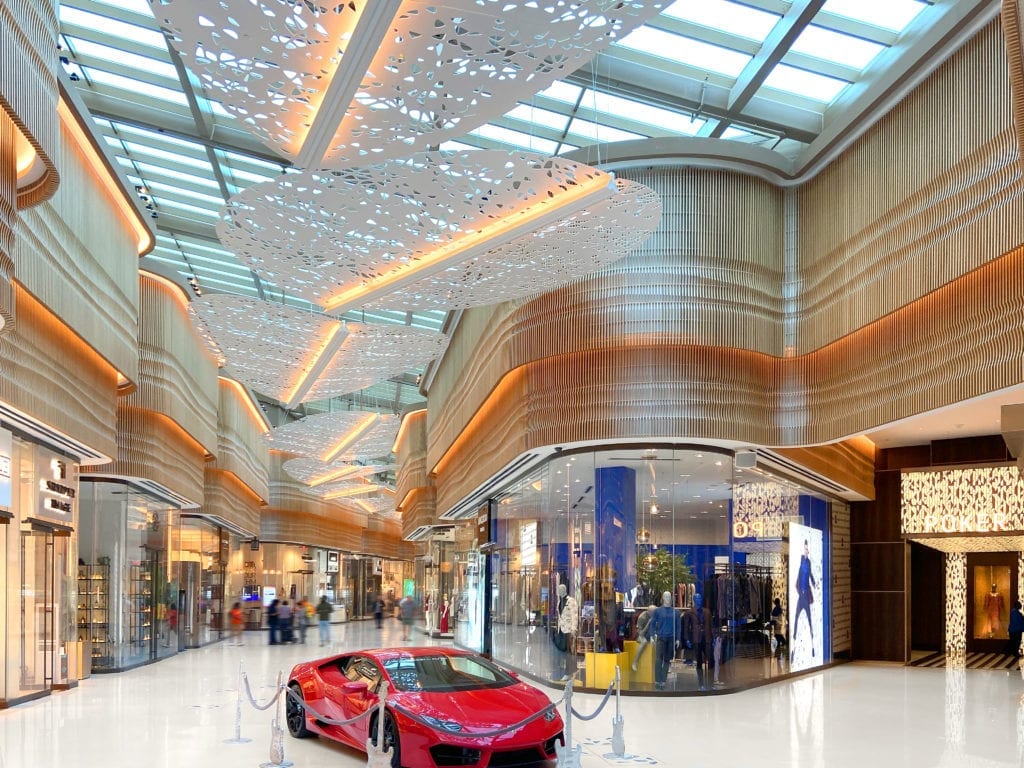
Retail environments often want visual interest overhead. Specialty systems like baffles, clouds, or dimensional panels catch the eye and define zones. Budget-conscious retailers still need functional performance but may prioritize first cost over lifecycle value.
Hotels and restaurants use ceilings to establish mood. The W Hotel Nashville showcases what’s possible when ceiling design serves a larger narrative—Rulon’s Linear Panelized system was specified for The Dutch restaurant in a chevron, board-and-batten pattern that grounds the 150-seat space in Music City’s authentic character while controlling acoustics across multiple seating areas.
At the Richard Gilder Center for Science, Education, and Innovation at the American Museum of Natural History, Rulon’s Baffle system met the unique challenge of blending architectural precision with the immersive, nature-inspired design language conceived by Studio Gang—proof that specialty ceiling systems can perform at the highest level of cultural architecture.
Cultural Venues and Libraries
Libraries, museums, and performing arts centers demand ceiling systems that balance acoustic precision with visual impact. The Mott Branch Library used Rulon’s Endure™ Linear system to achieve both—creating an indoor/outdoor transitional ceiling whose roofline geometry references quilts from the Underground Railroad, honoring the library’s namesake while delivering the durability required for a public building.

Consideraciones sobre la instalación y el mantenimiento
Even the best-specified ceiling system underperforms if installed poorly. Understanding installation requirements and ongoing maintenance needs helps set realistic expectations and avoid surprises.
Installation Complexity
Grid-based systems generally offer the simplest installation. Installers familiar with standard suspended ceiling techniques can adapt quickly. The grid provides built-in leveling, and panels drop into place.
Direct-applied systems—like drywall or direct-mounted panels—require more skill and time. Achieving level installations over large areas takes expertise. Linear systems with clip-rail attachments fall somewhere in the middle, requiring more care than tiles but less than drywall.
Custom or architectural systems often need manufacturer involvement. Curved ceiling panels arrive with specific installation sequences that must be followed. Specialty suspension systems might require training or factory-certified installers. At the Mott Branch Library, the complex installation—with different as-built conditions for peaks and valleys and modified attachment methods—required close collaboration between the contractor and Rulon’s team.
Access and Serviceability
The ceiling hides essential building systems. Maintenance technicians need reasonable access without destroying the aesthetic investment.
Tile and panel systems excel here. Individual components lift out or remove easily. This allows targeted access for repairs or modifications without affecting surrounding areas.
Drywall ceilings require cutting and patching. Each access point creates refinishing work that adds time and cost. Open-cell systems provide inherent access without removal, though working through them can be awkward for bulky equipment.
Access panel locations should be coordinated with common service points (valve locations, electrical junction boxes, fire damper access). Strategic placement minimizes the need to remove large sections of the ceiling.
Maintenance Requirements
Most ceiling systems need little regular maintenance beyond periodic cleaning. Dust accumulation affects appearance over time, particularly on horizontal surfaces.
Wood ceilings might need occasional refinishing if damage occurs, though this is rare with proper initial finishing. Metal ceilings maintain appearance indefinitely but may show dents or scratches in high-traffic areas.
Tile systems benefit from having spare tiles stored on-site. This ensures color and texture matches when replacement becomes necessary. Tiles fade over time, and production runs vary slightly. A few boxes stored in a dry location save headaches years later.
Making Your Final Selection
You’ve worked through performance requirements, budget parameters, code compliance, and aesthetic goals. Now the choices narrow to a manageable few.
Start by establishing hard requirements. What code obligations are non-negotiable? What acoustic values must you achieve? Where does budget become a deal-breaker? These constraints define your boundaries.
Within those boundaries, weigh your priorities. Does design impact matter more than lifecycle cost? Will the space undergo frequent reconfiguration? How important is sustainability to your client or their tenants?
Consider the whole assembly, not just the visible surface. Suspension systems, backing materials, edge conditions, and integration with lighting and sprinkler systems all affect performance and cost. Manufacturers provide complete system specifications that account for these components.
Request samples. Photos and specifications tell part of the story, but seeing and handling actual materials provides insight that data sheets can’t capture. How does light interact with the surface? What’s the actual color, not the color-corrected photo? How does texture feel? Browse the Rulon project gallery for installed examples across building types.
Talk to manufacturers early. Rulon International specializes in architectural ceiling and wall systems and can help navigate options, provide performance data, and identify solutions you might not have considered. With a product range spanning Linear, Grilles, Baffles, Aluratone, Curvatone, Flat Veneer Panels, Beams, Cubes, and the Endure™ engineered polymer line, they’ve solved similar challenges before and can share what worked—and what didn’t.
The right ceiling and wall system exists for your project. It meets your performance requirements, fits your budget, satisfies code officials, and realizes your design vision. The selection process takes time and careful evaluation, but the result—a space that performs exactly as intended—makes the effort worthwhile.
Ready to discuss your project? Schedule a discovery call or call Rulon International directly at (904) 584-1400.