A council chamber tells citizens whether their government is accessible or distant. A museum ceiling tells visitors whether discovery feels intimate or overwhelming. A library reading room tells scholars whether knowledge is celebrated or merely stored. In civic and cultural spaces, every surface communicates, and curved wood veneer paneling speaks with particular eloquence.
For architects designing museums, city halls, libraries, and performing arts centers, material selection is never purely technical. These buildings carry meaning. They express community values, institutional missions, and cultural identity. When architectural wood panels take curved forms, they become active participants in shaping spatial experience, guiding visitors through environments that reinforce why these institutions matter.
Why Material Choice Carries Meaning in Civic Architecture
Civic buildings serve as repositories of collective memory and identity. The materials that line their walls and ceilings communicate values before a single word is spoken. Hard, reflective surfaces suggest efficiency and formality. Soft, natural materials suggest accessibility and warmth. The distinction matters because civic spaces must welcome diverse communities while projecting institutional credibility.
Wood veneer paneling occupies a unique position in this material vocabulary. Unlike synthetic alternatives, wood carries inherent associations with nature, craft, and permanence. Its grain patterns and color variations create visual interest that rewards sustained attention. When specified for civic applications, wood signals that an institution values authenticity and human-centered design.
Research consistently demonstrates that natural materials reduce stress and enhance focus in built environments. For civic spaces where citizens engage in democratic deliberation, learn from cultural collections, or seek quiet contemplation, these psychological benefits translate directly into institutional effectiveness. Wood does not merely decorate these spaces; it shapes how people experience and remember them.
How Curved Wood Forms Shape Experience
Curved forms introduce movement, rhythm, and organic flow into architectural composition. Where rectilinear geometries impose order through repetition and right angles, curves suggest growth, connection, and natural processes. This distinction becomes significant in civic and cultural contexts where spatial experience reinforces institutional mission.
A serpentine wood ceiling guides the eye through space, creating a sense of journey and discovery. Undulating wall panels soften monumental scale, making large public rooms feel more intimate. Radiused transitions from wall to ceiling eliminate harsh boundaries, suggesting continuity between the ground and the sky, between the institution and the community. These principles connect to broader conversations about how multi-sensory environments shape human experience in built space.
Wood veneer paneling amplifies these effects through material warmth and tactile richness. The grain of quarter-sawn oak creates a linear rhythm that reinforces directional movement. The cathedral patterns of flat-cut maple add visual complexity that rewards close inspection. When these veneers wrap curved substrates, they create surfaces that feel alive, responsive to light, and connected to the natural world.
Biophilic design principles explain why these forms resonate so deeply. Humans evolved in environments defined by organic curves, from river bends to tree canopies to rolling hills. Curved wood panels echo these primal forms, triggering subconscious associations with safety, shelter, and abundance. In civic spaces, these associations translate into feelings of welcome and belonging.
Explore how Curvatone and Curvalon systems enable curved wood forms for your civic or cultural project.
Civic Applications: Government Buildings and Council Chambers
City halls and government centers face a particular design challenge: they must project institutional authority while remaining accessible to ordinary citizens. Traditional civic architecture often resolved this tension through classical symmetry and monumental scale. Contemporary approaches increasingly use material warmth and organic form to humanize governmental spaces.
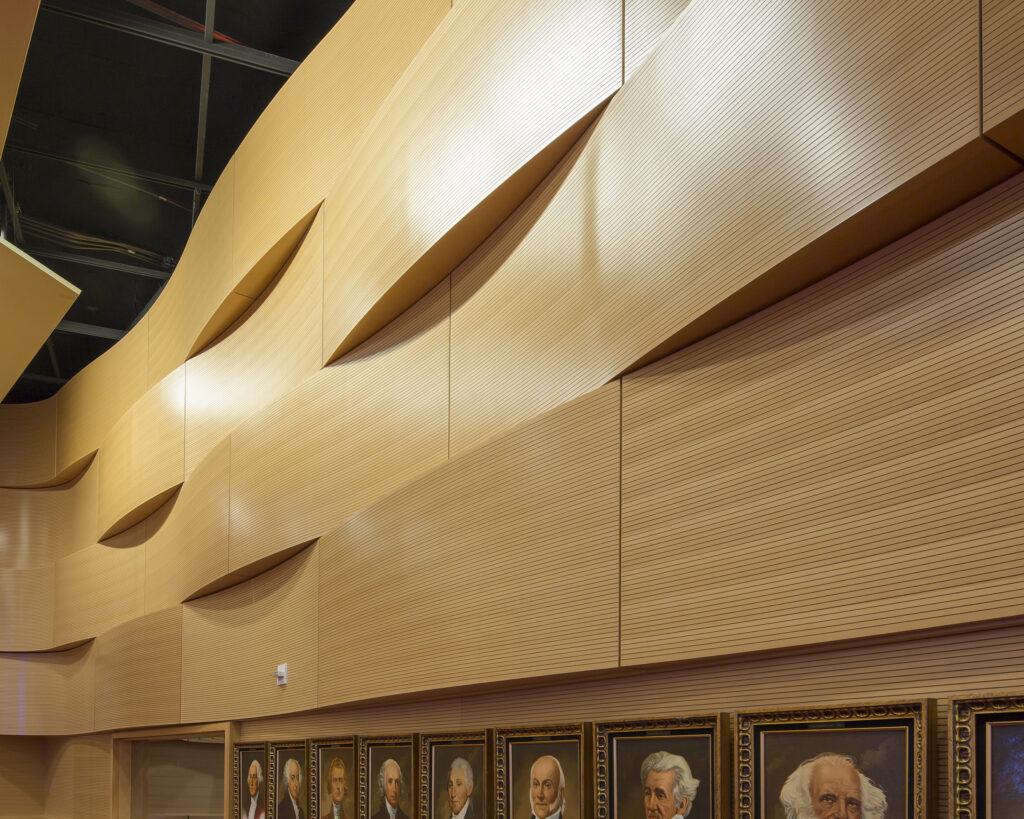
The Las Vegas City Hall council chamber exemplifies this strategy. JMA Architecture designed a 500-seat space wrapped in six rows of serpentine wood veneer paneling, each row featuring custom-curved Curvatone panels with individually designed undulating profiles. The result feels simultaneously contemporary and welcoming, projecting civic identity while inviting public participation.
The acoustic requirements of council chambers add to the functional complexity of design ambitions. Citizens must be able to hear proceedings clearly from every seat. Speakers must be intelligible without electronic amplification overwhelming the room. At Las Vegas City Hall, designers specified reflective panels at the front of the chamber to project sound toward the audience and absorptive panels at the rear to prevent echo and reverberation. The curved forms that create visual impact also serve acoustic function, demonstrating that experiential and performance requirements can align.
Beech veneer with a clear finish creates the warm, contemporary aesthetic while maintaining visual consistency across hundreds of individually shaped panels. The manufacturing precision required to achieve smooth transitions between serpentine profiles, around radiused rear walls, and across sloping floor planes demonstrates what becomes possible when design vision and fabrication capability align.
Cultural Applications: Museums, Libraries, and Healthcare
Museums, libraries, and performing arts venues present distinct opportunities for curved wood veneer paneling. These institutions exist to inspire, educate, and serve visitors. Their architecture should support these missions through spatial experiences that reinforce curatorial and programmatic intent.
The Richard Gilder Center for Science, Education, and Innovation at the American Museum of Natural History represents a landmark in experiential museum design. Designed by Studio Gang, the architecture features organic forms inspired by natural erosion, and Rulon International fabricated over 700 unique wood baffles that create immersive ceiling systems in key spaces.
These installations demonstrate how curved wood veneer paneling transcends decoration to become integral to institutional identity. The Gilder Center’s wood elements do not merely occupy space; they participate in the educational mission, showing visitors that nature’s geometry inspires human creativity.
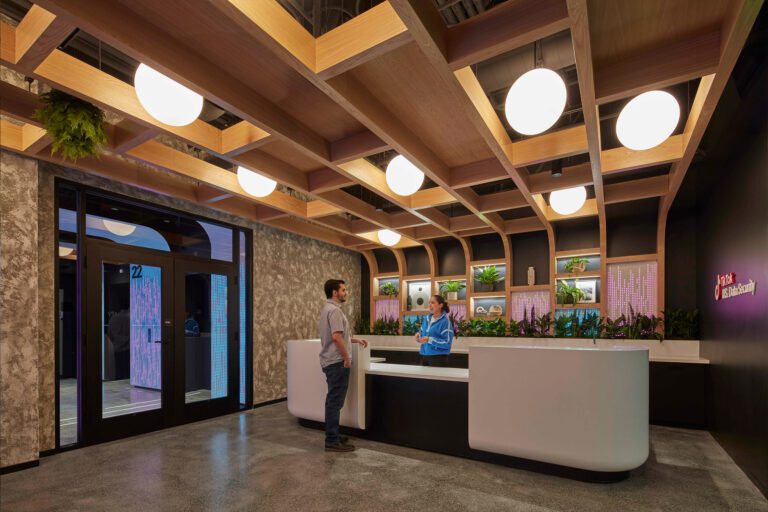
Healthcare facilities present another context where curved wood communicates institutional values. At Children’s Healthcare of Atlanta’s North Druid Hills campus, Curvalon curved wood panels and Flat Veneer Panels create a sweeping half-circle lobby entry that transitions fluidly from wall to ceiling. The design echoes nearby tree canopies, reinforcing biophilic design goals that support healing. Natural wood tones and gentle curvature promote feelings of safety and warmth for young patients, families, and staff.
Achieving Curved Forms in Practice
Design ambition requires manufacturing capability. Curved wood veneer paneling presents technical challenges that standard fabricators cannot address. Substrates must flex without cracking. Veneers must wrap compound curves without telegraphing joints. Acoustic performance must be maintained through custom configurations.
Rulon’s Curvatone and Curvalon systems solve these challenges through multi-step manufacturing approaches refined over decades. Curvalon provides custom-shaped panels with concave, convex, or compound curves, achieved with flexible core materials that accept wood veneer or HPL laminate. Curvatone combines these curved forms with the acoustic performance of Aluratone panels, offering perforated or grooved patterns that achieve NRC ratings appropriate for challenging acoustic environments.
Veneer selection influences the character of the finished space. Domestic species like white oak and cherry connect to regional heritage and support sustainability goals through shorter supply chains. Beech provides light, consistent grain suitable for contemporary civic aesthetics. Walnut offers warmth and gravitas for formal chambers. All veneers are available with FSC certification, providing the documentation required for LEED and other green building programs.
Coordination between design vision and manufacturing capability typically begins during design development, following Architectural Woodwork Institute standards for veneer matching and panel tolerances. Rulon’s engineering team creates 3D models that optimize panel sizing, reveal spacing, and installation sequencing for complex geometries. For projects like the Gilder Center, where every baffle had a unique curved profile, this digital coordination ensured that hundreds of individual components fit together precisely on site. For architects seeking comprehensive technical guidance on architectural wood systems, detailed resources support informed decision-making throughout the specification process.
For projects with accelerated timelines, Select N’ Ship programs offer curated options that maintain momentum without sacrificing quality.
Partner with Rulon for Your Civic or Cultural Project
Civic and cultural buildings shape how communities understand themselves. A city hall that feels cold and bureaucratic tells citizens their government is distant. A museum that feels generic tells visitors its collections lack distinction. A library that feels institutional tells scholars their work is tolerated rather than celebrated.
Curved wood veneer paneling offers architects a material vocabulary for creating different experiences. Spaces that feel welcoming and accessible. Environments that connect visitors to nature and craft. Interiors that communicate permanence and institutional commitment to quality. These outcomes emerge from material choices that shape perception before a single program begins.
For institutions ready to explore how wood can serve their mission, the path forward begins with understanding what experience the space should create. What values define your institution? What should visitors feel and remember? How can material warmth and organic form reinforce your architecture’s intent?
For nearly 40 years, Rulon International has partnered with architects to translate design ambitions into fabricated reality. From serpentine council chambers to sculptural museum installations, our manufacturing capabilities enable curved wood forms that would otherwise remain unrealized renderings. Our commitment to environmental responsibility and technical documentation ensures that sustainability goals are supported throughout the specification process.
Ready to discuss curved wood veneer paneling for your civic or cultural project? Contact our team to start the conversation.
Frequently Asked Questions
How does wood veneer paneling contribute to civic building design?
Wood veneer paneling introduces natural warmth, grain variation, and organic texture that communicate values of accessibility, heritage, and human connection. Curved configurations add movement and rhythm that guide visitors through spatial sequences, creating experiential journeys rather than static rooms. Unlike synthetic materials, wood’s natural variation creates unique character that distinguishes civic spaces from commercial environments. The material’s associations with craft and permanence signal institutional commitment to quality that citizens recognize and appreciate.
What makes curved wood panels effective in museum and library design?
Curved wood panels create immersive environments that reinforce institutional missions. In museums, sculptural wood forms can evoke natural structures such as tree canopies, insect wings, or geological formations that support exhibition themes and help visitors connect with content. In libraries, curved wood ceilings suggest shelter and contemplation, signaling that knowledge is celebrated and protected within these walls. The acoustic benefits of perforated curved panels also enhance speech clarity and reduce listener fatigue during extended visits.
Can curved wood panels meet the acoustic requirements of council chambers and performing arts venues?
Yes, Curvatone panels combine curved forms with perforated acoustic patterns that achieve NRC ratings suitable for speech intelligibility and performance venues. Designers can specify reflective panels in some areas to project sound toward audiences and absorptive panels in others to control reverberation and echo. This dual capability allows experiential design ambitions and functional acoustic requirements to coexist within the same space, as demonstrated in the Las Vegas City Hall council chamber where front panels reflect and rear panels absorb.
What veneer species work best for civic and cultural applications?
Species selection depends on design intent and regional context. Domestic hardwoods like white oak, maple, and cherry convey regional heritage and sustainability through shorter supply chains and FSC certification availability. Beech and ash offer light tones that brighten monumental spaces and create contemporary civic aesthetics. Walnut provides warmth and gravitas appropriate for formal council chambers and executive spaces. Rulon can match virtually any species, including exotic options, to align with specific institutional identities and design visions.
How do architects coordinate curved wood panel design with Rulon’s manufacturing team?
Collaboration typically begins during design development when design intent and spatial constraints become clear enough to inform technical decisions. Rulon’s engineering team creates 3D models to optimize panel sizing, reveal spacing, and installation sequencing for complex curved geometries. Shop drawings translate design vision into fabrication instructions with precise dimensions and assembly sequences. Sample approval ensures finish appearance and grain character meet expectations before full production begins, preventing costly surprises during installation.