Perforated Wood Panels: Acoustic Performance Guide
Poor acoustics in commercial spaces create more than just annoyance—they reduce productivity, drive customers away, and create uncomfortable environments. When conversations become difficult to hear over ambient noise, or when harsh echoes dominate a space, the solution often lies in professional acoustic wood panels.
Acoustic wood panels, particularly perforated wood panels with precision-engineered holes, provide scientifically-proven sound absorption while maintaining the natural beauty of wood. These specialized panels achieve Noise Reduction Coefficient (NRC) ratings from 0.65 to over 1.0, meaning they can absorb 65-100% of sound energy that strikes their surface.
At Rulon International, we’ve been manufacturing acoustic wood panels and ceiling systems for over 30 years. This guide covers acoustic wood panel technology, including perforated panel systems, material comparisons, and applications for commercial spaces.
Does Wood Absorb Sound? Understanding Wood’s Acoustic Properties
Does wood absorb sound?
Yes, wood absorbs sound, but the amount varies significantly based on how the wood is configured. Non-perforated solid wood absorbs approximately 15-35% of sound energy (NRC 0.15-0.35), providing modest acoustic benefits through the natural porosity of wood fibers. However, perforated wood panels with engineered holes and acoustic backing absorb 65-100% of sound energy (NRC 0.65-1.05), making them one of the highest-performing acoustic materials available.
Does wood reflect sound?
Yes, wood reflects sound, especially non-perforated wood which reflects approximately 65-85% of sound energy. However, wood provides warmer, more pleasant reflections compared to hard materials like metal, glass, or concrete. Perforated wood panels minimize reflection by allowing sound to pass through holes into absorptive backing material, converting sound energy into heat rather than reflecting it back into the space.
Why perforated wood panels perform dramatically better:
When sound waves strike a perforated wood panel, energy enters through the precision-engineered holes and encounters acoustic backing material—typically fiberglass or mineral wool. This backing converts sound energy into minute amounts of heat through friction, preventing reflection. The air cavity behind the panel creates resonant absorption that’s particularly effective at controlling problematic frequencies. This combination achieves 3-5 times better sound absorption than non-perforated wood.
The Importance of Acoustics in Large Commercial Spaces
Acoustic control is a major factor in whether or not a room is a pleasant place to spend time. When it’s easy to converse without raising your voice or being distracted by nearby noise, individuals are more likely to relax and engage in positive interactions.
Studies suggest a direct relationship between a pleasant sound environment and the amount of time and money that customers are likely to spend in stores. Likewise, in settings like boardrooms, decision-makers may be more likely to reach a positive consensus in a room with pleasant acoustics.
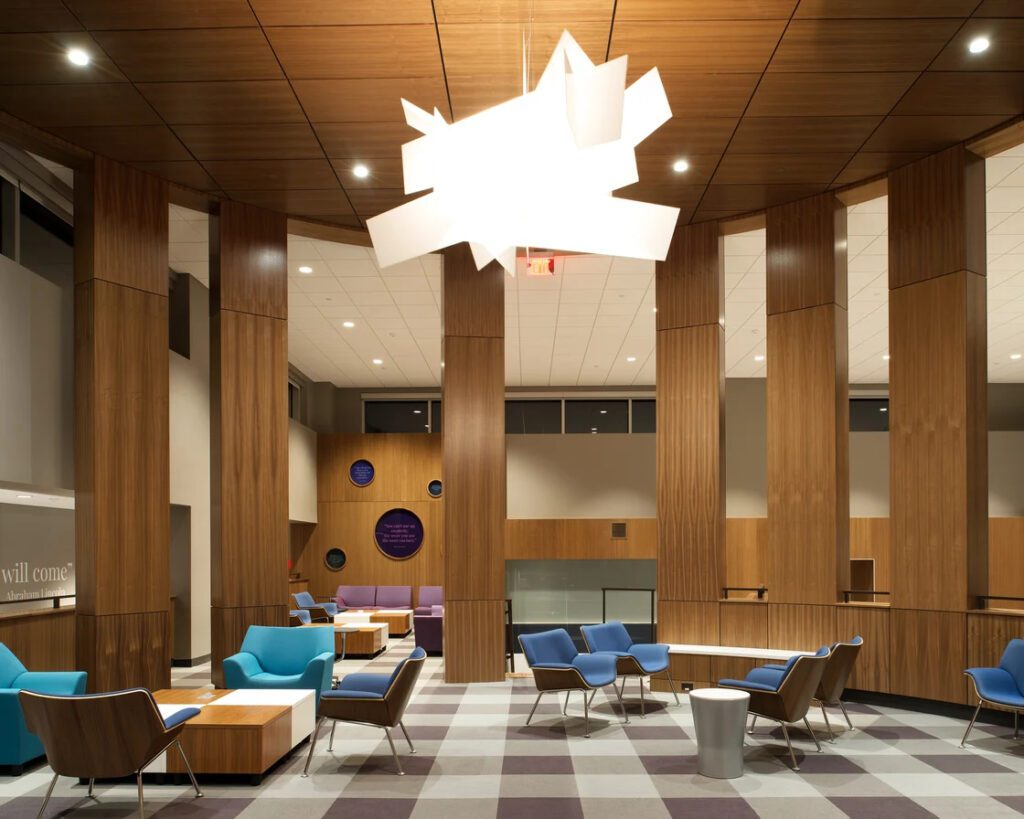
In large commercial spaces, acoustic control is challenging. Ample open space creates room for echoes and sound interference. Acoustic wood panels, especially perforated wood panels with engineered hole patterns and acoustic backing materials, provide the most effective solution for managing acoustics. By achieving NRC ratings of 0.70 to 1.05, properly designed systems can reduce reverberation time by 60-80%, transforming problematic acoustics into comfortable environments.
Acoustic Performance: Wood vs. Other Common Building Materials
Understanding how different materials interact with sound energy helps designers make informed decisions.
Wood Panels
Non-Perforated Wood: Achieves NRC 0.15-0.35. Relatively hard and reflective but provides warmth to reflected sound. Works through some absorption via natural porosity while primarily acting as a diffuser. Best for spaces needing sound diffusion rather than absorption.
Perforated Wood Panels: Achieves NRC 0.65-1.05. Provides high absorption across broad frequency range while maintaining wood aesthetics. Sound absorption occurs through perforations plus backing material with resonant absorption in the air cavity. Excels in any space requiring significant noise reduction—restaurants, offices, auditoriums.
Solid wood perforated panels offer authentic grain and natural resonance but cost more and weigh more. Veneer perforated panels on MDF cores provide more perforation options, lighter weight, and better dimensional stability at lower cost. Panel thickness matters—thicker panels (18-25mm) provide better low-frequency absorption. Acoustic backing type also affects performance: mineral wool offers better low-frequency absorption while fiberglass provides lighter weight and better mid-high frequency absorption.
Metal
Standard metal panels achieve minimal NRC of 0.05-0.15, making them highly reflective with bright, sharp acoustic character. Perforated metal with acoustic backing can achieve NRC 0.50-0.80 but the cold aesthetic and susceptibility to denting makes metal inferior to perforated wood for most applications.
Glass
Standard glass achieves extremely low NRC of 0.02-0.10, making it one of the most reflective materials in commercial construction. Glass creates focused echoes requiring extensive acoustic treatment in glass-heavy spaces. Specialty acoustic glass achieves slightly better NRC of 0.10-0.25 but remains expensive and ineffective for improving room acoustics.
Concrete
Standard concrete achieves minimal NRC of 0.01-0.05. While excellent for blocking sound transmission, concrete creates terrible room acoustics with long reverberation times and cold sound quality. Spaces with significant concrete require extensive acoustic treatment, often using acoustic wood panels. Specialty porous concrete achieves NRC 0.30-0.50 but remains expensive and still inferior to perforated wood panels.
Performance Summary: For commercial spaces requiring sound absorption, perforated wood panels offer optimal balance with NRC ratings of 0.70-1.05—the highest among materials that also deliver aesthetic appeal. They achieve broadband absorption across all frequencies while providing natural warmth. FSC-certified wood options support sustainability goals with extensive customization available.
Perforated Wood Panels: Types and Performance
Micro-Perforation Systems (0.4mm – 2mm holes)
Extremely fine holes nearly invisible from normal viewing distance (6+ feet). Very high perforation density of 80,000-200,000 holes per square meter with spacing of 2-6mm center-to-center.
Performance: NRC 0.75-0.95 with proper backing. Excellent mid-high frequency absorption (500Hz-4000Hz) but less effective below 250Hz without deep cavities.
Applications: Museums, high-end retail, corporate headquarters, conference rooms, boardrooms, healthcare facilities—anywhere “invisible acoustics” and aesthetic purity are paramount.
Standard Perforation Systems (3mm – 10mm holes)
Visible perforations creating intentional patterns. Perforation density of 3,000-15,000 holes per square meter with spacing of 8-32mm center-to-center.
Performance: NRC 0.65-1.05 with optimal backing and cavity. Broadband absorption including low frequencies. Tunable by adjusting hole size and spacing to target specific problem frequencies.
Applications: Restaurants and cafeterias (maximum absorption needed), open offices, call centers, gymnasiums, multi-purpose rooms, auditoriums, lecture halls.
Perforation Patterns:
- Linear/Grid: Holes aligned in rows and columns for clean, orderly appearance
- Staggered/Offset: Holes offset between rows for visually softer appearance and slightly better absorption
- Custom Geometric: Branded patterns, logos, artistic designs for signature features
Slotted Wood Panels
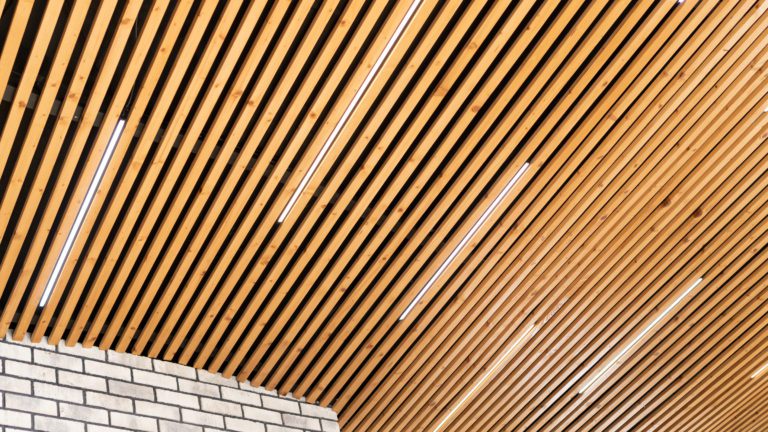
Linear slots milled into panel face (3-8mm wide, 10-20mm deep, 16-50mm spacing). Creates strong linear visual rhythm.
Performance: NRC 0.60-0.85. Good mid-frequency absorption, less effective at extremes. Shows directional sensitivity—absorbs better when sound strikes perpendicular to slots.
Applications: Spaces wanting strong directional design elements, modern architectural aesthetics, lighting integration between slot runs.
Acoustic Backing Materials: Critical Performance Factor
The material behind perforations critically affects performance.
Fiberglass Backing: Most economical option. Provides NRC contribution of +0.40 to +0.65. Lightweight and cost-effective. Best for mid-high frequency absorption in dry environments like offices and retail. Available in Class A fire rating.
Mineral Wool Backing: Mid-range cost. Provides NRC contribution of +0.45 to +0.75 with superior low-frequency absorption. Water-resistant, fire-resistant, adds some sound blocking. Heavier and more expensive. Non-combustible. Ideal for restaurants, spaces needing full-spectrum absorption, areas requiring fire resistance.
Acoustic Fleece/Fabric Backing: Budget option. Provides NRC contribution of +0.20 to +0.40. Very lightweight and easy to install. Class A fire-rated options available. Lower performance than fiberglass or mineral wool. Best for thin profile systems and weight-restricted installations.
Air Cavity Depth:
- Shallow (25-50mm): Absorbs frequencies above 500Hz. NRC typically 0.65-0.80
- Medium (75-125mm): Balanced absorption from 250Hz up. NRC typically 0.75-0.90. Most common specification
- Deep (150-300mm): Excellent low-frequency absorption (125-500Hz). NRC can exceed 1.0. Essential for music venues
Selecting Wood Species for Perforated Panels
For perforated wood panels, veneer species primarily affects aesthetics rather than acoustic performance since sound absorption occurs through perforations and backing material. However, species selection matters for visual impact and durability.
Light Species: Maple (most popular—consistent appearance, excellent durability), Ash (bold grain, contemporary look), Birch (budget-friendly, Scandinavian aesthetic)
Medium Species: White Oak (traditional, premium durability), Cherry (warm tones, darkens with age), Red Oak (pronounced grain, traditional spaces)
Dark Species: Walnut (sophisticated, luxury applications), Wenge (dramatic, modern, very dark)
Critical Performance Factors Beyond Species:
- Perforation specifications (hole diameter, pattern, open area percentage)
- Panel construction (core material, thickness 12-25mm)
- Acoustic backing type and thickness
- Air cavity depth (25-200mm)
All panels should prioritize FSC certification, low-VOC finishes (CARB Phase 2 compliant), and recycled content where possible (MDF cores often contain 50-90% recycled wood fiber).
Designing for Acoustics: Practical Considerations
Calculating Coverage Requirements
Different space types need different coverage based on function:
- Restaurants: 60-75% ceiling coverage, NRC 0.80-1.0 target
- Open Offices: 50-60% ceiling coverage, NRC 0.70-0.85 target
- Conference Rooms: 70-100% ceiling coverage, NRC 0.80+ target
- Retail: 40-50% ceiling coverage, NRC 0.65-0.75 target
Combining Perforated and Non-Perforated Panels
Strategic mixing creates design flexibility while controlling costs:
- Use 60-70% perforated in high absorption areas, 30-40% non-perforated for visual contrast
- Zone by noise level: high-noise areas get 80-100% perforated, moderate areas 50-70%, quiet areas 20-40%
- Balance frequencies: perforated panels target speech frequencies, thick non-perforated panels provide low-frequency absorption
Fire Ratings
Commercial perforated wood panels achieve Class A fire rating (flame spread ≤25, smoke developed ≤50 per ASTM E84) through fire-retardant treatment and fire-rated MDF cores. Perforations don’t compromise fire rating when properly treated. Mineral wool backing is non-combustible. Always verify certification for your specific product.
Installation Methods
Direct Attachment: Most economical. Panels attach to furring strips. Best for walls not needing access.
Concealed Grid: Specialized grid hidden behind panel edges. Moderate access. Best for ceilings needing occasional access.
Tegular/Lay-in: Panels with reveal edge on standard ceiling grid. Easy access. Best for frequent plenum access and retrofits.
Suspension: Individual panels hang from cables. Maximum cavity depth. Best for high-performance applications and architectural features.
For design inspiration, check out Rulon’s project gallery.
Perforated Wood Panels: Frequently Asked Questions
What are perforated wood panels?
Perforated wood panels are acoustic panels with precision-engineered holes (0.4mm-10mm diameter) that allow sound to pass through and be absorbed by backing material. They achieve NRC ratings of 0.70 to over 1.0, absorbing 70-100% of sound energy.
What’s the difference between micro-perforated and standard perforated panels?
Micro-perforated panels have tiny holes (0.4-2mm) nearly invisible from viewing distance, achieving NRC 0.75-0.95 with seamless appearance. Standard perforated panels have visible holes (3-10mm) in patterns, achieving NRC 0.65-1.05+ with better low-frequency absorption. Choose micro for high-end aesthetics, standard for maximum performance.
What NRC rating should I specify?
Restaurants and noisy environments need NRC 0.80-1.0+. Open offices and conference rooms work well with NRC 0.70-0.85. Reception areas and moderate spaces use NRC 0.60-0.75. Higher NRC means less coverage needed, potentially lowering total project cost.
Do perforated panels require special installation?
Yes. They require acoustic backing material (fiberglass, mineral wool, or fleece) and an air cavity (25-300mm) behind panels. Installation methods include direct attachment, concealed grids, standard ceiling grids, or suspension systems. Professional installation ensures proper performance and code compliance.
What’s the cost difference from non-perforated panels?
Perforated panels cost 30-60% more per panel but provide 3-5× better absorption. Total project cost may be similar since you need less coverage area to achieve acoustic goals. Micro-perforated panels cost 50-100% more than standard perforated.
How do I maintain perforated wood panels?
Minimal maintenance required. Vacuum quarterly with soft brush attachment. Wipe with slightly damp cloth if needed. Avoid harsh chemicals or excessive water. Modern finishes resist staining. Individual damaged panels can be replaced. Expected lifespan: 25-30+ years.
Specify Rulon Acoustic Wood Panels for Superior Sound Control
At Rulon International, we manufacture FSC-certified acoustic wood panels including perforated systems, slotted panels, and acoustic backing solutions for commercial applications worldwide. Our acoustic panel portfolio includes micro-perforated options with nearly invisible holes, standard perforated systems with engineered patterns, and non-perforated panels—all available in 150+ wood species with custom finishes.
Our acoustic wood panel expertise includes:
Custom perforation design and acoustic modeling including NRC calculations and reverberation time predictions. Fire-rated treatments and compliance documentation ensure Class A certification. Acoustic backing specification covers fiberglass, mineral wool, and fleece options matched to project needs. Installation system design addresses grid systems, direct attachment methods, and suspension approaches. BIM and Revit models plus detailed shop drawings facilitate coordination with other trades. Full-scale acoustic testing and performance verification confirm predicted results.
Rulon Acoustic Panel Product Lines:
Aluratone offers perforated acoustic panels with precision-engineered holes and acoustic backing for maximum sound absorption. Linear Systems provide slotted profiles for combined acoustic and visual performance. Grilles create open wood grille systems with acoustic infill options for exposed plenum aesthetics. Baffles offer suspended acoustic elements for high-ceiling applications needing vertical absorption. Custom Perforated panels include bespoke perforation patterns such as logos, geometric designs, and artistic layouts for signature architectural features.
Acoustic Wood Panel Resources:
View acoustic wood panel installations in our project gallery to see real-world applications across diverse project types. Explore perforated panel specifications and technical performance data including NRC ratings, fire certifications, and installation details. Review fire rating certifications and sustainability documentation including FSC chain of custody and environmental product declarations.
Ready to specify acoustic wood panels for your commercial project? Schedule a discovery call with our technical team to discuss your acoustic requirements, performance targets, budget, and timeline. We’ll provide expert guidance on perforation patterns, backing materials, NRC ratings, and installation methods to achieve your acoustic goals while creating beautiful, natural wood interiors that enhance occupant comfort and satisfaction.