Ceiling design as a driver of interior character
Ceilings are often called the “fifth wall,” but their influence extends far beyond appearance. They control acoustics, frame light, and determine the spatial character of a room. The right ceiling design type can make a classroom easier to learn in, a hospital calmer for patients, or an office more productive for employees.
Modern and traditional projects approach ceiling design in different ways. Modern spaces tend to favor clean lines, modular efficiency, and acoustic innovation. Traditional interiors often emphasize craftsmanship, warmth, and forms that connect to legacy architecture. For architects, designers, and contractors, comparing ceiling design types across both styles clarifies how to balance aesthetics, performance, and sustainability in every project.
Sustainability as a shared foundation
Whether a project is modern or traditional, sustainable design is now a central expectation. The construction industry continues to reduce its carbon footprint, and wood ceilings are contributing to this change. Responsibly sourced wood offers a renewable option with lower embodied energy compared to many conventional materials.
Projects that adopt documented sustainable practices show how ceiling systems can align with broader environmental commitments. These practices not only improve ecological outcomes but also contribute to certifications such as LEED and WELL. For building owners, a ceiling that supports sustainability goals adds measurable value to long-term operations.
Sustainability also connects directly to occupant well-being. Natural wood surfaces reduce stress, improve comfort, and support biophilic design strategies that link interiors to the natural world. Whether in a minimalist office or a traditionally detailed library, wood ceilings create a healthier indoor environment that aligns design integrity with human needs.
Ceiling design types for modern projects
Linear systems
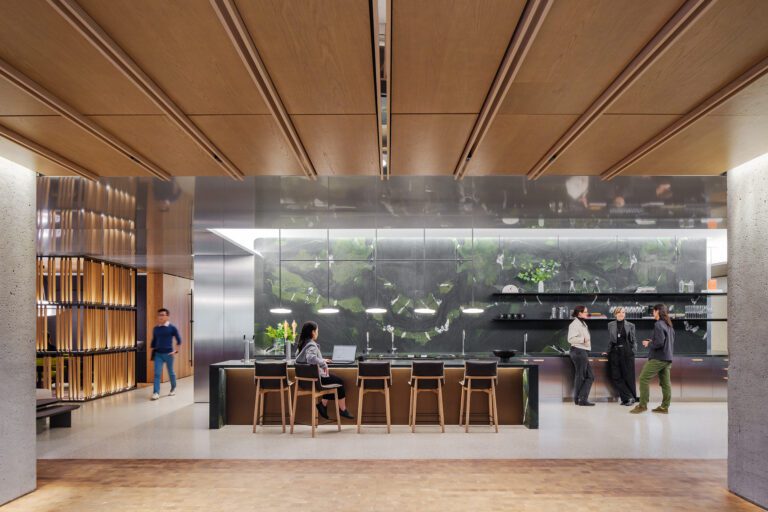
Linear slats are a defining feature of modern ceiling design. Their precise spacing patterns create visual rhythm and directional flow, making them especially effective in open-plan offices, educational facilities, and cultural venues. Designers can adjust spacing to control light penetration, airflow, and acoustic absorption.
In offices, linear slats help zone collaboration areas without enclosing them. In schools, they contribute to focus by absorbing noise while maintaining a contemporary aesthetic. This combination of form and function demonstrates why linear ceilings are widely regarded as one of the most versatile ceiling design types.
Grille systems
Grille ceilings expand on linear concepts with bolder repetition and greater shadow play. Their sculptural quality creates drama in lobbies and public atria while providing practical performance benefits. Grille systems also integrate seamlessly with lighting and mechanical systems, maintaining clean sightlines across large spaces.
For modern corporate headquarters, grille ceilings often become the defining architectural statement. They communicate a strong brand presence while delivering the acoustic performance necessary for high-traffic areas.
Modular cubes and beams
Cube ceilings and lightweight beams bring depth and scale to contemporary design. These systems are especially impactful in high-volume interiors such as airports, museums, or sports facilities. Cubes create a dimensional field that can read as art while still supporting building systems, while beams provide structure and rhythm without overwhelming the space.
Both ceiling types demonstrate how modular design can meet modern demands for bold expression and efficient installation.
Acoustic innovation
Modern design increasingly emphasizes performance alongside aesthetics. Creative acoustic ceiling solutions address this need with products that combine sound control and architectural character. Aluratone panels are engineered with micro-grooves and absorptive cores to reduce reverberation, making classrooms, offices, and performance halls more comfortable and productive.
The benefit of acoustic ceilings in modern design is twofold: they allow designers to maintain a clean, minimalist look while meeting stringent acoustic requirements. This is particularly important in projects where open spaces and hard surfaces dominate the design palette.
Ceiling design types for traditional projects
Flat veneer systems
Flat veneer panels embody traditional craftsmanship. Their broad planes highlight wood grain and create a sense of warmth and permanence. These ceilings are often used in courthouses, libraries, and academic buildings where continuity and durability are key.
Flat veneer panels also adapt well to modern building requirements. Access panels allow integration of HVAC and lighting systems, ensuring that traditional aesthetics meet contemporary technical needs.
Curved and sculpted designs
Traditional architecture often uses curvature to introduce softness and flow. Curvalon panels bring sweeping forms that guide movement, while Curvatone adds acoustic absorption to the same sculptural shapes. These solutions enrich formal spaces such as theaters, council chambers, and ceremonial halls.
Curved ceilings also carry cultural resonance, echoing the arches and vaults found in historic architecture. With modern fabrication techniques, designers can achieve these traditional effects while ensuring consistent quality and simplified installation.
Baffles for rhythm and scale
Baffle ceilings deliver vertical rhythm and strong visual definition. While often associated with contemporary design, baffles can also complement traditional settings when configured with symmetry and proportion. They improve acoustics in corridors, transit halls, and large gathering spaces, making them valuable in both functional and ceremonial environments.
The combination of tradition and performance allows baffle systems to maintain historic character while meeting modern standards for comfort.
Modular systems for both styles
Modularity transcends style, benefiting both modern and traditional interiors. Prefabricated wood panels are fabricated in controlled environments, ensuring precise quality and faster on-site installation. This method reduces waste, shortens construction schedules, and maintains consistency across large projects.
Products such as Endure Linear and Endure Direct Attach are designed for efficient delivery in a wide range of environments, from office buildouts to cultural renovations. For projects with compressed schedules, Select N’ Ship quick-ship options keep construction on track without compromising quality.
Modular systems show that efficiency and design flexibility are not mutually exclusive. They ensure ceilings remain both expressive and practical, no matter the architectural style.
Design inspiration from nature
Across modern and traditional styles, ceilings that draw inspiration from natural principles provide enduring value. Biomimicry demonstrates how patterns found in nature — such as honeycomb efficiency or organic repetition — can inform ceiling systems that are both functional and visually resonant.
In practice, biomimicry results in ceilings that improve performance while strengthening the human connection to nature. This connection supports biophilic design strategies and enhances wellness in schools, workplaces, and healthcare settings.
Bringing ceiling design types to life
Ceiling systems serve as more than overhead treatments. They shape identity, define function, and set the tone for how people experience space. From linear slats that give modern interiors clarity and rhythm to curved panels that reinforce traditional character, ceiling design types provide solutions that balance performance and design expression.
Explore the project gallery to see how ceiling design types are applied across education, healthcare, workplace, and cultural projects. For technical details and inspiration, visit the product catalog or contact the team to discuss the right ceiling solutions for your next project.