The modern corporate office has a wellness problem. Open floor plans, glass partitions, and synthetic ceiling tiles create environments that are visually cold, acoustically punishing, and physiologically disconnecting. Employees arrive to spaces that look productive but rarely feel it. Biophilic office design offers a research-backed path forward, and wood ceilings and wall systems are at the center of it.
Biophilia, the innate human attraction to nature, was first articulated by psychologist Erich Fromm and later popularized in architecture through decades of environmental psychology research. Today it is not a trend. It is a documented design strategy with measurable returns in productivity, employee retention, and occupant well-being.
What Is Biophilic Office Design and Why Does It Matter Now?
Biophilic office design is the intentional integration of natural materials, patterns, textures, and forms into the workplace to satisfy the human need for connection with nature. It goes far beyond placing potted plants near a reception desk. True biophilic design shapes the ceiling plane, the wall surfaces, the acoustic environment, and the sensory character of every space employees inhabit for eight or more hours a day.
The business case is substantial. Research published by Terrapin Bright Green in “The Economics of Biophilia” found that productivity costs are 112 times greater than energy costs in the workplace. That ratio reframes the entire conversation around design investment. A 6% gain in employee productivity or a 15% reduction in absenteeism, both outcomes associated with biophilic environments, represent far greater financial returns than any energy efficiency upgrade. When viewed through that lens, specifying natural wood ceilings is not an aesthetic indulgence. It is a strategic investment in human performance.
Post-pandemic, this calculus has sharpened. Corporate real estate leaders are asking how to make offices worth the commute. Workers who spent years in home environments with natural light, wood furniture, and access to outdoor views are returning to offices and noticing what is missing. Biophilic office design is architecture’s answer.
The Science Behind Wood as a Biophilic Material
Not all natural materials carry equal biophilic weight. Wood occupies a uniquely powerful position because of how the human nervous system responds to it. Exposure to wood in interior environments reduces sympathetic nervous system activity, the physiological signature of stress, and activates the parasympathetic response associated with calm and restoration. Measurable outcomes across multiple studies include lower heart rates, reduced cortisol levels, and improved concentration.
A University of British Columbia study tested these effects specifically in an office context by measuring both branches of the autonomic nervous system. Spaces with visible wood outperformed those without across every stress-response metric. A survey of 1,000 workers by Forest and Wood Products Australia linked the presence of wood in workplaces to higher overall satisfaction, lower absenteeism, and improved concentration. These are not marginal findings. They reflect a deep biological response to material that our nervous systems have been calibrated to recognize as safe and restorative over thousands of years.
Wood also activates what design researchers call “complex order,” the visual richness of natural grain patterns and organic variation that the brain processes differently from flat synthetic surfaces. Ceiling systems with slat spacing, grille patterns, or curved panel profiles provide that layered visual stimulus without cognitive overload, a condition that designers sometimes call “softly fascinating.” Unlike a screen or a complex task, a well-designed wood ceiling draws the eye gently and allows the mind to recover directed attention, exactly what Attention Restoration Theory predicts is needed to sustain productive focus across a workday.
How Biophilic Office Design Translates to the Ceiling Plane
The ceiling is the largest uninterrupted surface in most commercial interiors, and in open-plan offices, it is in the constant sightline of every seated employee. It is also the surface that typically receives the least biophilic consideration. Standard acoustic tile ceilings solve one problem (noise) while creating another (visual disconnection from any sense of warmth or nature).
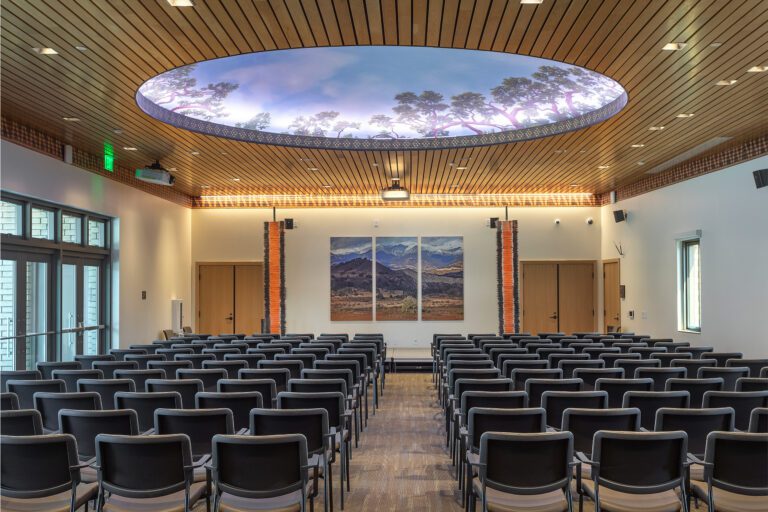
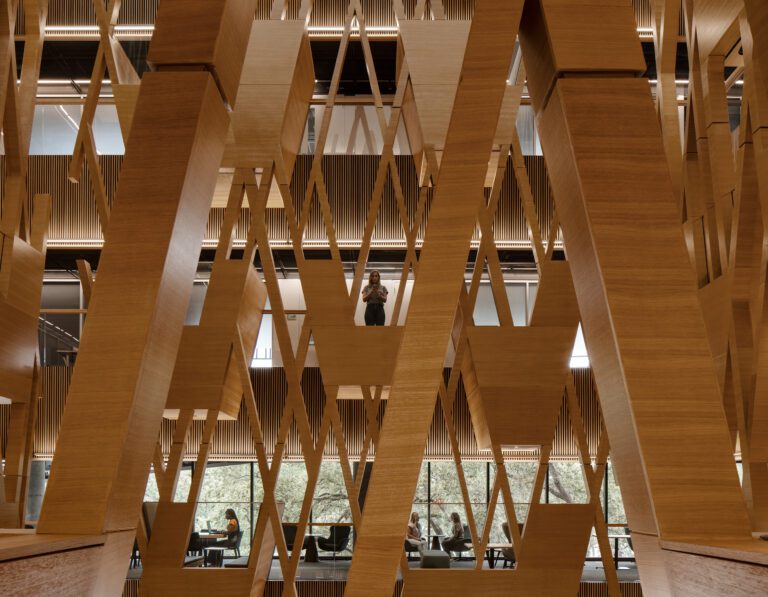
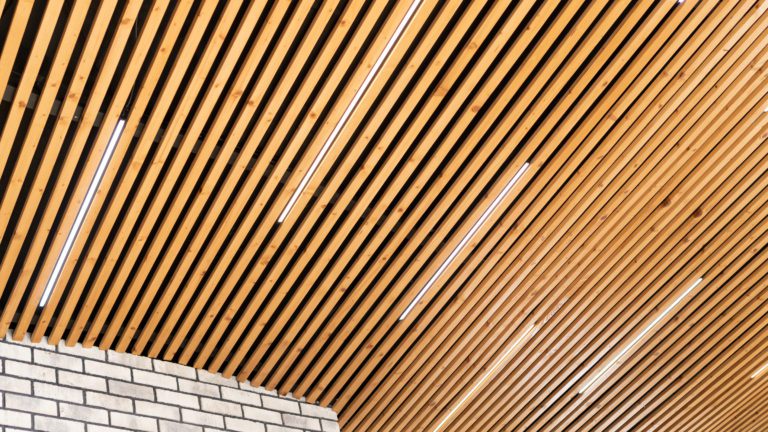
Wood ceiling systems resolve that tradeoff. As Rulon’s work across corporate interiors demonstrates, architectural wood panels function simultaneously as acoustic tools, biophilic elements, and design statements. Slatted linear systems create rhythm and directionality overhead, giving open offices a human scale that plain drywall or suspended tile cannot achieve. Baffle systems add depth and dimension while absorbing ambient noise. Curved panel profiles introduce the organic, non-repeating contours that research identifies as most effective at eliciting biophilic responses.
The ceiling plane also carries weight in terms of occupant perception of space quality. In competitive talent markets, where employees are choosing between employers partly on the basis of workplace experience, a ceiling that communicates care, craftsmanship, and natural warmth is a material signal that the organization values the people working beneath it.
Biophilic Office Design and Acoustic Performance
Biophilic intent and acoustic performance are not competing priorities in a well-specified wood ceiling system. They reinforce each other.
Open offices are among the most acoustically challenging commercial environments. Without meaningful sound absorption overhead, conversations carry across workstations, concentration erodes, and stress levels climb. The irony of many contemporary biophilic design efforts is that they prioritize visual warmth while leaving the acoustic environment untreated, an oversight that undermines the very well-being outcomes the design was meant to support.
Perforated and grooved wood panels with acoustic backers address this directly. Systems with high noise reduction coefficient ratings absorb reverberation that flat tile or exposed concrete amplifies. For open-plan corporate environments, wood baffle and slat systems deliver acoustic zoning without breaking the visual continuity of the space. Quieter zones for focused work and more open zones for collaboration can share the same material language, with ceiling configuration doing the functional work of differentiation.
This acoustic-biophilic integration is not incidental. Research consistently shows that noise is the primary driver of workplace dissatisfaction in open-plan offices. Specifying wood ceilings that address both the sensory warmth and the sound environment is the difference between a biophilic gesture and a biophilic strategy.
WELL Building Standard Credits and Wood Ceiling Systems
Biophilic office design has moved from design philosophy to building certification. The WELL Building Standard, administered by the International WELL Building Institute, includes specific provisions under its Mind and Materials categories that reward the integration of natural elements and biophilic design strategies. The International Living Future Institute similarly recognizes biophilic design as a core pillar in the Living Building Challenge, which requires a direct connection to nature as a condition of certification.
For design teams pursuing WELL certification, wood ceiling and wall systems contribute across multiple features. Natural materials reduce indoor chemical exposure, supporting WELL Materials credits. The stress-reducing and attention-restoring properties of wood align with WELL Mind requirements. Perforated wood systems support WELL Sound credits.
Rulon’s wood systems are designed to support this full spectrum of certification requirements, with FSC Chain-of-Custody certification, Environmental Product Declarations, Health Product Declarations, and compliance with EPA indoor air quality standards for composite wood. For architects building a WELL or LEED documentation package, that level of material transparency eliminates significant administrative friction and gives owners a defensible sustainability narrative.
Specifying Wood for Biophilic Office Design: Practical Considerations
Successful biophilic office design with wood is not about maximizing the quantity of wood on a surface. It is about the right configuration for the space, the occupancy, and the performance requirements.
Species selection matters. Oak, cherry, and walnut carry pronounced grain patterns that generate the visual complexity associated with stronger biophilic responses. Maple and lighter species deliver a cleaner, more contemporary aesthetic that suits organizations seeking warmth without the visual weight of darker tones. Finish selection affects how wood reads under different lighting conditions, a consideration that becomes critical in offices with predominantly LED artificial light.
Panel configuration shapes the acoustic outcome. Open slat systems allow sound to pass into the plenum and require coordination with acoustic insulation above. Perforated veneer panels with integrated backers provide more predictable, testable NRC performance. Curved or sculptural elements introduce biomorphic form, one of the most potent biophilic patterns, and are particularly effective in lobbies, reception areas, and collaborative hubs where first impressions and creative energy converge.
Rulon’s approach to sustainable wood sourcing ensures that the biophilic benefits of wood do not come at the cost of environmental integrity. FSC-certified materials, responsibly managed throughout the supply chain, mean that the connection to nature being designed into the office is also being honored outside of it.
A Workplace Worth Returning To
Biophilic office design is not an upgrade for organizations that have already solved the basics. It is increasingly a baseline expectation from employees, corporate real estate stakeholders, and building certification bodies that recognize the quantifiable relationship between natural environments and human health.
Wood ceilings and wall systems are the most architecturally significant biophilic intervention available to designers working on commercial interiors. They operate simultaneously across the acoustic, visual, sensory, and certification dimensions that define high-performance workplace design. And they endure. Unlike paint colors or furniture selections that cycle with trends, a well-specified wood ceiling system ages with character and continues delivering biophilic value for the life of the building.The office that earns attendance is the one that makes people feel something when they walk in. Wood is the material that does that. To explore how Rulon’s systems can support your next biophilic office design project, contact our team to schedule a discovery call.