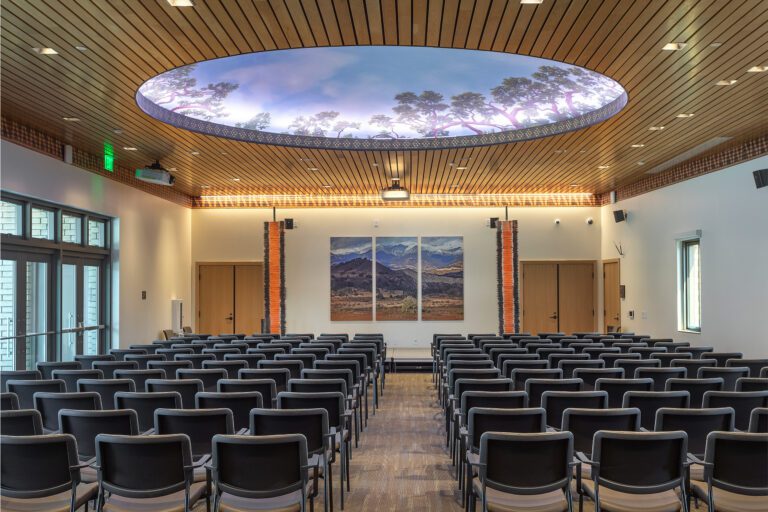
Few architectural moments carry more weight than a soaring atrium or a grand, high-volume interior. These spaces command attention from the moment someone walks through the door, and every material decision made overhead amplifies or diminishes that first impression. A well-designed wood panel ceiling does not simply fill square footage. It anchors the entire spatial experience, introducing warmth, texture, and acoustic intelligence into environments that might otherwise feel cold and echoey.
For architects and specifiers working on convention centers, corporate campuses, transit terminals, higher education buildings, and hospitality projects, the wood panel ceiling has become one of the most powerful tools in the design toolkit. This guide covers the most effective wood panel ceiling ideas for large-scale applications, along with the engineering and specification considerations that make them work.
Why a Wood Panel Ceiling Performs in High-Volume Spaces
High-volume spaces present a paradox. The grandeur that makes them memorable can also make them acoustically punishing and visually overwhelming. Hard surfaces at scale reflect sound aggressively, and without thoughtful material selection, an atrium becomes a reverb chamber rather than a gathering place.
A wood panel ceiling addresses this challenge on multiple fronts. Naturally warm in tone, wood absorbs and diffuses light in ways that reduce the harshness common in glass-and-concrete atriums. When specified with acoustic backing or perforation, wood panel ceiling systems also meaningfully reduce reverberation times across mid-range frequencies, improving speech intelligibility and occupant comfort at scale.
From a biophilic design standpoint, wood provides an organic counterweight to the structural engineering drama of tall, open interiors. Research and design practice increasingly confirm that natural materials in large commercial spaces reduce stress and increase occupant satisfaction. A wood panel ceiling introduces grain, color variation, and tactile visual richness that synthetic materials cannot replicate. According to the Whole Building Design Guide guidance on atrium design, sound-absorptive materials are specifically recommended in atria intended for performances, ceremonies, or large gatherings, which are exactly the conditions where wood panel ceiling systems excel.
Wood Panel Ceiling Design Ideas for Atriums
The atrium is the space where a wood panel ceiling design can move from functional to iconic. The design approach should be guided by ceiling height, the structural bay pattern, daylighting conditions, and the desired relationship between the ceiling plane and the surrounding architecture.
Flat Veneer Panel Fields
For atriums with strong geometric order, large-format flat veneer panels create a sense of continuity and craft. Panels sized up to 4 feet by 10 feet can span significant distances while maintaining clean reveal lines. Species selection plays an important role: white oak and walnut deliver richness and contrast appropriate for signature spaces, while maple and ash read lighter and allow daylight to bounce more effectively through glazed atrium roofs.
Flat panel systems work particularly well when designed to integrate lighting, HVAC registers, and sprinkler heads within the ceiling plane. Factory-coordinated cutouts maintain the clean visual field that large-scale installations demand.
Curved and Sculpted Panel Systems
Some of the most memorable wood panel ceiling installations in atriums use curvature to guide the eye and shape how sound moves through the space. Curvalon custom-shaped panels achieve concave, convex, and compound curves through a multi-step manufacturing process, making it possible to execute sweeping forms across large ceiling areas without sacrificing the warmth and authenticity of real wood veneer.
Curved wood panel ceiling configurations are especially effective in entry atriums and multi-story lobbies where the ceiling transitions from wall to overhead plane. When panels are engineered to arc continuously across both surfaces, the result is an immersive environment that feels resolved rather than assembled.
Baffle and Linear Panel Combinations
In atriums with exposed structural systems or unresolved overhead conditions, combining a wood panel ceiling treatment with vertical baffles creates depth, visual rhythm, and excellent acoustic performance. Baffles hung perpendicular to the ceiling plane intercept sound before it reflects back into the occupied zone, while a panelized ceiling above ties the composition together and conceals mechanical systems.
This layered approach suits convention center pre-function areas, university atria, and airport terminals where the volume is extreme, and the acoustic challenge is significant.
Engineering a Wood Panel Ceiling at Height: What Architects Need to Know
Designing a wood panel ceiling for a 30-plus-foot atrium is a fundamentally different exercise than specifying a standard ceiling in an office or classroom. Several engineering considerations become critical at scale.
Seismic and Wind Load Compliance
Suspended wood panel ceiling systems in high-volume spaces must be designed to comply with applicable seismic requirements under IBC and ASCE 7 standards. This means the suspension system, hanger wire gauge, and panel attachment hardware must all be engineered in coordination. Rulon’s seismically compliant torsion spring and saddle clip systems are designed with these requirements in mind, and shop drawings are produced by Rulon’s in-house engineering team to confirm compliance on a project-by-project basis.
Panel Size and Weight
Building Design + Construction’s AIA continuing education course on ceiling design highlights that weight load and suspension system design are among the most consequential decisions in any ceiling specification. For wood panel ceiling systems in high-volume spaces, maximizing panel size reduces the number of attachment points and speeds installation, but panel weight must stay within the structural limits of the suspension grid. Rulon’s flat veneer panels are manufactured on MDF and particleboard cores that balance dimensional stability with manageable weight for large-format applications.
Humidity and Acclimation
Wood is a hygroscopic material, and large-scale installations require careful attention to site conditions before and during installation. Panels should acclimate in the finished space for a minimum of 72 hours with HVAC systems operating before installation begins. In atriums with significant glazing, solar heat gain and condensation patterns should be evaluated to ensure the ceiling environment stays within the humidity range appropriate for the specified wood species and finish.
MEP Coordination
High-volume spaces invariably include complex mechanical, electrical, and plumbing systems routed through the ceiling plenum. A successful wood panel ceiling installation at scale depends on early BIM coordination to resolve conflicts between panel layout and MEP penetrations. Factory-cut openings for light fixtures, speakers, and sprinkler heads preserve the visual integrity of the ceiling field and eliminate field-cutting errors that can compromise the finish quality.
Choosing the Right Wood Panel Ceiling System for Large Spaces
Not all wood panel ceiling systems are suited to the demands of high-volume commercial applications. The selection process should weigh acoustic performance targets, maximum panel dimensions, finish options, and suspension system engineering.
Rulon’s full product lineup offers multiple systems capable of performing at the scale atriums and high-volume spaces require.
Flat Veneer Panels are the workhorse of large-scale wood panel ceiling applications. Available in standard species including white oak, walnut, ash, maple, cherry, and anegre, flat panels can be specified with Class A fire ratings through FR core construction and finished with low-VOC, water-based coatings. Custom stain matching is available for projects requiring a precise color relationship with other interior materials.
Curvalon is the system of choice when the design calls for sculptural curvature across a large ceiling area. Custom-shaped panels with concave, convex, or compound curves are engineered by Rulon’s team and can be coordinated with flat panel fields to create seamless transitions between planar and curved ceiling zones.
Aluratone acoustic panels bring engineered sound attenuation to large-scale wood panel ceiling installations without sacrificing the visual warmth of natural wood veneer. Micro-perforated and micro-grooved face options deliver high NRC performance while maintaining the material authenticity that makes wood ceiling systems so effective in signature spaces.
Wood Panel Ceiling Applications Across High-Volume Project Types
The considerations above translate differently depending on project type. Convention centers and exhibition halls prioritize acoustic control in pre-function areas and visual impact in entry sequences. University atriums balance the need for durable, low-maintenance surfaces with the desire for material warmth that supports student wellbeing. Corporate headquarters use large-scale wood panel ceiling installations to communicate brand values at the moment of arrival. Hospitality projects, from hotel lobbies to airport terminals, rely on wood ceilings to counterbalance the hard, high-traffic surfaces that dominate those environments.
Across all of these project types, the wood panel ceiling serves the same fundamental purpose: it transforms structural volume into a human-scaled experience. When the engineering is right and the design is resolved, the ceiling disappears into the architecture, and the space becomes what it was always meant to be.To discuss a specific atrium or high-volume project, contact Rulon International’s team at rulonco.com.