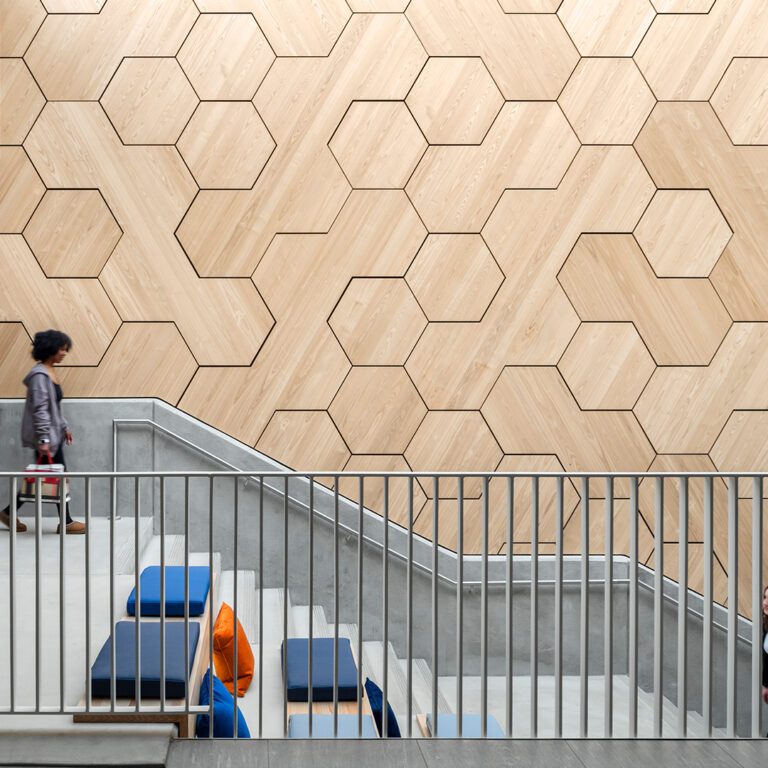
Every echo in an open office erodes concentration. Every muffled instruction in a classroom widens the gap between students who hear clearly and those who don’t. Acoustic quality isn’t background noise. It’s the invisible architecture of productive, equitable spaces.
Wooden acoustic panels address this challenge by combining measurable sound control with the material warmth that synthetic alternatives can’t replicate. For architects and designers specifying interior materials, the question isn’t whether acoustics matter; it’s how to achieve them without sacrificing design intent.
Why Acoustic Quality Shapes Occupant Experience
Acoustic comfort directly impacts how people think, learn, and heal. In open offices, excessive reverberation forces employees to work harder to focus, draining cognitive resources that should go toward productive tasks. In classrooms, poor speech intelligibility means some students miss up to half of what instructors say, creating inequities that compound over time.
The Productivity Cost of Poor Acoustics
Research consistently links acoustic environments to measurable outcomes. Industry benchmarks indicate that high-traffic spaces require NRC 0.80+ and CAC 35+ for optimal performance. Workplaces with uncontrolled noise see reduced concentration, increased stress, and lower satisfaction scores. Healthcare facilities with high ambient noise report slower patient recovery and elevated staff fatigue. These aren’t abstract concerns; they translate into real costs for building owners and real consequences for occupants.
Why Modern Interiors Create Acoustic Challenges
Contemporary design trends have amplified acoustic challenges. Open floor plans remove the walls that once contained sound. Glass partitions and polished concrete floors reflect noise rather than absorbing it. Minimalist aesthetics favor hard surfaces over soft furnishings. The result: spaces that photograph well but function poorly for the people who use them daily.
Wooden acoustic panels offer a path forward, providing the absorption modern interiors need while introducing the organic warmth and texture that occupants instinctively find calming.
How Wooden Acoustic Panels Control Sound
Understanding how wooden acoustic panels work helps architects specify systems that meet project requirements. Two metrics matter most: NRC (Noise Reduction Coefficient) and CAC (Ceiling Attenuation Class).
Understanding NRC and CAC Ratings
NRC measures how well a surface absorbs sound rather than reflecting it, rated on a scale from 0.0 to 1.0. Higher values indicate better absorption. Industry benchmarks suggest that high-traffic spaces and multipurpose environments benefit from absorptive surfaces with an NRC rating of 0.80 or higher for optimal performance.
CAC measures a ceiling system’s ability to reduce sound transmission between adjacent spaces through a shared plenum. This rating matters when demising walls don’t extend to the structure above, a common condition in commercial buildings where flexibility requires stopping partitions at the ceiling plane.
Perforation Patterns and Frequency Targeting
The physical structure of acoustic wood panels determines their absorption characteristics. Perforation patterns create pathways for sound waves to enter the panel assembly, where they encounter absorptive backing materials. The size, spacing, and depth of perforations influence which frequencies the panel absorbs most effectively.
Micro-perforations target mid- to high-frequency sounds typical of human speech, making them ideal for offices and classrooms. Larger openings and deeper cavities enhance low-frequency absorption in spaces such as auditoriums or music rooms. Products like Aluratone acoustic panels offer configurations ranging from slotted patterns to micro-perforated veneers, allowing designers to match acoustic performance with visual preferences.
Wood vs. Alternative Materials
Wood’s cellular structure naturally absorbs and diffuses sound rather than reflecting it harshly. Compared to glass, metal, or concrete, wood softens acoustic energy and creates warmer tonal qualities. Metal surfaces produce bright, sometimes harsh echoes. Glass reflects sound directly. Concrete, while excellent for blocking sound transmission, creates prolonged reverberation when used as interior finish.
Wooden acoustic panels bridge the gap between performance and material authenticity, delivering measured NRC values while contributing the biophilic presence that synthetic panels cannot match.
When acoustic performance falls short of expectations, solving acoustic challenges requires understanding the relationship between panel coverage, backing materials, and room geometry.
Explore the complete acoustic panel lineup to see how different configurations address specific performance requirements.
Application-Specific Acoustic Guidance
Different environments demand different acoustic strategies. The following guidance helps architects specify wooden acoustic panels appropriate for their project type.
Educational Environments
Classrooms and lecture halls require absorptive surfaces rated NRC 0.75 or above to ensure speech clarity across the room. Consistent intelligibility supports learning equity, ensuring every student can hear and participate fully regardless of seating position.
At Wichita State University’s Woolsey Hall, perforated wood panels enhance speech clarity while air quality-certified materials and low-emission finishes align with student health goals. The project demonstrates how acoustic quality and environmental responsibility can coexist in educational settings.
Healthcare Facilities
Hospitals and clinics use wooden acoustic systems to soften environments that patients often find stressful. Reduced ambient noise helps patients rest and allows staff to concentrate. In waiting areas, wood finishes reduce perceived stress, making clinical environments feel warmer and less intimidating.
Acoustic performance in healthcare directly supports health outcomes. Studies show that excessive noise increases patient blood pressure, disrupts sleep, and extends recovery times.
Corporate Workplaces
Open-plan offices rely on acoustic panels to create zones for focus, collaboration, and privacy within the same floorplate. Quiet focus areas benefit from higher NRC-rated assemblies, while collaborative zones may employ panels that balance absorption with appropriate diffusion to maintain natural speech communication.
The goal isn’t eliminating all sound; it’s creating acoustic variety that supports different work modes without visual barriers.
Cultural and Civic Spaces
Museums, libraries, and performing arts venues demand acoustics and aesthetics in equal measure. At the Gilder Center for Science, Education, and Innovation, Rulon fabricated over 700 custom wood baffles for Studio Gang’s design at the American Museum of Natural History. Wood was chosen over metal or gypsum for its tactile warmth, flexibility in shaping, and superior acoustic performance in large-volume spaces.
The Wellness Connection: Acoustics and Human Health
Acoustic comfort extends beyond functional performance into measurable wellness outcomes. Research documenting physiological responses shows that occupants in acoustically controlled environments demonstrate lower heart rates, reduced blood pressure, and improved mood compared to those in noisy spaces.
Research on Acoustic Comfort and Stress Reduction
The body responds to acoustic environments even when we’re not consciously aware of them. Prolonged exposure to reverberation and ambient noise triggers stress responses that accumulate over time. Conversely, spaces with appropriate absorption create conditions where occupants can relax, focus, and recover.
Wooden acoustic panels contribute to [multi-sensory environments](LINK TO FUTURE BLOG: “multi-sensory environments”) where sound, touch, and visual warmth work together. The natural grain patterns and organic textures of wood activate biophilic responses that synthetic materials cannot replicate.
Supporting WELL Certification with Wooden Acoustic Panels
The International WELL Building Institute recognizes acoustic comfort as a core contributor to occupant wellness. Meanwhile, LEED v5 emphasizes quality of life as one of three core impact areas, with acoustic comfort supporting occupant health and productivity goals.
Wooden acoustic panels directly support these objectives through material authenticity, natural texture, and sensory warmth. Combined with low-VOC finishes and FSC-certified sourcing, they help projects pursue both acoustic performance and wellness certification simultaneously.
For detailed guidance on FSC certification requirements and sustainability documentation, explore our comprehensive high-performance wood guide.
| Key Insight: NRC Quick Reference by Application Open offices and classrooms: NRC 0.75+Conference rooms: NRC 0.80+ with high CAC for speech privacyHealthcare waiting areas: NRC 0.80+Cultural venues: Varies by program (consult acoustic engineer for reverberation time targets) |
See how design teams have applied acoustic wood panels in education, healthcare, and corporate settings by exploring Rulon’s project gallery.
Specifying Wooden Acoustic Panels for Your Project
Successful acoustic specification requires early coordination and clear communication between design, engineering, and construction teams.
Early Coordination Best Practices
Calculate acoustic requirements during schematic design rather than treating them as an afterthought. Create reflected ceiling plans showing panel layouts, MEP penetrations, and lighting locations before finalizing designs. Engage manufacturer’s technical support to confirm panel configurations meet NRC targets for your specific applications.
Coordinate acoustic panels with lighting, sprinklers, and diffusers to maintain pattern continuity. Products like Linear wood ceiling systems offer friction-fit assembly that accommodates MEP integration while preserving visual consistency.
Modular Installation and Timeline Efficiency
Modular acoustic systems reduce field labor and coordination risk. Prefabricated panels ensure consistent quality and predictable reveals across large installations. For projects with compressed schedules, the Select N’ Ship quick-ship program ensures panels arrive when needed.
Systems like EndureTM Direct Attach simplify fastening strategies for high-traffic environments, while wood baffles provide sculptural acoustic treatment for atriums and auditoriums.
Acoustic specification is one component of a broader process involving [fire ratings, material composition, and installation coordination](LINK TO LONGFORM: “Solving Design Problems with High-Performance Wood”). Early manufacturer engagement helps align all performance requirements before production begins.
Frequently Asked Questions
What NRC rating should I specify for open office applications?
Classrooms, call centers, and open offices benefit from absorptive surfaces rated NRC 0.75 or above. This level provides meaningful noise reduction without creating overly dead acoustic conditions. Balance absorption with adequate reflected sound to support speech communication across typical distances. Acoustic modeling helps optimize ceiling coverage for specific room geometries.
How do wooden acoustic panels compare to fabric-wrapped panels?
Both materials absorb sound effectively, but wooden acoustic panels offer distinct advantages. Wood provides natural warmth and biophilic presence that fabric cannot replicate. Wood panels typically demonstrate greater durability and easier maintenance over building lifecycles. FSC-certified wood panels also contribute to LEED credits that fabric alternatives may not support.
Can wooden acoustic panels achieve visual continuity without exposed perforations?
Yes. Micro-perforation technology allows sound absorption while maintaining nearly seamless visual appearance. Aluratone 7X0 series panels combine micro-perforated veneers with acoustically engineered substrates, delivering measured NRC performance without visible holes or slots. This configuration suits high-end environments where visual refinement and acoustic control must coexist.
Do wood species affect acoustic performance?
Wood species selection primarily influences aesthetic characteristics rather than acoustic performance. Perforation patterns, panel construction, backing materials, and cavity depths determine sound absorption far more significantly than species differences. This frees designers to select species based on appearance preferences while ensuring specified configurations deliver required NRC values.
How do wooden acoustic panels support WELL Building certification?
WELL v2 Biophilia features encourage integrating natural materials that enhance occupant connection to nature. Wooden acoustic panels directly support these objectives through material authenticity, organic texture, and sensory warmth. When specified with low-VOC finishes and documented environmental credentials, they contribute to both acoustic comfort requirements and biophilic design recognition.
Improve Indoor Environments with Wooden Acoustic Panels
Acoustic quality shapes how people experience indoor environments, from the classroom where every student deserves to hear clearly to the workplace where concentration drives productivity. Wooden acoustic panels deliver the measurable sound control modern interiors require while providing the material warmth and biophilic presence that occupants instinctively value. For comprehensive guidance on specifying wood ceiling systems across acoustic, fire safety, and sustainability dimensions, explore our complete guide to high-performance wood ceilings.
For architects and designers, the path forward lies in combining early acoustic planning with manufacturer collaboration. Rulon International’s sustainability credentials include FSC certification maintained since 1998, third-party-verified EPDs, and CARB Phase 2-compliant finishes, ensuring that acoustic performance aligns with environmental responsibility.
Ready to specify wooden acoustic panels for your next project? Contact Rulon’s technical team at 904-584-1400 or email info@rulonco.com to discuss your acoustic requirements and explore panel configurations that align with your design intent.