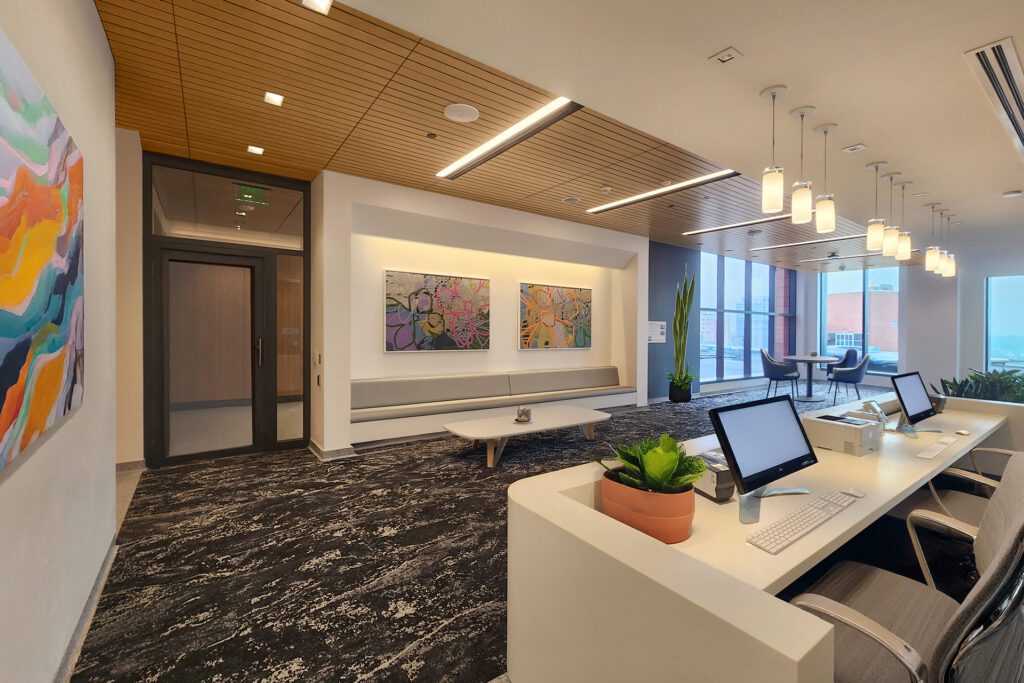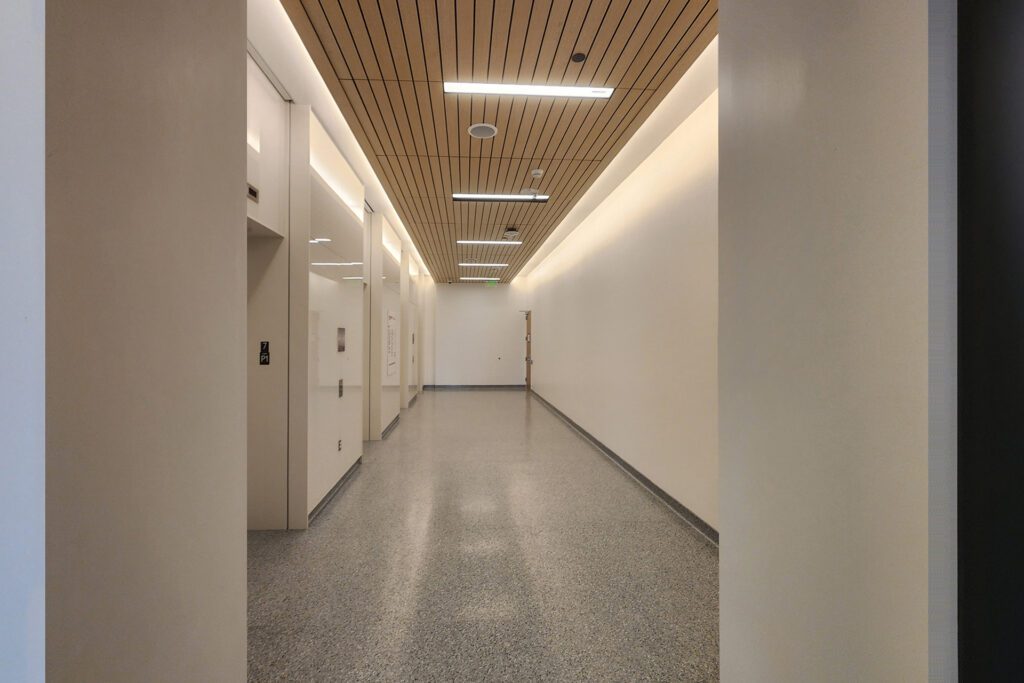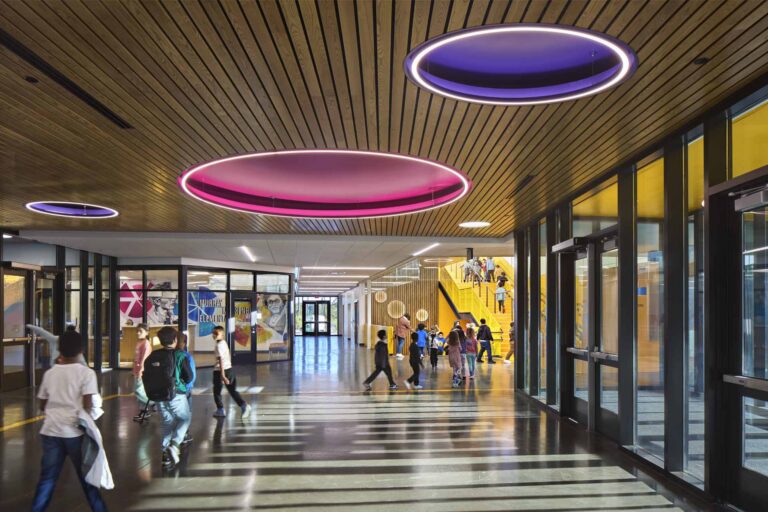
Located in New Jersey, the Rutgers Cancer Institute of New Jersey was designed as a highly integrated healthcare environment where connected architectural components, accessibility, and technical coordination were equally critical. The interior ceiling and wall applications were conceived as a direct extension of the building’s exterior identity, requiring a custom material solution that could carry the exterior façade language seamlessly into the interior spaces.
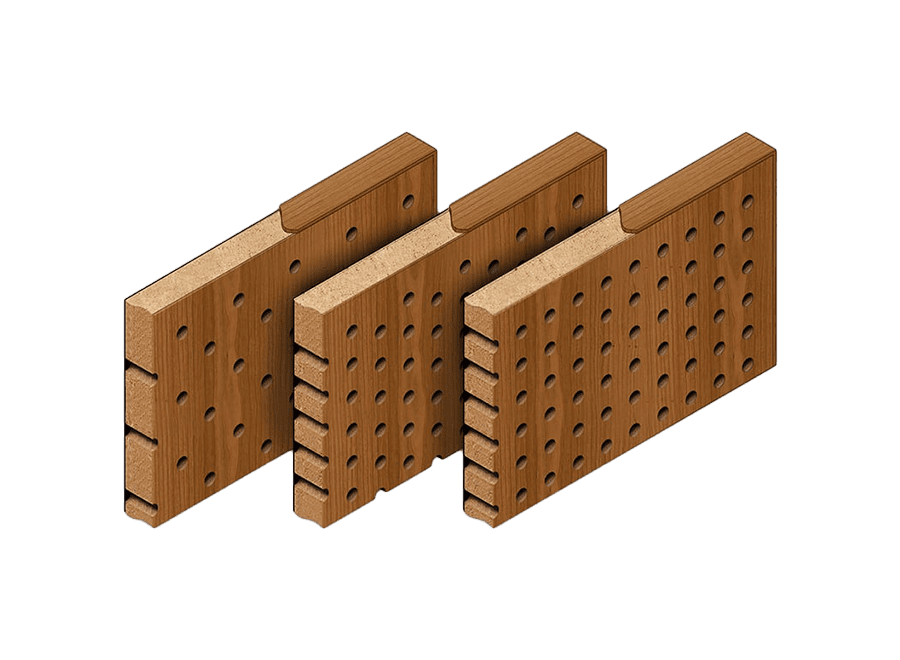
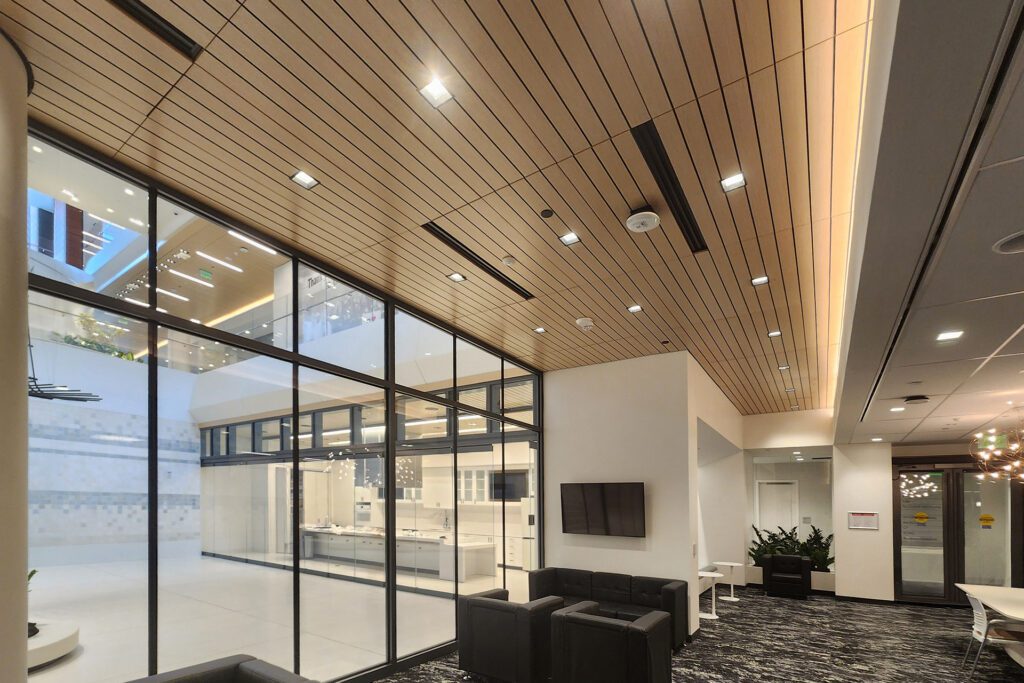
The design called for custom-machined White Oak panels configured to match the geometry of the exterior façade, creating a strong visual continuity throughout the facility. Each panel was grooved with 3/8″ slot spaced approximately 4 inches on center, producing a consistent linear pattern with a repetitive black reveal. The black core created an important visual contrast to the light veneer, reinforcing the patterns of the exterior facade without taking away from the visual intent. The specified materials and design remained consistent throughout the project, with no substantive changes from the original design. Approximately 50,000 square feet of custom Aluratone was manufactured for the project, making it one of the larger applications of custom-grooved Aluratone within a healthcare environment.

CHALLENGE & ACTION
Because the interior profiling was required to match the exterior façade geometry, the layout could not rely on standard panel sizes. Instead, a non-standard panel configuration was developed, and a custom layout for the heavy-duty grid system was implemented. This approach required a substantial amount of coordination between Rulon and the installing contractor, but it ensured alignment with the exterior geometry.
The complexity of the building systems introduced an additional layer of coordination. Specialty trims were required extensively throughout the project, particularly in areas with dense MEP integration. The media room proved especially challenging, requiring careful coordination between the design team, Rulon, and the installing contractor.
Accessibility was a critical success for the project. The system was designed to be 100% accessible, utilizing torsion springs for the majority of the installation and side-slot attachment methods where required. This approach allowed panels to be removed and reinstalled easily for maintenance and access, an essential consideration in a healthcare setting.
Due to the complexity of the system and the degree of customization involved, the project relied heavily on ongoing coordination rather than formal workshops. Numerous conference calls were held throughout design development and pre-installation to align engineering, fabrication, and installation requirements. Rulon’s engineering team worked directly with the installing contractor to refine torsion spring configurations, confirm panel layouts, and address site-specific conditions as they arose.
Installation was completed by Nicholson Corporation, with close collaboration between Rulon engineering and the field team to navigate the project’s complexity. Despite the demanding coordination requirements, the system was successfully installed to meet the project’s architectural, functional, and accessibility goals.
The Rutgers Cancer Institute of New Jersey project demonstrates how highly customized wood ceiling and wall systems can be successfully integrated into complex healthcare environments. Through precise machining, custom tooling, and sustained technical coordination, the project achieved a cohesive architectural design that aligns interior spaces with exterior form, while also meeting the stringent accessibility and performance requirements of a modern cancer treatment facility.