For architects and specifiers working on K-12 and higher ed projects, sustainability documentation has become inseparable from material specification. LEED v4 and v4.1 reorganized credit categories around third-party verified disclosure rather than single-attribute claims. WELL v2 added biophilic and material transparency requirements. Center for Green Schools treats Health Product Declarations and Environmental Product Declarations as standard line items. The ceiling specification carries weight in all of these frameworks because ceiling systems are typically among the largest material specifications in a school by area, and certifications applied to ceilings cascade across multiple credit categories. The decision in front of the design team is which ceiling system carries the documentation that the project’s certification goals actually require.
This piece covers how sustainability frameworks translate into ceiling specifications for K-12 and higher ed projects, the certifications that anchor compliant specifications, and the role of specific Rulon systems in delivering sustainable school ceilings.
What “Sustainable” Means in a Ceiling Specification
Sustainable ceiling specification has shifted from “low-VOC” or “recycled-content” claims toward documented disclosure across multiple impact categories. A ceiling system specified for sustainability in a current K-12 or higher ed project typically needs to document:
Sustainable sourcing for wood content (FSC Chain of Custody).
Material ingredient disclosure (HPD v2.1 or equivalent).
Lifecycle environmental impact (Environmental Product Declaration, EPD).
Low VOC emissions (Indoor Advantage Gold or equivalent).
Fire performance (ASTM E84 Class A) for code compliance, not sustainability per se but a baseline material requirement.
Restricted substance screening (Living Building Challenge Red List Free or equivalent) for projects pursuing higher certification thresholds.
Each of these documentation types serves a different framework and contributes to different credit categories. Specifications that map documentation to certification goals from the outset of design avoid late-stage substitutions that can be expensive and disruptive.
California’s Center for Green Schools Standard and Its National Influence
California’s Collaborative for High Performance Schools (Center for Green Schools) is the most detailed school-specific green building framework in the United States. Center for Green Schools verification requires documentation across material transparency, indoor air quality, low-VOC content, lifecycle impact, and acoustic performance. For ceiling systems, Center for Green Schools specification typically calls for FSC, HPD v2.1, EPD, Indoor Advantage Gold, and ASTM E84 Class A, all at the product level rather than corporate-level.
California’s Division of the State Architect (DSA) has a strict review process, which applies to all K-12 public school construction in California. DSA requires ASTM E84 Class A and references ANSI S12.60 for acoustic performance. A ceiling specification that satisfies DSA without supplementary documentation provides the foundation for Center for Green Schools verification, and the same specification can support LEED v4.1 certification with minor additions.
For architects working in California, the practical implication is that material transparency is a baseline procurement requirement, not a value-add. Ceiling systems that hold the full documentation stack are specifiable without supplementary certificates; systems that lack one or more documentation types create compliance risk and slow the documentation phase.
For architects working outside California, Center for Green Schools provides a defensible specification template even without formal Center for Green Schools verification. The certification stack that California schools have made standard is increasingly being adopted nationally as an indication of design ambition and material discipline.
Considerations That Drive Sustainable Ceiling Specification
Three considerations frame whether a ceiling specification will satisfy the sustainability frameworks the project pursues.
Match the documentation set to the framework. A LEED-only project may not require full HPD documentation; a LEED-plus-WELL project does. Center for Green Schools verification adds Red List screening on top of LEED-equivalent documentation. The specification should reference the specific certifications the project pursues and require documentation tied to those certifications.
Specify product-level certificates, not corporate-level. A manufacturer that holds FSC certification corporately may not have FSC documentation specific to every product line and configuration. Specifications should require Chain of Custody documentation tied to the specific product being installed.
Coordinate ceiling specification with adjacent material specifications. Ceiling systems support credit categories that walls, floors, and millwork also contribute to. A coordinated material strategy delivers more credit value than treating each surface as an independent specification.
Linear, Grilles, Flat Panels, Aluratone, and Endure Linear
Rulon’s product portfolio for K-12 and higher ed projects covers the range of design intentions and durability requirements that sustainable school specifications need to address.
Linear and Grille systems carry FSC Chain of Custody, ASTM E84 Class A, and Indoor Advantage Gold certifications. Both are specified across libraries, learning commons, lecture halls, atria, and high-design classrooms in projects pursuing LEED, WELL, or Center for Green Schools certification.
Flat Panels carry FSC Chain of Custody and ASTM E84 Class A certifications. Flat Panels are specified in higher-profile spaces where the design calls for a refined, monolithic ceiling treatment.
Aluratone carries ASTM E84 Class A and Indoor Advantage Gold and is specified where wood aesthetics and documented acoustic absorption are both program requirements. Available in a range of face profiles delivering NRC values up to 0.85, it supports material continuity across a project’s wood palette while meeting the absorption targets a given space requires.
Endure Linear, engineered for high-traffic and high-humidity environments, carries ASTM E84 Class A and FSC Chain of Custody. Endure Linear is specified in corridors, locker rooms, and gymnasium entries where standard wood systems would underperform.
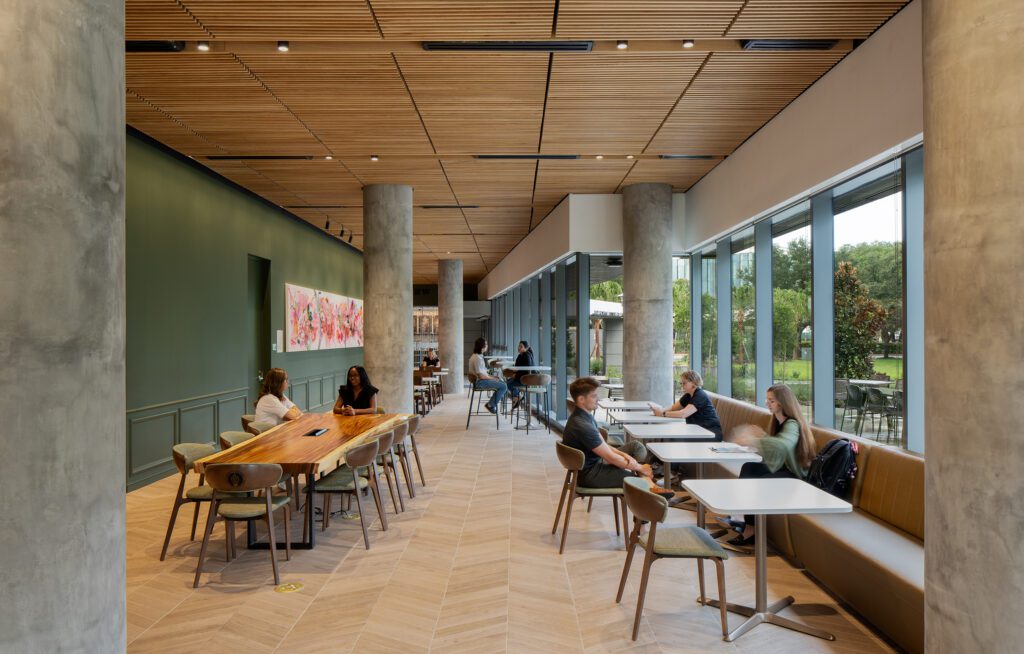
At the University of South Florida’s Judy Genshaft Honors College, the design team approached a project where sustainability documentation, biophilic design, acoustic performance, and the architectural ambition of an honors program all had to be resolved within an academic facility’s specification framework. The Rulon systems specified for the project supported the building’s sustainability and wellness goals through documented certifications across multiple impact categories, demonstrating that comprehensive sustainable specification at scale is achievable when the design team coordinates certification choices with system selection from the outset of design.
Specification Takeaways
For architects assembling sustainable ceiling specifications for K-12 and higher ed projects:
Map the documentation stack to the certification framework the project pursues. LEED, WELL, Center for Green Schools, and Living Building Challenge each have specific requirements that drive product selection.
Treat product-level documentation as a baseline. Corporate-level certifications do not substitute for product-specific FSC, HPD, EPD, and Indoor Advantage Gold documentation.
Coordinate ceiling specification with wall, floor, and millwork specifications. Sustainability credits cascade when specifications are coordinated.
For California projects, treat the full Center for Green Schools documentation stack as the foundation. For projects outside California, use the Center for Green Schools stack as a template for specifications that need to defend their sustainability claims.
Plan for long-term sustainability outcomes. Ceiling systems with long service lives, documented finish durability, and replacement pathways aligned with the building’s maintenance environment deliver better lifecycle outcomes than systems that perform at installation but degrade quickly.
Related Resources:
For the architectural framework: Architectural Wood Ceilings & Walls for Schools covers the broader pillar context for wood ceiling and wall specifications in K-12 and higher ed.
For the highest-ambition material specifications: Red List Free Certified: Why Rulon’s Wood Ceiling Systems Meet the Highest Healthy Materials Standards for Schools addresses the top tier of healthy materials documentation for projects pursuing the most rigorous certification thresholds.