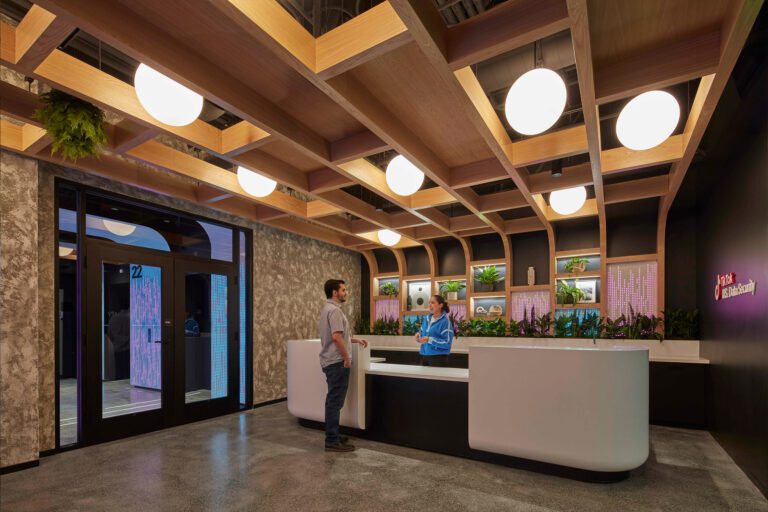
Commercial architects face an increasingly complex challenge: balancing ambitious aesthetic vision with rigorous technical requirements while meeting aggressive sustainability goals and budget constraints. High-performance wood ceilings have evolved from decorative elements into sophisticated architectural systems that solve multiple design problems simultaneously. This comprehensive guide examines how modern wood ceiling systems address acoustic performance, fire safety, sustainability certification, and design integrity throughout the commercial specification process.
Wood ceiling panels specifically designed to minimize sound reflection and enhance acoustic performance through grooved, perforated, or machined structures can absorb sound waves and prevent excessive reverberation. High-end systems provide superior sound control with NRC ratings of 0.7-0.85, making them essential for open office environments, educational facilities, and performance venues where sound quality directly impacts user experience.
The sustainability performance of wood ceiling systems has advanced considerably, with modern products offering verified responsible sourcing, low-emission materials, and transparent documentation that supports green building goals. FSC is the only forest product certification standard recognized under LEED, and FSC-certified products, including veneer wall coverings and ceilings, can contribute to achieving LEED points when they meet leadership extraction practices for at least 25% of permanently installed building materials. This positions responsibly sourced wood as a strategic material choice for projects pursuing high-performance, environmentally responsible design.
This article provides architects, interior designers, and project teams with technical knowledge and practical guidance for confidently specifying wood ceiling systems that perform flawlessly across acoustic, fire safety, sustainability, and aesthetic dimensions.
Table of Contents
- Understanding High-Performance Wood Ceiling Systems
- Acoustic Performance: The Science of Sound Control
- Fire Safety and Code Compliance in Commercial Applications
- Sustainability Credentials: LEED, FSC, and WELL Building Standard
- Material Composition: Veneer, Core, and Finish Systems
- Installation Methods and Structural Integration
- Biophilic Design and Occupant Wellness
- Cost Considerations and Value Engineering
- Specification Process and Technical Documentation
- Common Design Challenges and Solutions
- Case Studies: Real-World Applications
- Frequently Asked Questions
Understanding High-Performance Wood Ceiling Systems
High-performance wood ceilings represent a fundamental shift from traditional decorative ceiling treatments. These engineered systems integrate acoustic management, fire resistance, structural integrity, and environmental responsibility into unified architectural solutions. The evolution reflects growing demand from commercial building owners for materials that deliver measurable performance outcomes rather than purely aesthetic value.
The construction of these systems typically combines carefully selected wood veneers with engineered cores and specialized backing materials. This layered approach allows manufacturers to optimize each component for specific performance characteristics while maintaining the visual warmth and authenticity of natural wood. The result bridges the gap between designers’ creative vision and the technical requirements imposed by building codes and project specifications.
Modern manufacturing capabilities enable unprecedented customization. Projects can specify exact wood species, grain patterns, panel configurations, perforation patterns, and finish treatments while still meeting standardized performance benchmarks. This flexibility represents a significant advantage over catalog-only products that force designers to compromise vision for availability.
Acoustic Performance: The Science of Sound Control
Sound management remains one of the most critical performance requirements in contemporary architecture. Open offices, classrooms, and public gathering spaces all rely on careful acoustic design to ensure comfort and functionality. High-performance wood ceilings play a central role in achieving these outcomes, combining natural warmth with measurable acoustic control.
NRC ratings range from 0 to 1, with higher values indicating better sound absorption, and different materials have varying NRC ratings which impact their ability to reduce noise. NRC is a rating between 0.0 and 1.0 that measures how well objects and surfaces in a room absorb sound instead of reflecting or refracting it. Softer materials typically absorb more sound waves, resulting in higher NRC values than hard materials.
The physical structure of acoustic wood panels determines their sound absorption capabilities. Perforation patterns create pathways for sound waves to enter the panel assembly where they encounter absorptive backing materials. The size, spacing, and depth of perforations directly influence which frequencies the panel absorbs most effectively. Micro-perforations target mid-to-high frequency sounds typical of human speech, while larger openings and greater cavity depths enhance low-frequency absorption.
The NRC of wall, floor, and ceiling finishes is most important when designing spaces for large groups of people, such as restaurants, offices, and schools. Understanding that high traffic spaces or multipurpose spaces where maximum sound absorption and sound blocking are needed require NRC 0.80+ and CAC 35+ for best performance helps architects make informed specifications.
Beyond NRC values, designers should consider Ceiling Attenuation Class ratings for projects with demising walls that do not extend to the structure above. CAC is a measure of the ability of a suspended ceiling system to reduce sound transmission over the wall separating adjacent spaces through a shared plenum, and it is essential to consider the CAC rating of ceiling systems where noise is a concern and walls do not extend to the deck above.
Proper acoustic design requires understanding the intended use of each space. Conference rooms demand speech privacy through high CAC performance. Open office areas benefit from balanced NRC to reduce ambient noise without creating dead acoustics. Performance venues and auditoriums need precisely tuned systems that support both absorption and appropriate reverberation times for their specific programs.
Fire Safety and Code Compliance in Commercial Applications
Fire safety requirements remain a non-negotiable component of every commercial specification. Architects must ensure that all interior finishes, including high-performance wood ceilings, meet the International Building Code (IBC) standards for flame spread, smoke development, and structural integrity under fire exposure.
The IBC, published by the International Code Council (ICC), sets minimum fire safety requirements for ceiling assemblies in commercial buildings. To achieve compliance, wood ceiling systems are tested in accordance with ASTM E84 (surface burning characteristics) and ASTM E119 (fire-resistance of building assemblies). These tests measure flame spread index, smoke development, and the time an assembly can withstand fire exposure without structural failure.
The performance of wood ceiling assemblies depends on how multiple components interact. Veneers influence surface flame behavior; core materials determine combustibility and structural endurance; and fire-retardant treatments enhance ignition resistance. In addition, protective membranes or backing layers on the panel’s reverse side further increase fire resistance.
Understanding the difference between component testing and assembly testing is essential. Individual materials might not carry standalone ratings, but complete, tested assemblies do. Collaborating early with manufacturers ensures your specified system includes the proper documentation for the intended construction type and occupancy classification.
Different IBC construction types dictate how wood systems can be used. Type V allows combustible materials with controlled flame spread, while Type III demands careful integration with rated structural assemblies. Early coordination with code officials avoids redesigns late in the approval process.
When properly specified, high-performance wood ceilings meet Class A fire-rating requirements without sacrificing design intent, offering architects the assurance that aesthetic ambition and code compliance can coexist safely and elegantly.
Sustainability Credentials: LEED, FSC, and WELL Building Standard
Sustainability is no longer optional; it’s a design imperative. Architects and designers are expected to specify materials that meet environmental, health, and performance criteria simultaneously. High-performance wood ceilings answer this call, combining renewable sourcing, third-party certification, and wellness-focused design into one cohesive solution.
FSC Certification and Chain of Custody
The Forest Stewardship Council (FSC) remains the most rigorous global standard for responsible wood sourcing. Rulon International has maintained FSC certification since 1998, ensuring every ceiling and wall system originates from responsibly managed forests with full traceability.
To contribute to LEED v4 credits, all entities that take ownership of certified wood, from forest to fabricator, must hold an FSC Chain of Custody (CoC) certificate. For LEED documentation, valuation depends on the product claim:
- Materials labeled FSC 100% or FSC Mix Credit are valued at 100 percent of cost.
- Materials labeled FSC Mix followed by a percentage are valued at that specific percentage of cost.
Every invoice must list the supplier’s FSC certificate code and claim type. This ensures transparency and simplifies LEED submittals for design teams pursuing sustainable building certification.
Environmental Transparency and Low-Emission Materials
Rulon supports full product transparency through Environmental Product Declarations (EPDs) and Health Product Declarations (HPDs). These third-party reports disclose environmental impact, ingredient content, and manufacturing data, streamlining documentation for LEED v4.1 and the Living Building Challenge.
Products also comply with EPA indoor air quality standards for composite wood, ensuring low formaldehyde and VOC emissions. This commitment helps architects meet both performance and health criteria while supporting occupant well-being over a building’s lifecycle.
Why LEED Certification Matters for Building Owners
LEED certification is no longer viewed as a long-term sustainability investment alone. Many commercial building owners now pursue certification because it offers immediate market value, particularly in competitive urban markets. During the 2025 Greenbuild keynote, the U.S. Green Building Council highlighted that LEED-certified buildings are increasingly seen as stronger assets for attracting tenants who prioritize wellness, energy efficiency, and environmental responsibility. As LEED v5 expands its focus on human health, climate impact, and material transparency, owners recognize that certified spaces can command higher occupancy rates and support long-term operational savings. High-performance wood ceilings contribute directly to these goals through verified sourcing, low-emission finishes, and documented transparency, helping owners differentiate their properties in an evolving marketplace.
WELL Building Standard and Biophilic Design
The International WELL Building Institute identifies natural materials like wood as key contributors to occupant wellness. Under Biophilia I (Feature 89) and Biophilia II (Feature 100), WELL-certified projects are encouraged to integrate natural materials, textures, and forms that evoke calm and connection.
Rulon’s high-performance wood ceilings directly support these objectives, bringing the sensory warmth, natural rhythm, and material authenticity that improve comfort and productivity. By merging biophilic design with technical performance, they help designers deliver spaces that both meet wellness standards and inspire human connection to nature.
Key Insight: The Rulon Sustainability Advantage
- FSC-certified since 1998, ensuring verifiable chain of custody
- Third-party verified EPDs and HPDs for material transparency
- Low-VOC, CARB Phase 2 compliant finishes supporting EPA standards
- Contributes to both LEED v4 and WELL v2 certifications
- Manufactured in St. Augustine, Florida, reducing transportation emissions
Material Composition: Veneer, Core, and Finish Systems
Understanding the material composition of wood ceiling panels allows architects to make informed specification decisions. Each layer, core, veneer, and finish, contributes to both performance and aesthetics, ensuring high-performance wood ceilings meet the technical and visual demands of modern architecture.
The panel core typically consists of MDF or other engineered wood products, chosen for stability and uniformity. These cores provide consistent substrates for veneer application while minimizing warping and expansion. Combined with precision machining, this structure allows for tight tolerances that maintain clean ceiling lines and long-term performance.
Veneer selection defines the visual character of the system. Modern production techniques maximize material efficiency, up to 1,000 square meters of veneer can be produced from a single cubic meter of wood, making it an environmentally responsible alternative to solid wood. Veneers may be plain-sliced for traditional cathedral patterns, quarter-sliced for linear uniformity, or rift-cut for a refined, straight-grain look. Separating these cutting techniques during the design phase helps ensure alignment between aesthetic intent and fabrication outcomes.
Species choice further enhances design versatility. Domestic species such as maple, walnut, and oak offer familiar textures and reliable supply chains, while responsibly sourced exotics introduce distinctive coloration and figure. Each veneer reflects a balance between visual warmth, sustainability, and project-specific availability.
Backing materials, such as acoustic fleece or fiberglass, contribute to sound absorption while supporting LEED and WELL certification goals. The air cavity between the panel face and backing layer can be tuned for specific frequency absorption, enabling tailored acoustic control within the same ceiling system.
Finish treatments complete the system’s protection and appearance. Factory-applied finishes ensure quality control and low emissions, preserving natural grain while providing durability. Clear coatings enhance color depth, stains introduce tonal variation, and opaque finishes offer complete color flexibility. Specifying low-VOC or No Added Formaldehyde (NAF) options ensures compliance with EPA Indoor Air Quality standards and CARB Phase 2 limits, critical for occupant health in sensitive environments.
Installation Methods and Structural Integration
Successful ceiling installations rely on early coordination and clear communication among design, engineering, and construction teams. Every project’s acoustic, structural, and aesthetic goals depend on how well these systems integrate with mechanical, electrical, and lighting components. Thoughtful planning ensures high-performance wood ceilings not only look exceptional but perform flawlessly throughout their service life.
Suspended grid systems remain the most flexible solution for projects requiring frequent plenum access. They allow integration with lighting, HVAC diffusers, and sprinkler heads while maintaining ease of maintenance. Concealed grid systems, by contrast, achieve seamless visual continuity—ideal for high-end environments where visible framing would detract from the design. Direct-mounted systems, often attached to furring channels or structural framing, deliver a clean, continuous surface where access needs are minimal.
Early coordination is critical. Rulon recommends engaging the ceiling manufacturer during schematic design to align structural loading, access zones, and attachment methods before final layout drawings are issued. This collaboration reduces field conflicts and protects design intent. Architects can contact Rulon’s technical team during early design phases to confirm compatibility between ceiling type, mounting method, and building system coordination.
Lighting and HVAC integration require equal precision. Recessed fixtures, linear tracks, and diffusers must align with panel seams or reveals to maintain pattern continuity. Clearances for sprinklers and access panels should be reviewed with local code officials to avoid rework. Maintaining this dialogue during shop drawing review minimizes coordination issues once fabrication begins.
Common pitfalls typically arise from late coordination or unverified site conditions. Inadequate support framing, unforeseen MEP penetrations, or neglected access requirements can disrupt installation sequencing and increase costs. Conducting a pre-installation meeting—including Rulon’s field support or technical representative—ensures that ceiling modules, hangers, and suspension systems are properly aligned before installation starts.
Because every project involves unique constraints, Rulon provides detailed shop drawings, mounting diagrams, and on-site guidance when needed. The result is a smooth, predictable installation process that preserves both architectural intent and system performance.
Biophilic Design and Occupant Wellness
The connection between natural materials and human wellbeing provides compelling rationale for specifying wood ceiling systems beyond their technical performance characteristics.
Biophilia, or the idea that humans have an affinity towards the natural world, is an emerging field that aims to address our psychological need to be around life and life-like processes, and exposure to views and images of nature can help to speed up healing and recovery time, boost positive feelings and reduce negative ones.
Wood holds a distinct place in biophilic design, serving not only as a building material but often as a structural element. Thoughtfully crafted wall and ceiling applications introduce natural warmth and comfort through organic grain patterns, textures, and tones. The natural aroma and warmth of wood have been shown to reduce stress responses, lower blood pressure, and enhance overall mood.
The ceiling plane offers strategic opportunities for biophilic intervention. It is not uncommon for wood ceiling designs to create the impression of a tree canopy, suggesting a sense of shelter, warmth, and protection. This psychological association occurs even in spaces where actual nature connection remains limited.
Pattern and rhythm in wood ceiling design amplify biophilic effects. Layered, natural, textured, and open wood ceilings exhibit more natural patterns than flat, smooth systems, and natural branching or wave patterns integrating with structures, open grilles, or trellis frames that are rhythmic or non-rhythmic can inspire positive human connections, while ceiling panels that float can be more analogous to tree canopies, clouds, or even flocks of birds.
Incorporating wood ceilings supports multiple aspects of wellness-focused building standards. They contribute to indoor air quality when low-emission finishes are specified. They enhance acoustic comfort through sound absorption. They provide visual interest and complexity that supports cognitive function. They establish tangible connections to natural systems and materials that reduce stress and improve mood.
Research continues documenting these benefits quantitatively. Studies measuring physiological responses show measurable decreases in heart rate and blood pressure when occupants transition from spaces with synthetic finishes to those featuring natural wood. Self-reported mood assessments consistently favor environments incorporating wood elements. Productivity metrics in workplace environments show modest but significant improvements associated with biophilic design interventions including wood ceiling systems.
Cost Considerations and Value Engineering
Budget constraints influence virtually every commercial project. Understanding cost drivers for wood ceiling systems enables strategic decisions that preserve design quality while respecting financial realities.
Wood ceiling panels range from affordable engineered wood products at $17-$30 per square foot to premium solid hardwoods and mass timber systems at $40-$50 per square foot. This range reflects differences in material quality, acoustic performance, sustainability credentials, and customization complexity.
Several factors drive cost variations. Veneer species selection significantly impacts material expense, with domestic species typically costing less than exotic options. Panel size affects labor costs, as larger panels cover more area per installation cycle. Perforation patterns requiring precise CNC machining add manufacturing complexity. Custom stain colors or specialty finishes increase production time. Rush delivery schedules compress manufacturing windows and may incur premium charges.
Value engineering decisions should prioritize performance over pure cost reduction. Reducing acoustic performance to meet budget targets may result in spaces that fail to support their intended functions. This generates user dissatisfaction and potential remediation costs that exceed initial savings. Instead, consider these strategies:
Standardize panel sizes to minimize cutting waste and labor. Limit the number of different wood species within a project to reduce material ordering complexity. Careful planning and clear communication help prevent extended lead times and avoid rush charges.. Reserve premium materials and complex patterns for high-visibility areas while using simpler systems in utilitarian spaces. Coordinate ceiling layouts early to optimize panel layouts and minimize field cutting.
Compare total installed costs rather than material costs alone. A moderately more expensive panel system with simpler installation requirements may deliver lower overall project costs than cheaper materials requiring extensive field labor. Factor in lifecycle costs including cleaning, maintenance, and potential replacement needs over the building’s service life.
Working with manufacturers early in design development reveals cost-saving opportunities. They understand their production capabilities and can suggest modifications that significantly reduce expense without compromising design intent. They can identify where catalog products meet project needs versus where custom engineering becomes necessary. They can recommend attachment methods appropriate for project conditions and budget parameters.
Sustainability certifications add modest cost increments but deliver measurable value. FSC-certified wood can be comparable or even less expensive than the same non-certified products sold elsewhere depending on market conditions and local demand, and utilizing FSC-certified wood for your green building project can allow you to manage your budget differently and give you more flexibility in spending on more materials that will increase your chances of earning LEED credits.
Specification Process and Technical Documentation
Comprehensive specifications prevent misunderstandings and ensure installed systems meet design expectations. Wood ceiling specifications should address multiple dimensions simultaneously.
Begin with performance requirements. State required acoustic values including NRC ratings for sound absorption and CAC ratings for sound attenuation between spaces. Specify fire ratings including flame spread and smoke development indices or required assembly ratings. Identify sustainability credentials including FSC certification requirements, formaldehyde emission limits, and VOC content restrictions. Define structural requirements including dead load limits and seismic design provisions.
Address aesthetic characteristics precisely. Name specific wood species rather than generic categories. Describe grain patterns and cutting methods. Specify veneer matching within panels and between adjacent panels. Define acceptable color variation ranges. Identify finish types, sheen levels, and application methods. Provide panel layout drawings showing module sizes, joint locations, and transitions.
Installation requirements deserve detailed attention. Specify attachment methods and required substrates. Define tolerances for joint alignment and surface flatness. Identify required clearances around lighting fixtures, diffusers, and sprinkler heads. Mandate coordination with other trades. Establish protection requirements during adjacent construction activities.
Quality control provisions protect project interests. Require submittal of samples showing actual wood species, finish treatment, and perforation patterns before production begins. Mandate manufacturer’s installation instructions confirming compatibility with specified attachment methods. Request test reports documenting acoustic performance, fire ratings, and emission levels. Establish pre-installation meetings to resolve coordination issues before panels arrive on site.
Warranty terms clarify post-installation responsibilities. Define coverage periods for material defects, finish failures, and acoustic degradation. Establish procedures for addressing damaged or non-conforming materials. Identify exclusions for conditions outside manufacturer control such as building settlement or moisture infiltration from other sources.
Technical support from manufacturers proves invaluable throughout this process. They can provide specification language matching their documented product capabilities. They can review project drawings to identify potential installation challenges, prepare submittal packages that meet project requirements, and conduct site visits during installation to verify proper procedures
Common Design Challenges and Solutions
Even well-planned projects encounter challenges during design development and installation. Anticipating common issues enables proactive solutions.
Acoustic performance shortfalls frustrate clients and reflect poorly on design teams. This typically results from inadequate surface coverage rather than poor product performance. Calculate required absorption using room acoustics formulas or software modeling. Remember that partially covering a ceiling with high-NRC panels often proves less effective than comprehensive coverage with moderate-NRC products.
Coordinating penetrations for lighting, HVAC, and fire protection requires detailed planning. Create reflected ceiling plans showing all penetrations early in design development. Provide these to ceiling system manufacturers for panel layout development. Establish panel modulation that accommodates required penetrations without creating awkwardly placed small pieces. Detail transition conditions where penetrations occur between panels rather than within them.
Maintaining appearance consistency across large installations challenges even experienced teams. Wood veneer wallcovering is crafted from a selection of woods, and each piece is sliced into thin veneers, dyed, cut in strips and placed into patterns that are virtually seamless. However, wood remains a natural material with inherent variation. Establish realistic expectations about color and grain variation during sample review. Consider sequencing panels from the same veneer lot, or a reconstituted veneer, for the most consistent appearance. Accept that some variation represents authentic material character rather than quality defects.
Moisture management prevents performance problems. Wood products expand and contract with changes in relative humidity. This natural movement must be accommodated through proper installation details. Avoid tightly constraining panels at perimeters where expansion could cause buckling. Maintain stable environmental conditions during and after installation. Address water leaks from above immediately to prevent staining and potential delamination.
Budget pressures tempt value engineering that undermines design quality. Resist reducing panel coverage to meet cost targets if this compromises acoustic goals. Avoid switching to lower-quality core materials that may emit higher levels of formaldehyde. Consider adjusting veneer species or simplifying patterns rather than eliminating performance features. Remember that ceiling systems remain visible for building lifespans measured in decades; short-term savings often prove penny-wise and pound-foolish.
Delivery and storage logistics require attention. Wood panels arrive as precision-manufactured products requiring protection from damage. Ensure adequate storage space maintaining climate control similar to the final installation environment. Inspect materials immediately upon delivery to identify shipping damage while responsibility remains clear. Establish sequenced delivery schedules preventing long-term storage exposure to construction dust and moisture.
Case Studies: Real-World Applications
Real-world installations show how high-performance wood ceilings solve complex design challenges across different building types. From science centers to schools and restaurants, Rulon International’s projects demonstrate how performance, sustainability, and design intent can work in harmony.
Gilder Center for Science, Education, and Innovation
Designed by Studio Gang for the American Museum of Natural History, the Gilder Center illustrates how natural materials can create an immersive architectural experience. Rulon’s custom-fabricated wood ceiling systems integrate seamlessly within the building’s flowing concrete forms while controlling acoustics in expansive volumes. The result is a dynamic environment that celebrates science, learning, and the sensory power of wood.
Benjamin Banneker High School
In educational environments, acoustic quality and environmental responsibility are essential. At Benjamin Banneker High School, Rulon’s wood ceiling and wall systems establish a warm and focused atmosphere that supports student engagement. Perforated panels enhance speech clarity, while FSC-certified materials and low-emission finishes align with LEED documentation goals. The project demonstrates how architectural performance and sustainability can coexist without compromise.
Frequently Asked Questions
What is the typical lead time for custom wood ceiling systems?
Lead times vary based on project complexity and manufacturer capacity. Standard products with catalog finishes typically require 6-8 weeks from order to delivery. Custom configurations involving unique panel sizes, specialized perforation patterns, or custom stain colors generally need 10-14 weeks. Large projects may require staged deliveries coordinated with construction schedules. Factor additional time for sample review and approval cycles before production begins. Discuss timeline requirements early during manufacturer selection to identify potential scheduling constraints.
Can wood ceiling systems achieve Class A fire ratings?
Yes, properly designed wood ceiling assemblies can achieve Class A fire ratings meeting IBC requirements for commercial construction. This typically involves combinations of fire-retardant-treated wood components, appropriate core materials, and protective backing layers. However, individual components might not carry standalone ratings. The complete assembly tested according to ASTM E84 or E119 determines compliance. Work with manufacturers providing documented test results for assemblies matching your specified configuration. Understand that achieving Class A ratings may limit certain finish options or require specific installation methods.
How do I specify FSC-certified wood for LEED projects?
Specify FSC Chain-of-Custody certified manufacturers for all wood ceiling products. Include language requiring FSC invoicing meeting LEED documentation requirements. The company’s FSC certificate code must be shown on any invoice that includes FSC-certified products (Frequently Asked Questions about LEED credit achievement and FSC-certified material). Request FSC project certificates when available. Understand valuation rules for FSC 100%, FSC Mix, and FSC Recycled products under LEED v4/v4.1/v5. Coordinate with general contractors to ensure millwork subcontractors also maintain FSC certification when they fabricate or modify products offsite. Maintain comprehensive invoice documentation throughout construction for LEED submittal.
What NRC rating should I specify for open office ceiling applications?
Classrooms, call centers, and open offices demand high speech clarity and therefore benefit from absorptive surfaces rated NRC 0.75 or above (NRC Rating 101: Understanding Noise Reduction Coefficient). This level provides meaningful noise reduction without creating overly dead acoustic conditions. Consider complementing ceiling absorption with appropriate amounts of wall treatment and furnishings contributing additional absorption. Balance absorption with adequate reflected sound supporting speech communication across typical office distances. Acoustic modeling helps optimize ceiling coverage and NRC values for specific room geometries and occupancy patterns.
Can wood ceiling panels be removed for plenum access?
Yes, multiple attachment systems allow panel removal for accessing mechanical, electrical, and plumbing systems above. With demountable clips, the panels can be easily installed and removed to allow access to the plenum. Suspended grid systems offer the simplest access by lifting individual tiles. Clip-rail systems typically require removing several connected panels together. Direct-attached systems may require more extensive disassembly. Coordinate access requirements with facility management teams during design. Identify locations requiring frequent access and ensure panels in those areas can be removed without specialized tools or damaging adjacent materials.
What maintenance do wood ceiling systems require?
Wood ceiling systems require minimal maintenance under normal conditions. Regular dusting or vacuuming removes accumulated dirt preventing it from becoming embedded in wood grain or perforations. Occasional damp wiping with mild cleaning solutions addresses localized soiling. Avoid harsh chemicals or excessive moisture that could damage finishes. Address water leaks immediately to prevent staining or potential delamination. Factory-applied finishes typically outperform field-applied alternatives in durability and maintenance resistance. Establish maintenance protocols with facility management during project closeout, including recommendations for cleaning products and frequencies.
How do wood ceilings compare to acoustic ceiling tiles in cost?
Wood ceiling systems typically cost more than standard acoustic ceiling tiles on a per-square-foot basis. However, total cost comparisons should consider multiple factors beyond material prices. Wood systems often provide superior aesthetic value potentially eliminating other finish upgrades. They contribute to green building certification earning points that might otherwise require expensive systems elsewhere. They deliver biophilic design benefits supporting occupant wellness and potentially improving productivity. Their durability and timeless appearance reduce lifecycle replacement costs. For projects where these factors carry weight, wood ceiling systems represent sound value despite higher initial expense.
Can wood ceiling panels incorporate integrated lighting?
Yes, many manufacturers offer integrated lighting solutions designed specifically for their ceiling systems. Options include edge-lit panels creating luminous ceiling surfaces, linear fixtures mounting between adjacent panels, and recessed downlights integrated within panel assemblies. Coordinate lighting integration early during design development to ensure electrical infrastructure properly aligns with ceiling layouts. Consider acoustic implications of lighting penetrations and select solutions maintaining required performance levels. Understand that integrated lighting typically adds cost and complexity compared to separate ceiling and lighting systems but delivers unified aesthetic results.
What formaldehyde standards apply to wood ceiling products?
Formaldehyde and other VOCs in composite wood products will negatively affect air quality and therefore occupant health. Specify products meeting CARB Phase 2 or TSCA Title VI emission standards as minimum requirements. Consider No Added Formaldehyde (NAF) or Ultra-Low Emitting Formaldehyde (ULEF) alternatives for projects prioritizing indoor air quality. Request documentation confirming compliance including third-party certification when available. Understand that emission standards apply to core materials rather than veneers, making manufacturer verification essential.
Do wood species selection affect acoustic performance?
Wood species selection primarily influences aesthetic characteristics rather than acoustic performance. Perforation patterns, panel construction, backing materials, and cavity depths determine sound absorption far more significantly than species differences. However, extremely dense hardwoods may reflect slightly more sound than softer species when unperforated. For projects where acoustic performance represents the primary driver, select species based on appearance preferences while ensuring specified perforation and backing configurations deliver required NRC values. Manufacturers can provide acoustic testing results for various species confirming this principle.
How do I coordinate wood ceiling specifications with MEP consultants?
Establish coordination protocols early during design development. Share preliminary ceiling layouts with MEP consultants identifying intended module sizes and joint locations. Request MEP consultants locate diffusers, sprinkler heads, and lighting fixtures coordinating with ceiling patterns. Conduct coordination meetings reviewing composite drawings showing all ceiling penetrations before finalizing layouts. Identify locations where architectural features take precedence versus where functional requirements drive coordination decisions. Maintain flexibility allowing reasonable adjustment to ceiling patterns accommodating essential MEP requirements while preserving overall design intent.
Can wood ceiling systems be installed in exterior soffits?
Wood ceiling systems can be installed in protected exterior soffits meeting specific conditions. Materials must be rated for exterior exposure or protected from direct weather. Ventilated soffits require adequate drainage preventing water accumulation. Temperature and humidity cycling will be more extreme than interior applications. Finishes must provide appropriate UV and moisture resistance. Fastening systems must accommodate greater expansion and contraction ranges. Manufacturers should confirm their products are appropriate for intended exterior conditions and provide modified installation guidelines addressing exposure requirements.
What happens if a wood ceiling panel gets damaged after installation?
Damaged panels can typically be replaced individually without affecting surrounding materials. Each panel can be easily removed downwards and allow full access to the plenum, and every panel can still be removed simply by lifting and tilting depending on attachment method. However, achieving perfect color match with replacement panels requires advance planning. Order additional panels during initial procurement designated as attic stock for future use. Store these panels in controlled conditions preventing color shift. When damage occurs, replacement follows installation procedures in reverse. For severe damage affecting multiple panels, consult the manufacturer regarding options for matching existing materials.
Are there quick-ship options for wood ceiling projects with tight timelines?
Some manufacturers maintain inventories of popular configurations enabling shortened lead times. Standard panel sizes with common wood species and catalog finishes often qualify for accelerated delivery. However, quick-ship programs typically involve limited customization options and may carry premium pricing. Projects with unique requirements usually require standard lead times allowing proper manufacturing. If scheduling constraints exist, discuss options with multiple manufacturers during selection. Consider value engineering specifications toward available quick-ship options. Factor potential premium costs into budget evaluations. Understand that compressed schedules may limit sample review cycles potentially increasing risk.
How do I ensure color consistency across a large wood ceiling installation?
Perfect color consistency remains challenging with natural wood products. Wood species exhibit inherent variation in color and grain pattern. Veneer from different logs or different parts of the same log varies noticeably. Staining processes involve some batch-to-batch variation despite quality control. Finishes can appear different under various lighting conditions. Manage expectations by reviewing large samples showing typical variation ranges. Specify that panels should be manufactured from veneer sequenced from the same log lot when feasible. Request manufacturers pre-sort and arrange panels optimizing visual consistency before shipment. Consider that some variation represents authentic material character valued in natural wood products.
The Value of High-Performance Wood Ceilings in Modern Architecture
High-performance wood ceilings have redefined how architects and designers approach material selection, acoustic control, and environmental responsibility. These systems combine natural warmth with measurable technical performance, meeting the acoustic, fire safety, and sustainability criteria that modern projects demand.
From LEED-certified schools to world-class museums, Rulon International’s installations show that design excellence and building performance can exist in perfect balance. Every ceiling system is engineered to meet precise specifications, minimize embodied carbon, and support occupant wellness through biophilic materials and low-emission finishes.
For more than four decades, Rulon International has supported the architectural community as a trusted technical partner. Our products are manufactured with FSC-certified wood, transparent documentation, and exceptional craftsmanship. This dedication helps project teams achieve their creative and environmental goals without compromise.
Architects, designers, and contractors can learn more about Rulon’s wood ceiling and wall systems by visiting rulonco.com. To discuss design goals or technical requirements, contact our team at info@rulonco.com or call 904-584-1400. Rulon International is headquartered in St. Augustine, Florida, and serves clients domestically and internationally with personalized design and technical support. You can also locate your nearest representative through the Rulon Sales Locator.