The case for architectural wood paneling in commercial projects
Architectural wood paneling is no longer just a decorative finish. Today it is recognized as an essential building system that supports sustainability goals, improves acoustics, and speeds up construction through modular installation. Design teams in education, healthcare, workplace, and cultural projects are turning to wood systems that combine performance with a natural, human-centered character. When one material can deliver durability, efficiency, and comfort, it elevates interiors beyond appearance to create spaces that work better for the people who use them.
Sustainability that aligns with design and operations
Lower-impact material, higher-impact outcomes
Architecture is under pressure to meet strict environmental targets, and material choice plays a central role. Compared to many conventional options, wood has a lower embodied energy and is renewable, making architectural wood paneling a smart choice for projects focused on sustainability. The industry is shifting toward responsibly sourced wood as a standard interior solution for high-traffic commercial spaces.
Transparent documentation and clear environmental commitments strengthen a project’s sustainability profile. The organization’s sustainable practices provide insight into how sourcing and manufacturing processes support responsible wood selections, even in highly regulated environments.
Biophilic cues that support health and focus
Sustainability extends to human well-being. Wood supports biophilic design through natural textures, organic patterns, and tactile variation. Research consistently shows that these qualities help reduce stress and improve focus, making interiors healthier and more engaging.
Prefabrication and material efficiency
Prefabricated wood systems improve efficiency with reduced material use, faster installation, and consistent quality. Timber’s adaptability ensures both repeatable assemblies and unique design forms, making it a reliable option for sustainable delivery.
Acoustic performance that protects learning, healing, and work
Why sound control is central to building performance
In performance-focused interiors, acoustics serve as a core design element rather than a secondary feature. Classrooms rely on speech clarity, healthcare spaces benefit from calm soundscapes, and offices function best with a sense of privacy that reduces cross-talk and distraction. Architectural wood paneling addresses all of these needs with absorptive and diffusive properties that enhance performance without interrupting the design vision.
Wooden acoustic panels and sound attenuation insulation
Perforations, micro-grooves, and slatted geometries allow wood panels to pair effectively with acoustic backers and sound attenuation insulation. Aluratone wooden acoustic panels are designed to deliver measurable performance while presenting a continuous architectural finish. Options range from subtle micro-grooved faces to high-performing solutions engineered for maximum sound attenuation, creating environments where design quality and acoustic comfort work seamlessly together.
Education case snapshot: speech clarity and collaboration
The Judy Genshaft Honors College at the University of South Florida features Aluratone 900 and 950 systems throughout classrooms, offices, and gathering areas. These panels enhance speech clarity while contributing to a cohesive interior palette that highlights the warmth of natural wood. The project shows how acoustic solutions can adapt across multiple program types, supporting both functional performance and a consistent design language.
Healthcare case snapshot: calming first impressions
Children’s Healthcare of Atlanta incorporates Flat Veneer Panels and custom Curvalon elements within a sweeping curved entry. The wood finishes create a welcoming atmosphere that guides visitors through the space, while the natural character of the material supports a calming environment in a clinical setting. This case demonstrates how curved wood panels enhance both visual identity and the emotional quality of healthcare interiors.
Campus case snapshot: performance with a certification lens
George Washington University incorporates Aluratone and Curvatone systems within its LEED Platinum-certified facility. Installed across multiple floors, these panels deliver high acoustic performance while reinforcing the university’s sustainability objectives. The project highlights how wood acoustic systems integrate seamlessly with concrete structures and expansive atria, supporting both design excellence and certification goals.
Modular wood wall systems that accelerate delivery
What modularity looks like on site
Modular wood wall systems shift much of the work to the factory, where conditions allow for precise fabrication and quality assurance. This approach results in consistent reveals, reliable schedules, and smooth installation. The advantages are especially clear in renovation projects and fast-track commercial interiors where efficiency and predictability are critical. Growing interest in prefabricated timber solutions reflects the industry’s confidence in modular methods.
Direct-attach and linear options for speed and consistency
System families designed for rapid installation make modular solutions even more effective. Endure Direct Attach uses a straightforward fastening method that accelerates field work in corridors, lobbies, and office fit-outs. For spaces requiring rhythm and linear expression, Endure Linear provides consistent results with durable performance in public-facing environments. When timelines are compressed, Select N’ Ship quick-ship options help ensure material availability, while early coordination on finish schedules and mockups keeps projects on track.
Modular thinking for diverse program types
Different project sectors benefit from modular systems in unique ways. Healthcare facilities gain predictable staging and minimal disruption during expansions. Corporate offices can phase construction while maintaining occupancy, using panelized wood walls and ceilings with consistent modules to simplify logistics. Cultural institutions have the freedom to shape galleries and performance spaces with curvature and texture while maintaining a cohesive design language. Across all sectors, modular wood systems enable efficient delivery while preserving richness and design integrity.
Sensory design that invites people to stay
Texture, tone, and touch
Sensory architecture engages people through sight, sound, and touch, and wood naturally supports all three. Its grain and finish catch light in subtle ways throughout the day, creating depth and variation. The warmth of the surface encourages tactile interaction, while its acoustic qualities promote calm and comfort in shared environments. These multi-sensory benefits make wood a powerful material choice for interiors where experience and well-being are priorities. The perspective on sensory-driven design highlights how thoughtful material selection enhances every aspect of a space.
Curvature as wayfinding and identity
Curved wood panels extend beyond visual appeal to serve functional roles in guiding movement and defining zones. Curvalon curved panels provide fluid shapes that organize circulation, while Curvatone curved acoustical panels integrate sound absorption with sculptural form. Combined with lighting and color, these panels turn curvature into a design language that communicates identity and purpose throughout a space.
An expanded product palette for performance and expression
Start with the portfolio, then target by need
A wide portfolio of ceiling and wall systems allows design teams to match the right solution to project requirements. The full product catalog provides a comprehensive overview, which can then be refined by focusing on specific system families and their unique strengths.
Linear slats and grille assemblies
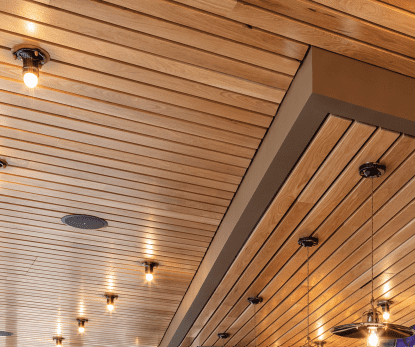
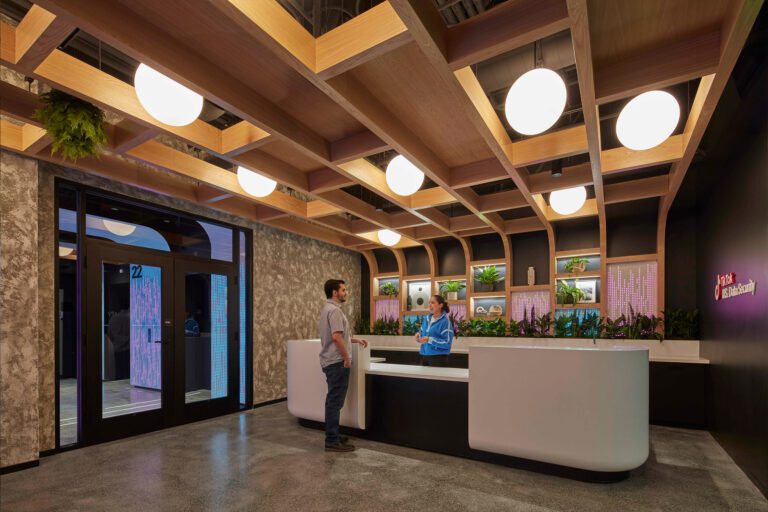
Linear slats introduce rhythm and directionality, making them effective in circulation paths and open offices. Adjustments in slat spacing can balance transparency, airflow, and visual depth. For a stronger sculptural presence, grille ceilings use aligned strips to create bold patterns that also integrate with lighting and mechanical systems. A case in point is the Trend Micro Ottawa workspace, where grille systems adapt seamlessly across different zones while maintaining design continuity.
Cubes, beams, and baffles
The cubes ceiling system adds dimension and pattern that stands out in lobbies, atriums, and other large volumes. Lightweight beams can mirror structural rhythms or act as visual frames that organize open areas. Wood baffle ceilings provide vertical rhythm while enhancing acoustic absorption, making them well suited to corridors, transit halls, and expansive assembly spaces.
Flat veneer, curved forms, and acoustical cores
Flat veneer panels establish broad, uninterrupted planes with built-in strategies for access and maintenance. Curved systems introduce movement and identity, while acoustic panels integrate absorption with finish palettes to deliver performance and visual harmony.
Coordination with designers and contractors
How teams make decisions
Different project stakeholders evaluate materials through their own priorities. Interior designers and architects rely on BIM, design software, and materials databases to guide coordination and approvals. Contractors concentrate on ease of installation, scheduling, and value engineering to keep projects efficient and cost-conscious.
Supporting each role with the right resources accelerates decision-making. Revit families or 3D blocks, clear acoustic performance data, and finish schedules tied to product specifications help designers work with accuracy. Structural requirements for suspension or direct-attach systems, along with information on backing or sound attenuation insulation for perforated and micro-grooved panels, give contractors confidence in field execution. When technical documents align with each team’s workflow, approvals and coordination move forward smoothly.
Submittals that de-risk the install
Comprehensive submittal packages build trust and reduce risk before installation begins. Strong packages typically include panel shop drawings, attachment details, load data, mockup protocols, and finish samples from production runs. Confirming fire performance requirements early ensures compliance, while coordination with sprinkler heads, return air paths, occupancy sensors, and lighting avoids conflicts in the field. In seismic zones, structural considerations should also be addressed. Ceiling coordination drawings that illustrate hanger spacing and clearances keep all trades aligned and installation predictable.
From concept to specification: a practical workflow
A structured approach helps design teams maximize the benefits of architectural wood paneling:
- Set project goals: Define sustainability, acoustic targets, and certification requirements.
- Match products to needs: Use the product portfolio to align options with performance, from Aluratone for acoustics to Curvalon for curved forms.
- Plan for efficiency: Quick-ship options like Select N’ Ship support compressed schedules.
- Coordinate details: Clarify how panels integrate with other finishes, access points, and building systems.
- Verify and document: Use mockups to confirm quality, then record as-built conditions for long-term maintenance.
Product-by-product pathways for common goals
Architectural wood paneling adapts to diverse performance and design requirements:
- Acoustics: Aluratone panels enhance speech clarity with engineered absorption.
- Wayfinding and flow: Curvalon and Curvatone introduce curvature with or without acoustic performance.
- Rhythm and direction: Linear slats and grille systems create order, guide movement, and diffuse sound.
- Dimension and scale: Cubes, beams, and baffles define space and are ideal for large-scale applications where strong visual impact is required.
- Continuity: Flat veneer panels support broad planes while maintaining system access.
- Durability: Endure Linear and Endure Direct Attach extend performance across indoor and covered outdoor spaces.
Planning your next interior with architectural wood paneling
Architectural wood paneling is shaping the future of commercial interiors with a balance of performance and design integrity. It advances sustainability, enhances acoustics, and supports efficient delivery while enriching the sensory character of spaces.
Across education, healthcare, workplaces, and cultural venues, wood creates environments that encourage clarity, calm, collaboration, and identity. Its adaptability ensures that whether the objective is efficiency, wellness, or creative expression, the result is consistently reliable and enduring.
For design teams and project leaders, architectural wood paneling stands as more than a finish. It is a material foundation that connects environmental responsibility with human experience — a defining element for interiors built to last.
Explore the project gallery to see completed installations, or contact the team to discuss your next project.