
When you walk into a space with poor acoustics, you know it immediately. Conversations echo, background noise builds to uncomfortable levels, and the simple act of communication becomes exhausting. For architects and design professionals, specifying the right acoustic solution isn’t just about technical compliance. It’s about creating environments where people can focus, collaborate, and thrive. Wood acoustic panels have emerged as one of the most effective tools in your arsenal, combining superior sound control with the organic character and tactile richness that only natural materials can deliver.
As building standards evolve and occupant expectations rise, architects who treat acoustic design as integral to their specification process—rather than an afterthought—consistently deliver stronger results. This guide examines how wood acoustic panels work, when to specify them, and how to integrate them into ceiling and wall systems for projects that demand both technical performance and architectural distinction.
Understanding How Wood Acoustic Panels Control Sound
Sound behaves predictably in built environments. When sound waves encounter hard surfaces like concrete, glass, or metal, they reflect back into the space. These reflections accumulate, creating reverberation that reduces speech intelligibility and increases ambient noise levels. In open offices, classrooms, and public spaces, this phenomenon turns productive environments into acoustically hostile ones.
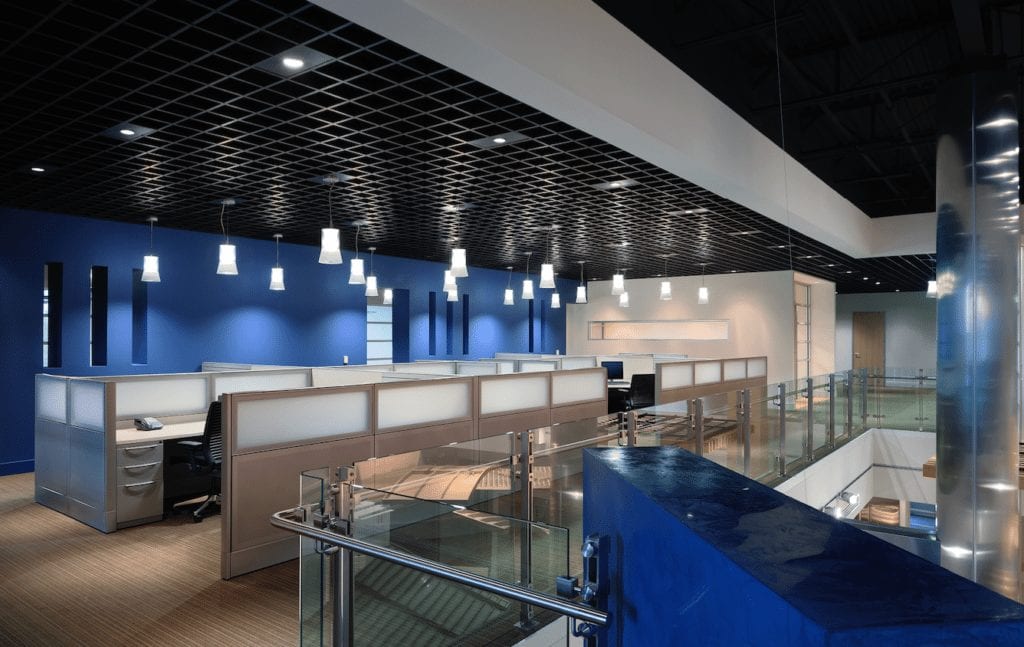
Wood acoustic panels interrupt this cycle through strategic sound absorption. Unlike solid wood planks, acoustic panels feature engineered patterns—perforations, grooves, or slots—that allow sound waves to penetrate the surface. Behind these openings, specialized backing materials trap and dissipate sound energy, preventing it from reflecting back into the room.
The effectiveness of this absorption is measured by the Noise Reduction Coefficient (NRC), a single-number rating that averages absorption performance across four critical speech frequencies: 250 Hz, 500 Hz, 1,000 Hz, and 2,000 Hz. Understanding how NRC ratings translate to real-world performance is essential when comparing acoustic solutions.
High-performance wood acoustic panels can achieve NRC ratings between 0.70 and 0.95, meaning they absorb 70% to 95% of the sound energy that strikes them. For context, painted drywall typically rates around 0.05, while standard acoustic ceiling tile might reach 0.55 to 0.70. The difference isn’t subtle. In a typical conference room, replacing reflective ceiling tile with wood panels rated at NRC 0.85 can reduce reverberation time by 40% or more. Rulon’s Aluratone line, for example, achieves NRC values up to 0.85 through precision micro-perforation—rivaling the best mineral fiber tiles while delivering the material character that commodity products can’t match.
But NRC tells only part of the story. Different panel configurations excel at different frequencies. Perforated patterns with larger holes and wider spacing tend to perform better at lower frequencies (250–500 Hz), where bass tones and mechanical rumble dominate. Micro-perforated or finely grooved panels often show superior performance at mid to high frequencies (1,000–4,000 Hz), where speech clarity matters most.
This frequency-dependent performance means specifying wood acoustic panels requires matching the panel type to your acoustic challenges. A lecture hall dealing with boomy low-frequency buildup needs different treatment than an open office struggling with conversational noise at 2,000 Hz.
The Science Behind Micro-Perforation and Backing Systems
Modern wood acoustic panels rely on precision engineering that wasn’t possible a generation ago. Micro-perforation—where thousands of tiny holes are drilled through wood veneer—represents a significant advancement. These perforations (typically 0.5mm to 2mm in diameter) are small enough to remain visually subtle from normal viewing distances, yet large enough to provide effective sound absorption.
The pattern density and hole size directly influence acoustic performance. A panel with 5% open area (the percentage of surface area occupied by perforations) will perform differently from one with 15% open area. Higher percentages generally increase absorption but may compromise the visual continuity of the wood grain. Skilled acoustic engineers balance these factors to achieve target NRC values while preserving aesthetic intent.
Equally critical is the backing system. Most high-performance acoustic panels use one of three approaches:
Acoustic fleece or mineral wool: Dense, fibrous materials placed directly behind the wood face absorb sound energy through friction as air moves through the material. These systems work across a broad frequency range and are particularly effective when installed with an air gap between the panel and the structural substrate.
Resonant cavity absorption: An air space behind the perforated face acts as a tuned absorber, particularly effective at specific frequency ranges. By varying the cavity depth, engineers can target problematic frequencies in the acoustic environment.
Composite constructions: Multi-layer systems combining different materials optimize performance across the full frequency spectrum. A typical composite might include acoustic fleece for high-frequency absorption, a rigid core for structural integrity, and a carefully tuned air gap for low-frequency control.
The mounting method influences final performance as much as the panel itself. Direct attachment to a solid substrate yields different results than suspension with a 16-inch plenum above. Testing standards account for these variations, which is why specification sheets should always note the mounting condition used during testing. The Ceiling & Interior Systems Construction Association (CISCA) publishes Wood Ceilings Technical Guidelines that offer detailed reference for architects and contractors navigating these variables.
When Wood Outperforms Alternative Acoustic Materials
Architects have numerous acoustic solutions available: fabric-wrapped panels, acoustic ceiling tile, perforated metal, polyester felt, and foam treatments all compete for project specifications. Wood acoustic panels occupy a unique position in this landscape, offering advantages that matter when projects demand both performance and presence.
Material character in high-visibility spaces. Corporate lobbies, university atriums, and civic buildings require materials that project permanence and craft. Wood delivers this at a scale and consistency that fabric panels cannot match. When 2,000 square feet of ceiling needs uniform acoustic treatment, wood grille systems or linear panels provide visual coherence while maintaining the acoustic performance you need. These same systems translate seamlessly to wall applications, creating material continuity from ceiling to wall that reinforces the spatial identity of a room.
Durability in high-traffic environments. Educational facilities and transportation hubs see constant use and occasional abuse. Wood panels with proper finish coatings resist impact damage, maintain their appearance through years of service, and can be refinished if needed. Compare this to fabric panels that stain, tear, and deteriorate in harsh environments.
Integration with lighting and building systems. Modern buildings demand complex ceiling systems that integrate electrical, lighting, and acoustic functions. Wood panels can be CNC-machined to accommodate specific light fixture locations and sprinkler heads while maintaining acoustic continuity. This flexibility proves invaluable in renovation projects where existing infrastructure dictates constraints.
Fire performance that meets code. A persistent misconception suggests wood can’t meet commercial fire codes. This is incorrect. With appropriate fire-retardant treatments, wood acoustic panels routinely achieve Class A fire ratings per ASTM E84 testing (flame spread index 0–25, smoke developed index 0–450). Current building codes recognize these treatments, making wood viable for projects with stringent fire safety requirements.
Sustainability credentials that support green building goals. FSC-certified wood, low-VOC finishes, and potential for end-of-life recycling position wood panels favorably in LEED and WELL Building projects. The embodied carbon in responsibly harvested wood compares favorably to aluminum or vinyl alternatives, particularly when transportation distances are optimized. Explore Rulon’s sustainability commitments for specifics on responsible sourcing and third-party certifications.
The material choice should always serve project priorities. For sound isolation between spaces (blocking sound transmission), wood panels aren’t the primary answer. For absorbing sound within a space to control reverberation and reduce noise buildup—on ceilings and walls alike—wood panels excel.
Applications Across Building Types
Open Office Environments
The open office presents perhaps the most challenging acoustic environment in commercial architecture. Research from the Journal of the Acoustical Society of America confirms that a lack of privacy creates 25% more acoustic dissatisfaction than general noise disturbance. Employees struggle to concentrate amid overlapping conversations, phone calls, and equipment noise.
Wood acoustic panels address these challenges through strategic ceiling and wall coverage. Optimizing office acoustics typically requires 50–60% of the ceiling area to feature absorptive treatment. This doesn’t mean the entire ceiling must be wood panels. Instead, acoustic zones can be created above workstation clusters, with standard ceiling tile or exposed structure in circulation areas.
The key metric for open offices is spatial decay rate: how quickly sound pressure level drops as distance from the source increases. In untreated spaces, conversation remains intelligible 15–20 feet from the speaker. With proper acoustic treatment—including ceiling panels rated NRC 0.75 or higher—intelligibility drops below problematic levels within 8–10 feet. This creates the acoustic privacy employees need without building floor-to-ceiling barriers.
Suspended baffle systems offer an alternative approach in spaces with high ceilings or exposed structure. Vertical wood baffles increase effective absorption area while creating visual interest and defining zones within open plans. When combined with perimeter wall treatments, baffles can achieve acoustic performance similar to full ceiling coverage while preserving the open feel that makes these spaces appealing.
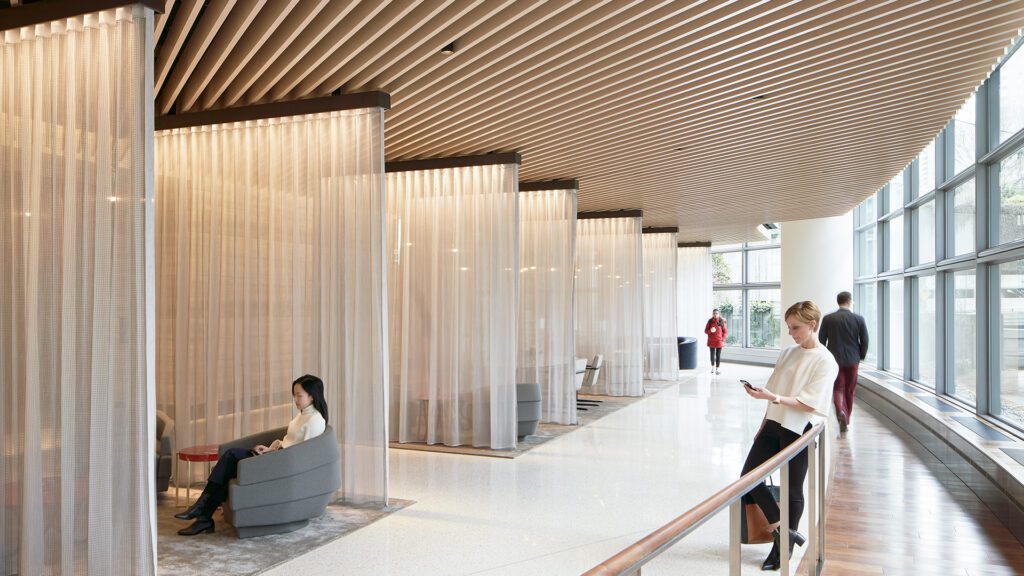
At Two Union Square in Seattle, the remodel of this 56-story office tower used Rulon’s Beam system to create a ceiling that emulates the waves of the Pacific—bringing the outdoors in while managing acoustics across the open lobby. The complexity of the curved wood configurations required close collaboration between Rulon’s engineering team, the general contractor, and the project architects.
Educational Facilities
Classroom acoustics directly impact learning outcomes. Students in poor acoustic environments struggle with speech recognition, experience higher cognitive load, and show measurably worse academic performance than peers in properly designed spaces. These effects amplify for students with hearing challenges, learning differences, or those learning in a non-native language.
Multiple studies demonstrate that classroom acoustics affect both students and teachers. In spaces with excessive reverberation (RT60 > 1.0 seconds), teachers strain their voices to be heard, leading to vocal fatigue and increased sick days. Students miss critical information, particularly in subjects requiring precise comprehension like mathematics and science.
Wood acoustic ceiling and wall panels address these issues while creating learning environments that feel grounded and inviting rather than institutional. In lecture halls seating 200+ students, curved wood ceiling systems can be engineered to provide both absorption and diffusion, ensuring even sound distribution while preventing echoes. The natural material palette helps reduce the stress response that harsh institutional environments can trigger.
At Benjamin Banneker High School in Washington, D.C., architectural firm Perkins Eastman specified Rulon’s Linear Open and Grille systems throughout multi-level communal spaces to control sound while reinforcing the sense of openness central to the school’s collaborative learning model. The wood systems add material richness to the common areas—spaces designed to encourage interaction among a diverse student body—while keeping reverberation in check across large, active gathering zones.
For music rooms, band halls, and performance spaces, acoustic requirements become more complex. These spaces need variable acoustics that support both practice (requiring higher absorption) and performance (requiring some reverberation for musical richness). Hybrid systems combining fixed wood panels with operable acoustic curtains or panels provide this flexibility.
K-12 and university projects increasingly specify wood treatments not just for acoustic performance but for their contribution to biophilic design principles. Natural materials in learning environments correlate with reduced stress, improved focus, and better attendance. When acoustic panels can serve both technical and wellness functions simultaneously, the investment becomes easier to justify. The LEED Silver-certified University of South Florida Judy Genshaft Honors College demonstrates this approach: Rulon’s Aluratone 900 and 950 panels were specified throughout the first floor for their acoustic properties, while Grille wall treatments in the atrium create a cohesive material language that supports both concentrated study and energetic collaboration within the same building.
Performance Venues and Cultural Spaces
Theaters, concert halls, museums, and multi-purpose auditoriums require acoustic precision that goes beyond simple absorption. These spaces need carefully calibrated reverberation times that vary by use. A symphony orchestra performs best with RT60 times around 1.8–2.2 seconds at mid frequencies. Amplified speech benefits from 0.8–1.2 seconds. The same hall may need to accommodate both.
Wood acoustic panels in these contexts become part of a comprehensive acoustic design that includes room geometry, seating absorption, and often sophisticated variable acoustic systems. Custom-shaped panels can provide acoustic diffusion at specific reflection points while absorbing excess energy at others.
The visual expectation in these spaces runs high. Audiences expect materials that convey craft and permanence. Wood achieves this while meeting technical requirements that synthetic alternatives struggle to match. When properly engineered, wood panels can achieve NRC values approaching 0.95 while presenting a seamless, monolithic appearance that supports architectural vision.
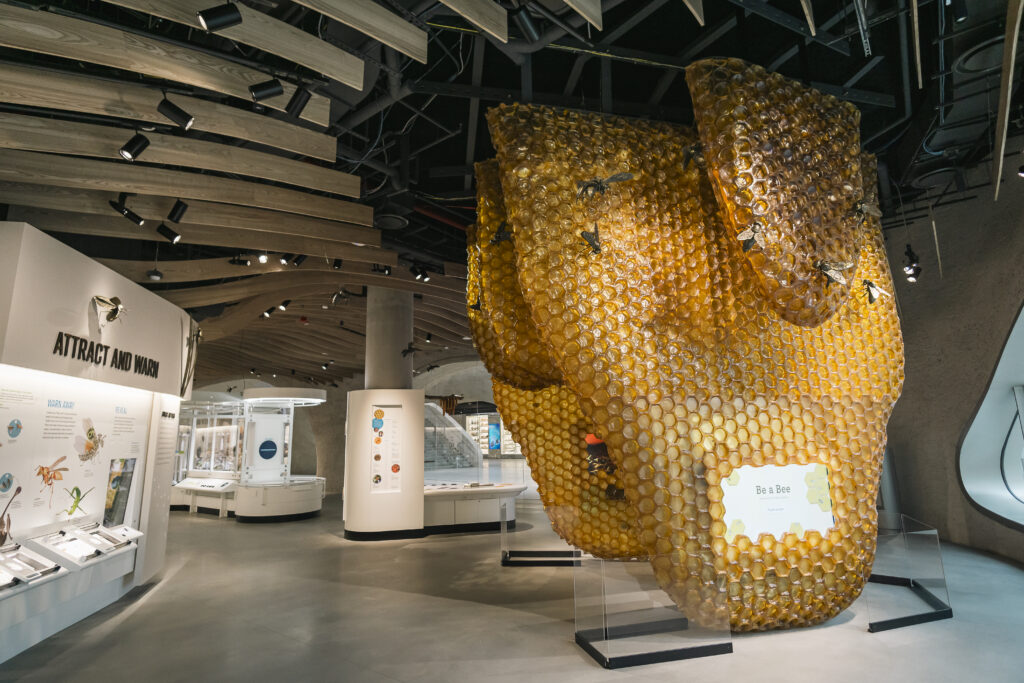
At the Richard Gilder Center for Science, Education, and Innovation at the American Museum of Natural History, Studio Gang’s design called for materials that could perform within sculpted, organic interior forms. Rulon’s Baffle system met the challenge in the Insectarium and research library spaces—blending architectural precision with the immersive, nature-inspired character of the building while managing sound across complex geometries.
Installation complexity increases in performance and cultural venues due to rigging loads, lighting positions, and acoustic tuning requirements. Close collaboration between the architect, acoustical consultant, and manufacturer becomes essential.
Healthcare and Wellness Facilities
Hospitals, medical office buildings, and wellness centers present unique acoustic challenges. Patient privacy requires speech confidentiality. Healing environments benefit from reduced ambient noise. Staff communication demands clarity in high-stress situations.
Wood acoustic ceiling and wall panels contribute to these goals while supporting the growing emphasis on biophilic design in healthcare. Research consistently shows that natural materials and connections to nature accelerate healing, reduce anxiety, and improve patient satisfaction scores. When acoustic panels can simultaneously reduce noise and provide biophilic benefits, they address multiple design objectives with a single intervention.
Installation in healthcare settings must account for cleaning protocols and infection control. Wood panels with appropriate finish coatings withstand regular cleaning with approved disinfectants. The monolithic surface of tongue-and-groove installations minimizes dust accumulation compared to lay-in tile systems with exposed grid.
Specifications should consider the acoustic needs of different healthcare zones. Waiting areas benefit from speech privacy and ambient noise reduction. Examination rooms need low background noise to support accurate diagnosis. Corridors require durability and easy maintenance alongside acoustic control. A single panel specification rarely serves all these needs equally well—but pairing ceiling treatments like Aluratone with wall-applied Flat Veneer Panels or Endure™ Direct Attach creates a layered acoustic strategy tailored to each zone.
Hospitality and Retail
Restaurants, hotels, and retail environments use acoustics to shape customer experience and support brand identity. The acoustic character of these spaces directly influences how long customers stay, how much they spend, and whether they return.
Restaurants particularly struggle with acoustic design. Untreated spaces with hard surfaces create noise that builds throughout service. Conversations become difficult. The experience becomes unpleasant. Yet excessive absorption creates an acoustically dead environment that feels sterile and unwelcoming. The target for most dining spaces sits around RT60 0.8–1.2 seconds, providing enough acoustic liveliness to feel energetic while preventing noise buildup.
Wood ceiling and wall treatments achieve this balance while reinforcing design narratives around natural materials, craftsmanship, and quality. The W Hotel Nashville illustrates what’s possible at the high end of hospitality design. For The Dutch—a 150-seat modern American restaurant by James Beard Award winner Andrew Carmellini—Rockwell Group specified Rulon’s Linear Panelized system in a chevron, board-and-batten ceiling pattern that grounds the space in Music City’s authentic character while controlling acoustics across multiple seating zones.
Retail environments use acoustics to support specific experiences. Luxury retail benefits from quieter, more intimate acoustic environments that encourage conversation and extended browsing. High-volume retail may tolerate higher ambient noise but still needs speech intelligibility at checkout and customer service areas. Custom pattern layouts and wood species selection enable differentiation that commodity acoustic products cannot provide.
Technical Specifications and Performance Standards
NRC Ratings and Real-World Performance
The Noise Reduction Coefficient provides a useful shorthand for comparing acoustic materials, but architects should understand its limitations. NRC ratings average absorption coefficients at 250 Hz, 500 Hz, 1,000 Hz, and 2,000 Hz, rounding to the nearest 0.05. This averaging obscures performance at specific frequencies that may matter for your project.
A panel with NRC 0.80 might achieve this through balanced performance across all four frequencies (0.80 at each), or through unbalanced performance (0.60 at 250 Hz, 0.75 at 500 Hz, 0.90 at 1,000 Hz, 0.95 at 2,000 Hz). For spaces with specific acoustic challenges, the full absorption coefficient data matter more than the summary NRC value.
Testing standards specify mounting conditions that may not match your installation. A panel tested in Type A mounting (directly against a hard surface) will show different performance than Type E400 mounting (simulating a 16-inch plenum). Always verify the test mounting matches your intended installation, or request test data for your specific condition.
Recent testing standard revisions address the “edge effect” that sometimes produces NRC values above 1.00. While these values are mathematically possible due to diffraction at panel edges, they don’t indicate absorption exceeding 100%. For practical specification purposes, any NRC above 0.95 represents excellent performance.
Fire Performance and Code Compliance
Commercial projects require materials that meet fire safety codes. Wood acoustic panels achieve this through factory-applied fire-retardant treatments that become integral to the wood structure. These treatments allow wood to achieve Class A fire ratings per ASTM E84, meeting International Building Code requirements for interior finishes.
Class A rating requires a flame spread index of 0–25 and a smoke developed index of 0–450. With proper treatment, wood panels consistently meet these thresholds. The treatment penetrates the wood structure and remains effective throughout the panel’s service life.
For projects requiring additional fire resistance, panels can be installed as part of rated ceiling assemblies. When combined with appropriate substrate and attachment methods, these assemblies can contribute to one-hour or two-hour fire-resistance ratings for the overall construction.
Specifications should always verify fire performance documentation. Manufacturers should provide copies of actual test reports from accredited laboratories, not just claimed ratings. These reports specify the exact panel construction, finish coating, and treatment used during testing. CISCA’s technical publications provide additional guidance on fire testing standards and code compliance across occupancy types.
Sustainability, LEED v5, and the Business Case for Certification
Green building programs increasingly require verified sustainability performance. But for building owners in 2026, the question isn’t just how to earn credits—it’s why the investment in certification delivers short-term, tangible returns.
The Business Case. Projects that invest in LEED certification see measurable financial returns. According to data cited by USGBC, certified buildings command higher asset values, increased occupancy rates, and premium rents compared to non-certified equivalents. Tenants increasingly seek certified spaces to satisfy their own ESG commitments, creating competitive advantage in leasing. As Felipe Flores, administrator of the LEED v5 Platinum-certified Torre Diana in Mexico City, noted, certification generates trust among visitors, users, and industry leaders—and tenants develop stronger belonging that translates into more stable, lasting relationships. For building owners weighing upfront costs, LEED certification is an asset strategy, not just an expense—and ceiling and wall material selections are among the most straightforward credit pathways.
With LEED v5 now open for project certification and new tools available through the Arc platform, wood acoustic panels can contribute to multiple credit categories:
Materials and Resources: FSC-certified wood provides verified responsible sourcing. The Forest Stewardship Council certification is recognized under LEED for forest product sourcing. FSC Chain-of-Custody documentation verifies that materials originate from responsibly managed forests. LEED v5’s increased focus on embodied carbon makes renewable materials like wood increasingly valuable—the biogenic carbon stored in wood represents a tangible environmental benefit compared to carbon-intensive alternatives.
Indoor Environmental Quality: Low-VOC finishes and adhesives minimize emissions that affect indoor air quality. Third-party testing and certification through programs like GREENGUARD and Indoor Advantage Gold demonstrate compliance with emission limits. The natural composition of wood and mineral wool backing materials avoids the off-gassing concerns associated with some synthetic acoustic products.
Innovation: Biophilic design strategies using natural materials can qualify for innovation credits when supported by appropriate documentation and design narrative.
The WELL Building Standard recognizes acoustic comfort as essential to occupant wellness. Wood acoustic panels support WELL Feature Sound 01 (Sound Mapping) and Feature Sound 02 (Maximum Noise Levels) through their contribution to ambient noise reduction and reverberation control.
Documentation requirements vary by certification program but generally include FSC Chain-of-Custody certificates, VOC emission test reports, Health Product Declarations (HPD), Environmental Product Declarations (EPD), and manufacturer sustainability statements. Requesting this documentation during specification rather than during construction avoids delays and ensures credit compliance.
Design Integration Strategies
Pattern Selection and Visual Scale
Wood acoustic panels succeed or fail based on pattern selection relative to viewing distance and architectural scale. Micro-perforated patterns work well in spaces with normal ceiling heights (9–12 feet) where the subtle perforation pattern reads as texture rather than obvious holes. In spaces with 20+ foot ceilings, these same patterns may appear flat and lack visual interest.
Larger perforation patterns or slotted configurations provide visual texture at greater distances. The trade-off involves acoustic performance at specific frequencies and the ability to conceal the backing material. Wider slots may require careful coordination of backing color to prevent visual contrast that draws attention to the mechanical function.
Pattern options range from barely perceptible micro-perforations to bold linear slots that become primary design features. Selection should consider viewing distance and ceiling height, lighting design and how it will interact with the pattern, coordination with lighting fixtures and sprinkler heads, acoustic performance requirements across frequency ranges, and budget implications of complex custom patterns.
Wood species selection amplifies or moderates pattern visibility. Light woods like maple or birch minimize pattern contrast, allowing the overall surface to read as continuous. Darker woods like walnut emphasize pattern through shadow, creating stronger visual texture. Browse Rulon’s project gallery to see how different species, patterns, and scales interact in completed installations.
Integration with Lighting and Building Systems
Modern ceiling systems accommodate electrical, lighting, and fire protection infrastructure while maintaining acoustic performance and visual continuity. Wood acoustic panels offer advantages here through precise CNC fabrication capabilities.
Light fixtures can be factory-integrated into panel assemblies, with cut-outs dimensioned to accept specific fixture types. This eliminates field coordination issues and ensures clean integration. For linear LED systems, wood panels can be fabricated with continuous slots that house lighting while maintaining acoustic function through the remaining panel area.
Sprinkler heads present a common challenge. Fire protection codes specify maximum spacing and coverage requirements that may not align with panel module sizes. Solutions include custom panel layouts that position sprinkler heads at panel joints, factory-fabricated penetrations with escutcheons that coordinate with the wood finish, flush-mount sprinkler heads that minimize visual impact, and semi-recessed sprinklers that balance code compliance with aesthetics.
Access for maintenance drives many installation decisions. Spaces with significant infrastructure above the ceiling benefit from demountable panel systems. Mechanical clips or torsion spring systems allow individual panel removal without disturbing adjacent panels. This access proves essential in spaces where equipment requires regular service or where building systems continue to evolve after initial construction.
Color, Finish, and Wall-to-Ceiling Coordination
Wood species selection influences far more than appearance. Different species exhibit different acoustic properties due to density variations. Dense hardwoods like maple and oak provide excellent dimensional stability and durability. Lighter woods like Douglas fir or pine may require additional structural backing but can reduce weight for ceiling applications.
Stain and finish options allow customization to match design intent or coordinate with existing materials. Options range from clear finishes that preserve natural wood color to opaque stains that dramatically alter appearance. Custom color matching enables integration with brand standards or coordination with adjacent materials.
One increasingly common strategy is extending the same wood system from ceiling to wall, creating an uninterrupted material surface that wraps the room. This approach amplifies acoustic coverage—treating two surfaces rather than one—while creating architectural cohesion. Systems like Rulon’s Endure™ Direct Attach are specifically designed for wall applications with streamlined attachment.
Finish selection affects maintenance as well as appearance. High-traffic environments benefit from harder finishes that resist wear and simplify cleaning. Spaces with specific cleaning protocols (healthcare facilities, food service) require finishes that withstand approved cleaning agents without degradation.
Sample approval becomes critical for wood products due to natural variation in grain, color, and figure. Digital renderings cannot fully capture how wood will appear in the finished installation. Physical samples under project lighting conditions prevent surprises during installation.
Installation Considerations and Best Practices
Attachment Methods and Structural Considerations
Wood acoustic panels require secure attachment to structural systems capable of supporting their weight. While panels themselves are relatively lightweight (typically 3–5 pounds per square foot), the cumulative load across large ceiling areas demands proper structural design.
Common attachment methods include:
Direct attach to substrate: Panels fasten directly to gypsum board, plywood, or concrete using mechanical fasteners. This method provides the simplest installation but limits future access and may reduce acoustic performance compared to installations with air gaps. Rulon’s Endure™ Direct Attach system is specifically engineered for this approach on walls and ceilings.
Suspended systems using grid: Panels attach to a conventional suspended ceiling grid using proprietary clips. This allows integration with standard ceiling tile in surrounding areas and provides access to plenum space by removing individual panels.
Batten and clip systems: Wood battens attach to the structure, with panels clipping to the battens. This method accommodates moderate structural irregularities and provides a concealed fastening system.
Torsion spring and saddle clip: Individual panels attach via spring mechanisms to the suspended grid, allowing easy removal for maintenance access while maintaining precise alignment.
Structural coordination begins during design development. The structural engineer needs panel weight, spacing, and attachment point locations to properly size supports. Coordination drawings showing exact panel layouts relative to the structure prevent conflicts during construction.
Sequencing with Other Trades
Successful installations require careful coordination with related trades. The typical sequence that produces the best results: complete structural rough-in and any above-ceiling work, install electrical, plumbing, and fire protection infrastructure, install suspension system or attachment framework for panels, complete any remaining work requiring ceiling access, then install panels starting from the control points established during layout.
Changes to the installation sequence often create problems. Installing panels before completing other ceiling work risks damage during subsequent trades’ access. Delaying panel installation until the end of construction compresses the schedule and may compromise installation quality.
Layout and control points require establishment before installation begins. Wood panels cannot accommodate significant field modification without a visible impact. Starting from the wrong control point can result in narrow slivers at perimeters or misalignment with architectural features.
Quality Control and Inspection
Wood products require different QC approaches than commodity ceiling materials. Natural variation in grain and color makes absolute uniformity impossible. Instead, quality control focuses on consistent finishing and color matching within acceptable ranges, precision in dimensional tolerances (typically ±1/16 inch), pattern alignment and continuity across panel joints, secure attachment without visible damage or deformation, and coordination with integrated components (lights, sprinklers).
Pre-installation meetings establish expectations and review mock-up requirements. For projects with extensive wood ceiling and wall areas, installing a mock-up section allows review of appearance, joint details, and coordination with adjacent materials before proceeding with field installation.
Inspection should occur at multiple stages: material delivery (verify quantity, damage, finish quality), installation in progress (verify attachment, alignment, coordination), and final completion (comprehensive review of entire installation).
Lead Times, Cost Considerations, and Value Engineering
Timelines: Standard vs. Custom
Lead times for wood acoustic panels vary significantly based on project scope. Standard panel configurations with common wood species and perforation patterns typically ship in 6 to 10 weeks. Fully custom systems—involving specialty species, unique CNC patterns, curved geometries, or complex integration—may require 10 to 14 weeks or more for engineering, shop drawings, and fabrication.
For projects on tight timelines that still want the character of architectural wood, Rulon’s Select-N-Ship program offers pre-configured ceiling and wall systems with accelerated lead times, bridging the gap between stock commodity tile and full custom fabrication.
Cost and Value
Wood acoustic panels typically command higher first costs than commodity acoustic solutions. Initial material and installation costs may run 2–4 times the cost of conventional acoustic ceiling tile. This cost premium requires justification through a combination of performance advantages and lifecycle value.
Performance justification focuses on superior acoustic absorption (NRC 0.75–0.95 vs. 0.55–0.70 for acoustic tile), durability in high-use environments, fire performance matching Class A tile, and flexibility in accommodating building system integration.
Lifecycle value derives from extended service life (30+ years vs. 15–20 years for tile), minimal maintenance requirements, resistance to damage and degradation, potential for refinishing rather than replacement, and contribution to green building certification and associated financial benefits (higher rents, faster leasing, increased asset value).
Value engineering discussions often target acoustic treatments for reduction. Effective responses focus on documented performance requirements and the consequences of inadequate acoustic treatment. Studies on workplace acoustics show that a majority of employees struggle with noise, directly impacting productivity and satisfaction. The cost of acoustic treatment becomes modest compared to ongoing productivity losses.
Strategic specification can reduce costs while maintaining performance: reserve the highest-performing panels for critical areas (open office work zones, classrooms), use standard ceiling tile in less critical spaces (corridors, storage areas), specify standard panel sizes and patterns rather than extensive customization, coordinate panel module sizing with structural bay dimensions to minimize waste, and evaluate suspended baffle systems as alternatives to full ceiling coverage.
Maintenance and Lifecycle Performance
Wood acoustic panels properly specified and installed provide decades of service with minimal maintenance. Unlike fabric-wrapped panels that accumulate dust and stains, or acoustic tile that sags and discolors, wood maintains its appearance through normal commercial use.
Routine maintenance involves dusting or light vacuuming to remove accumulated dust. Most installations require this quarterly in normal commercial environments, monthly in high-dust environments. The smooth surface of wood panels resists dust accumulation better than fibrous materials.
Damage repair depends on the finish system and damage extent. Minor scratches or mars in clear-finished panels can often be touched up with matching finish. Deeper damage may require panel replacement. The modular nature of most installations allows replacement of individual damaged panels without disturbing surrounding areas.
Refinishing becomes possible with solid wood veneer panels in situations where appearance standards change or long-term wear accumulates. This option provides sustainability benefits by extending useful life rather than requiring replacement.
Long-term acoustic performance remains stable with wood panels. Unlike foam materials that may deteriorate or compress over time, reducing their effectiveness, properly manufactured wood panels with mineral wool or fiberglass backing maintain their acoustic properties indefinitely.
Working with Rulon and Acoustical Consultants
Complex acoustic projects benefit from early manufacturer involvement. Rulon International provides preliminary acoustic modeling to verify that panel coverage and NRC values will achieve the target RT60, coordination drawings showing panel layout relative to structure and lighting, sample provision for review and approval, technical support during specification and construction, and installation training or direct installation services for critical projects.
This support proves most valuable during design development and early construction documents phases, when decisions about acoustic approach and panel specification most influence project outcomes. With a product range spanning Linear, Grilles, Baffles, Aluratone, Curvatone, Curvalon, Flat Veneer Panels, Beams, Cubes, and the Endure™ engineered polymer line, Rulon offers solutions across virtually every ceiling and wall acoustic challenge.
Independent acoustical consultants provide additional expertise for projects with critical acoustic requirements—performance halls, recording studios, and specialized educational facilities. These professionals establish quantitative acoustic criteria appropriate to the use, model acoustic performance using room acoustics software, specify treatment types, locations, and quantities to achieve targets, review submittals for compliance with acoustic criteria, and verify installed performance through post-occupancy testing.
The consultant’s involvement costs money but provides insurance against acoustic failure in spaces where performance directly affects building function. For standard commercial applications (typical offices, classrooms, restaurants), Rulon’s in-house technical support often proves sufficient without independent consulting.
Emerging Trends and Future Directions
The acoustic panel industry continues to evolve in response to changing building standards and design priorities. Several trends are reshaping how architects approach acoustic specification:
Biophilic design integration. Natural materials in buildings correlate with measurable improvements in occupant wellness, productivity, and satisfaction. Wood acoustic ceiling and wall panels serve both technical (acoustic performance) and wellness (biophilic benefits) functions simultaneously. This dual value proposition strengthens their position in projects pursuing WELL Building certification or similar wellness-focused programs.
Embodied carbon and sustainability accounting. The building industry’s focus on embodied carbon favors materials like wood that sequester carbon during growth. Sustainably sourced wood panels with verified chain-of-custody documentation support project sustainability goals while providing the required acoustic performance. LEED v5’s three core impact pillars—decarbonization, quality of life, and ecological conservation—align directly with the strengths of responsibly sourced wood systems.
Digital fabrication and customization. CNC machining capabilities enable increasingly complex custom patterns and geometries. Architects can specify one-of-a-kind designs for signature spaces while maintaining the dimensional precision necessary for clean installation. This customization extends to perforation patterns optimized for specific frequency ranges, creating panels tuned to project-specific acoustic challenges.
Performance verification. Building certification programs increasingly require documented performance verification. This trend favors materials like wood panels with predictable, testable acoustic properties over solutions that rely on subjective assessment.
Moving Forward with Confidence
Specifying wood acoustic panels requires balancing multiple factors: acoustic performance, visual design, sustainability, budget, and building code compliance. Success comes from approaching acoustic design as an integral part of your architectural vision rather than a technical requirement to be satisfied with minimum compliance.
The acoustic environment you create influences how people experience your buildings every day. In offices, proper acoustics reduce stress and support productivity. In schools, good acoustics enable learning. In performance venues, acoustics can elevate or undermine artistic expression. In healthcare settings, sound control supports healing and protects privacy. Wood acoustic panels provide a proven tool for creating these environments while supporting the broader design narratives that define contemporary architecture.
Begin acoustic planning early in design development. Establish quantitative acoustic targets appropriate to building use. Model expected performance using absorption coefficients and reverberation time calculations. Coordinate panel layouts with structure and lighting. Review physical samples under project lighting. Specify appropriate quality control during installation.
When wood acoustic panels become integral to your design approach rather than applied corrections, you create buildings that perform as precisely as they were envisioned. The investment in proper acoustic specification returns dividends every day throughout the building’s life, in the form of spaces where people can hear clearly, communicate effectively, and work or learn without the exhausting background noise that diminishes so many contemporary environments. Ready to start your next project? Schedule a discovery call or reach Rulon International directly at (904) 584-1400.