Most passengers could not tell you what makes one terminal feel calm and another feel chaotic. They experience the difference — the ease of hearing a gate announcement, the absence of the exhausting ambient roar that makes a two-hour layover feel like four — but they attribute it to something vague: the layout, the lighting, the crowds. Rarely do they name the ceiling.
Architects and facility planners know differently. The acoustic environment in a transportation hub is largely a product of the ceiling specification. And wood acoustic ceiling design is one of the most effective interventions available to design teams working to close the gap between how a terminal looks and how it actually feels to move through.
The Acoustic Problem Passengers Feel But Cannot Name
The specific acoustic failures that define a poorly designed terminal are identifiable and, importantly, addressable:
- Reverberation: When sound energy persists in a space long after its source has stopped, every subsequent sound layers on top of the previous one. In a terminal with a reverberation time above 3.5 seconds, a gate announcement does not finish — it blurs into the ambient noise before it resolves, and passengers miss the information.
- Flutter echo: Parallel hard surfaces cause sound to bounce back and forth repeatedly with little energy loss. The result is a rapid, repeating echo that makes a space feel unstable and difficult to concentrate in.
- Ambient noise amplification: In an untreated terminal, every person added to the space raises the noise floor. The crowd noise compounds itself, and the PA system has to compete with an increasingly loud baseline. Passengers raise their voices. The environment becomes louder still.
- Acoustic fatigue: Sustained exposure to elevated, unpredictable noise environments elevates cortisol, reduces concentration, and degrades the experience of time spent in the terminal. Passengers do not identify this as an acoustic problem. They identify it as a bad terminal.
What the Data Shows
The acoustic standards that govern public assembly spaces provide a useful framework for understanding the gap between acceptable and excellent terminal design. Speech Transmission Index (STI) values in the 0.30 to 0.45 range are rated ‘poor’ by IEC 60268-16 standards — meaning PA announcements in those environments are statistically likely to be misunderstood. Many untreated terminals fall in this range.
The target for transportation environments, where PA clarity is a safety requirement, not just a passenger comfort consideration, is an STI of 0.60 or higher. Achieving that target in a large-volume terminal almost always requires ceiling treatment. The ceiling is where the acoustic intervention is both physically feasible and acoustically most impactful.
For a broader overview of how wood acoustic panels perform across building types, Rulon’s wood acoustic panels guide covers NRC performance, panel configurations, and specification considerations in depth.
Why the Ceiling Is the Primary Acoustic Lever
In a terminal environment, the ceiling is the largest available surface for acoustic treatment. The walls are typically glass or structural concrete – acoustically reflective by design and often by code. The floors are hard-surface for durability and cleanability. The ceiling is where the design team has the most latitude to introduce acoustic absorption, and where that absorption has the greatest effect on the reverberation environment.
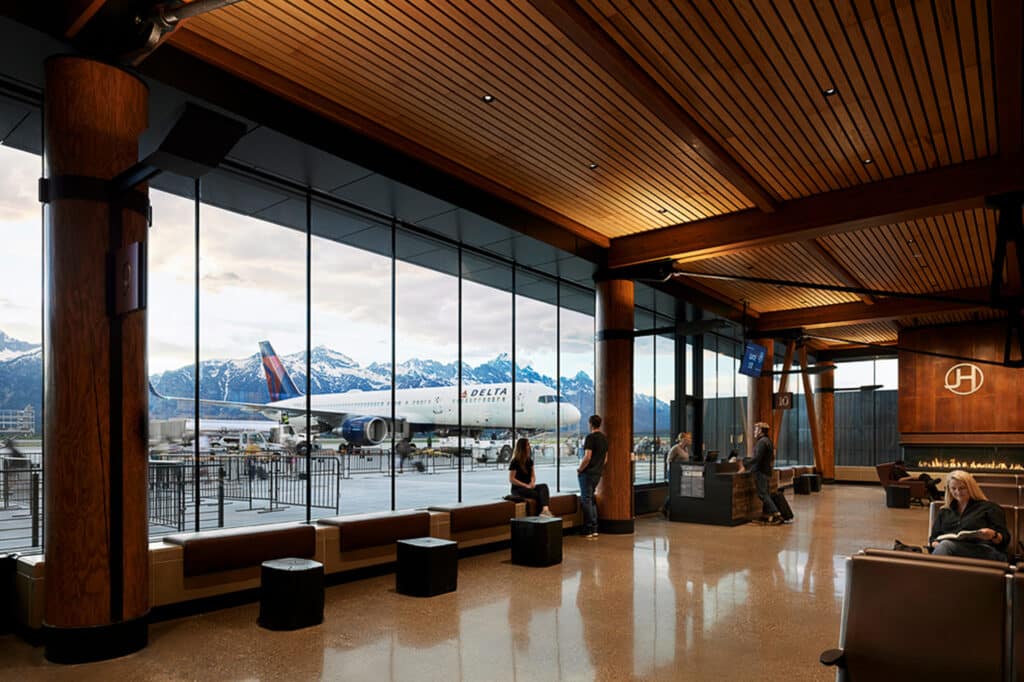
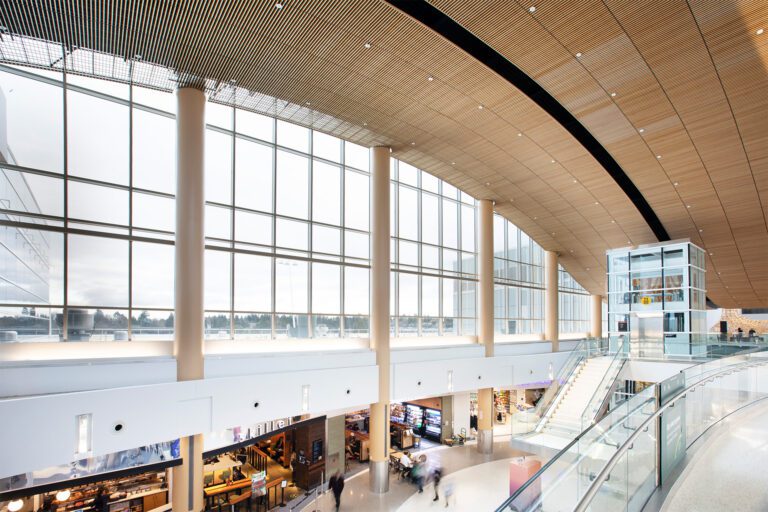
Wood ceiling systems — perforated and grooved panel configurations, suspended baffle arrays, linear slat systems with open spacing — introduce sound absorption into the ceiling plane without requiring the material to look like acoustic treatment. This matters in transportation architecture, where the visual quality of the space is a significant project goal and materials that read as functional rather than designed undermine that goal.
The ceiling also defines the character of the space more than any other single surface. In a terminal, it is what passengers look up at while waiting, what shapes the sense of volume and scale, what makes the space feel like a destination rather than a processing facility. A well-specified wood acoustic ceiling does acoustic work and design work simultaneously, which is why it has become a standard specification in landmark transportation projects.
For a full breakdown of specification criteria and product applications by terminal zone, see our acoustic specification guide for airport terminals.
Design Approaches That Improve Passenger Experience
Acoustic ceiling design for passenger environments is most effective when it is treated as a zone-specific decision rather than a uniform ceiling specification:
- Departure halls and ticketing areas benefit from the highest acoustic performance. Suspended ceiling systems with NRC ratings of 0.70 or above meaningfully reduce reverberation in these large-volume, PA-critical zones.
- Gate lounges are where dwell time concentrates. Acoustic treatment in gate lounge ceilings has an outsized effect on passenger experience because passengers spend the most time there. Even modest NRC improvement in a gate lounge is felt acutely by the people waiting in it.
- Connector corridors and people movers have different acoustic conditions, including lower ceilings, directional sound propagation, and high transit noise from mechanical systems. Suspended wood baffles are often the most effective treatment in these environments.
- Material health matters in enclosed, high-occupancy environments. Wood ceiling systems certified to Indoor Advantage Gold test for 35 individual VOCs in accordance with California Section 01350, confirming low chemical emissions in spaces where thousands of people spend hours each day. It is a specification credential increasingly requested in transportation projects with sustainability mandates.
The terminals that passengers remember – that feel intentional, calm, and worth returning to – are not the ones with the most dramatic architecture. They are the ones where the architecture and the acoustic environment work together. The ceiling is where that work happens.
Rulon International manufactures wood ceiling and wall panel systems specified in airports, transit hubs, and transportation infrastructure worldwide. Products include Aluratone perforated and grooved panels, Linear wood slat systems, suspended Baffles, and Curvalon custom curved panels – all available with ASTM E84 Class A fire rating, FSC Chain of Custody certification, and Indoor Advantage Gold IAQ certification.