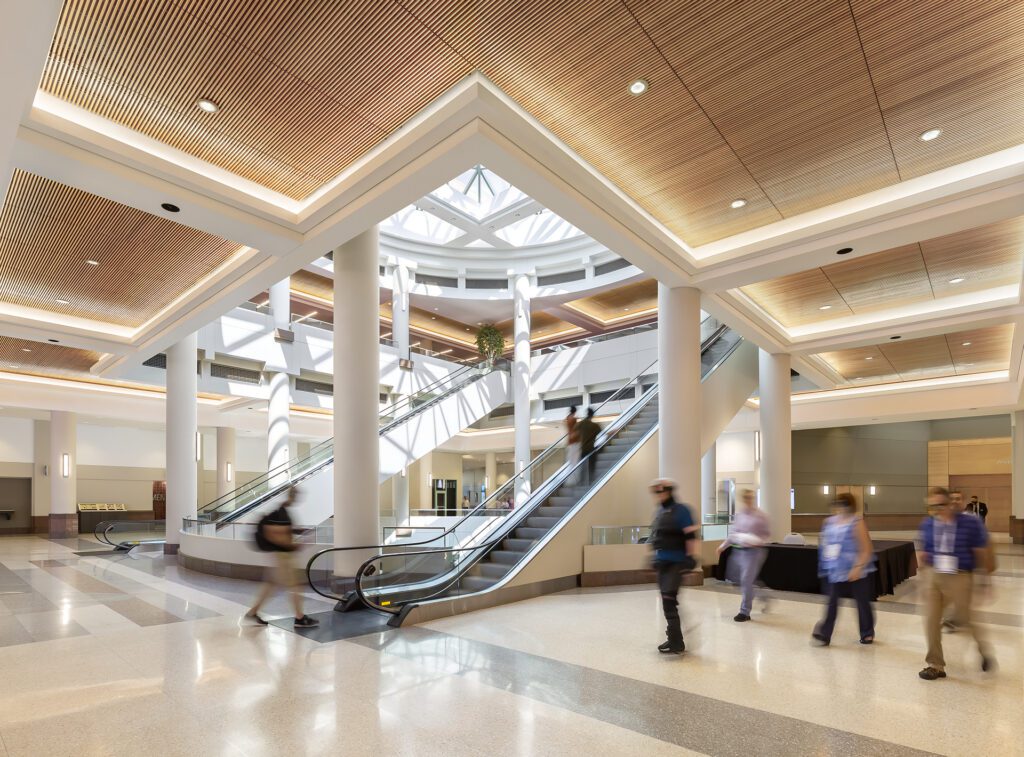
Every acoustic ceiling specification sheet displays an NRC rating prominently. This single number—typically ranging from 0.50 to 0.95—influences product comparisons and acoustic design decisions disproportionately. Yet many architects treat NRC as a simple “higher is better” metric without understanding what it actually measures, how testing conditions influence results, or when other acoustic metrics matter more for their specific project.
The Noise Reduction Coefficient exists to simplify acoustic material comparison, averaging sound absorption performance across four speech-critical frequencies into one number between 0 and 1. A ceiling tile with an NRC rating of 0.70 theoretically absorbs 70% of the sound energy striking it, while a painted concrete ceiling at NRC 0.05 absorbs only 5%. Understanding how NRC ratings are derived helps architects interpret published data and make informed specification decisions. This apparent simplicity conceals nuances that affect specification decisions and project outcomes.
How NRC Ratings Are Actually Measured
The noise reduction coefficient comes from standardized laboratory testing specified in ASTM C423. This test method uses a reverberation chamber, a specially designed room with hard, reflective surfaces that create near-perfect sound reflection. Acoustic engineers measure how long sound takes to decay by 60 decibels in the empty chamber, then repeat the measurement with the test material installed. The difference reveals how much sound energy the material absorbed.
Testing occurs across multiple frequencies, typically in one-third octave bands from 100 Hz to 5,000 Hz. Each frequency provides an absorption coefficient ranging from 0.00 (no absorption) to 1.00 (complete absorption). The NRC calculation takes the arithmetic average of coefficients at 250 Hz, 500 Hz, 1,000 Hz, and 2,000 Hz, then rounds to the nearest 0.05. Rulon’s Aluratone line achieves NRC values up to 0.85 through precision micro-perforation patterns optimized for these speech frequencies.
This rounding means materials with slightly different actual performance receive identical NRC ratings. A product measuring 0.727 rounds to 0.75, as does a product measuring 0.748. For most applications this precision proves adequate, but projects with critical acoustic requirements should examine the full frequency data rather than relying solely on the summary NRC value.
The test sample size matters more than most specifiers realize. ASTM C423 requires specific minimum sample sizes (typically 72 square feet) to minimize edge effects and provide statistically valid results. Smaller test samples can produce artificially high results because sound diffracts around the sample edges, making the material appear more absorptive than it will perform in a full installation.
What NRC Ratings Tell You (and What They Don’t)
NRC provides useful information for general-purpose spaces where speech intelligibility drives acoustic requirements: open offices, classrooms, meeting rooms, and reception areas. These environments primarily struggle with conversational noise in the 250-2,000 Hz range that the NRC rating specifically addresses. For these applications, comparing products by NRC gives you meaningful information about relative performance.
However, NRC has limitations that become problematic in certain situations. The averaging process conceals frequency-specific performance that may matter for your project. Consider two hypothetical ceiling products, both rating NRC 0.75:
Product A: 0.75 at 250 Hz, 0.75 at 500 Hz, 0.75 at 1,000 Hz, 0.75 at 2,000 Hz
Product B: 0.50 at 250 Hz, 0.70 at 500 Hz, 0.85 at 1,000 Hz, 0.95 at 2,000 Hz
Both products deliver the same NRC, but Product A provides balanced absorption across frequencies while Product B excels at higher frequencies but underperforms at lower frequencies. For a space troubled by traffic noise (low-frequency problems), Product A performs better despite the identical NRC rating. For architects specifying open office environments where speech privacy drives acoustic requirements, understanding how NRC translates to spatial decay rates and conversational intelligibility proves essential.
The NRC doesn’t account for absorption at frequencies below 250 Hz or above 2,000 Hz. Low-frequency absorption matters in spaces with mechanical equipment noise, music performance, or large volumes where bass frequencies build up. High-frequency absorption affects the character of speech and can influence perceived comfort. Projects with specific needs in these frequency ranges require examination of the full absorption coefficient data.
NRC testing specifies particular mounting conditions that may not match your installation. The most common mounting types include Type A mounting (directly against a hard substrate) and Type E400 mounting (simulating a 16-inch plenum above the material). The air space in Type E400 mounting improves low-frequency absorption, boosting the overall NRC. A product tested in Type E400 won’t perform identically when installed in Type A mounting.
Specification sheets should always note the test mounting condition. When comparing products, verify that they were tested using the same mounting. If your installation differs from the test mounting, request data for your specific condition.
How Different NRC Values Translate to Perceived Performance
Selecting appropriate NRC ratings requires matching performance levels to specific acoustic challenges and occupancy types. Understanding what different NRC values mean in practice helps set appropriate expectations and specification targets.
NRC 0.00-0.20: Highly reflective materials like concrete, painted drywall, glass, and ceramic tile. These materials reflect nearly all sound back into the space, contributing to reverberation and noise buildup.
NRC 0.25-0.45: Moderately absorptive materials including some carpet, fabric-wrapped panels with thin insulation, and certain wood products without acoustic backing. These materials provide minor acoustic improvement but typically prove insufficient as primary acoustic treatment.
NRC 0.50-0.70: Good absorptive performance found in standard acoustic ceiling tile, carpet with padding, and some fabric-wrapped panels. These materials handle typical office and commercial applications adequately when installed in sufficient quantity.
NRC 0.75-0.95: Excellent absorptive performance from specialized acoustic products including high-performance ceiling tile and engineered wood acoustic panels with optimized backing systems. High-performance wood systems like Rulon’s Linear and perforated panel products rating NRC 0.75-0.95 deliver superior absorption per square foot of coverage.
At Benjamin Banneker High School, the design team specified wood acoustic systems exceeding NRC 0.80 to meet ANSI S12.60 reverberation requirements across multi-level communal learning spaces.
For most commercial spaces, targeting NRC 0.70-0.85 for primary acoustic treatments delivers measurable improvement without overtreatment. Commercial spaces managing speech intelligibility typically require primary acoustic treatments rating NRC 0.70-0.85, with specific targets determined by room volume, occupancy density, and existing surface materials.
Mounting Methods and Their Impact on Performance
The way acoustic materials attach to building structure significantly influences their performance, yet the mounting method receives less attention than it deserves during specification. Understanding these effects prevents surprises when installed performance differs from data sheet values.
Direct attachment involves mechanically fastening material directly to a solid substrate (concrete deck, gypsum board ceiling, plywood). This mounting method provides the simplest installation but generally produces the lowest acoustic performance. Sound waves must be absorbed in a single pass through the material with no air cavity to enhance low-frequency absorption.
Suspended with air gap creates space between the acoustic material and the structural deck above. This air cavity acts as an additional absorption mechanism, particularly at lower frequencies. A 16-inch plenum (common in suspended ceiling systems) provides better low-frequency performance than direct mounting.
The acoustic benefit of air gaps explains why ceiling tile tested in Type E400 mounting (16-inch plenum) typically shows higher NRC values than the same tile in Type A mounting (direct). If your project uses a suspended ceiling with a deep plenum, products tested in Type E400 provide realistic performance data.
Rulon’s technical team can provide mounting-specific performance data matching your installation conditions. Contact Rulon at 904-584-1400 for project-specific guidance.
Using NRC Data to Calculate Required Coverage
Once you understand NRC values, you can estimate how much acoustic treatment your project needs. This calculation provides schematic-level assessment capability before detailed acoustic modeling.
The reverberation time (RT60) of a space depends on room volume, total surface area, and total absorption. The Sabine equation relates these factors:
RT60 = 0.049 × (Volume / Total Absorption)
Total absorption equals the sum of (Surface Area × Absorption Coefficient) for every surface in the room. Adding acoustic treatment increases total absorption, reducing reverberation time.
For example, consider a typical conference room 20 feet × 30 feet × 10 feet high (6,000 cubic feet). Without treatment, this room might have RT60 around 1.2 seconds, making speech intelligibility difficult. Adding 400 square feet of ceiling treatment rated NRC 0.80 adds 320 sabins of absorption (400 sq ft × 0.80), potentially reducing RT60 to 0.7-0.9 seconds depending on other room surfaces.
This simplified calculation provides schematic-level assessment but doesn’t account for room shape effects, focusing zones, or spatial distribution of absorption. L-shaped rooms, spaces with high ceilings, or areas with specific acoustic problem zones benefit from more sophisticated modeling or consulting input.
Beyond NRC: When Other Metrics Matter More
Several acoustic metrics complement or supersede NRC for specific applications:
Sound Absorption Average (SAA) averages absorption coefficients at twelve one-third octave bands from 200 Hz to 2,500 Hz, providing a more detailed picture of mid-frequency performance than NRC.
Articulation Class (AC) specifically measures how well a ceiling surface supports speech privacy and limits sound transmission between spaces. High AC values (typically 180+) indicate good speech privacy. Spaces prioritizing speech privacy should evaluate AC alongside NRC. Open office installations at Two Union Square in Seattle demonstrate how high-NRC ceiling treatments improve speech privacy in densely occupied workspaces. See case studies.
Ceiling Attenuation Class (CAC) measures how well a ceiling system blocks sound transmission between adjacent rooms when those rooms share a common plenum. Materials can show high NRC (good absorption within a space) but low CAC (poor blocking between spaces).
For educational facilities following ANSI S12.60 standards, reverberation time targets and background noise limits take precedence over simple NRC specifications. The standard specifies maximum RT60 values (0.6-0.7 seconds, depending on room volume) that must be verified through calculation or measurement. Rulon’s colleges and universities projects demonstrate compliant installations across learning environments.
Performance venues (concert halls, theaters, recording studios) require detailed absorption coefficient data across the full frequency spectrum, not summary ratings. The acoustic consultant specifies treatments based on frequency-specific needs that simple NRC values cannot adequately represent.
NRC Performance and Green Building Certification
Acoustic performance contributes to green building certification through multiple pathways. LEED v5’s Indoor Environmental Quality credits recognize acoustic comfort as essential to occupant wellness, with NRC-rated ceiling treatments supporting reverberation control requirements.
For building owners, LEED certification delivers measurable returns—certified buildings command higher asset values and rental premiums. Acoustic treatments meeting performance standards while providing material transparency documentation (EPDs, HPDs) serve dual functions: code compliance and certification contribution.
The U.S. Green Building Council’s LEED v5 framework recognizes acoustic design as fundamental to quality commercial environments. Wood acoustic panels with FSC certification and low-VOC finishes support multiple credit categories while delivering NRC performance. Rulon’s sustainability commitments detail certifications supporting certification goals.
Specification Language and Quality Assurance
Effective specifications for acoustic ceilings communicate requirements clearly while allowing contractor flexibility to meet performance targets. Consider this approach:
Instead of: “Provide Armstrong Ultima ceiling tile or equal.”
Use: “Provide acoustic ceiling tile with minimum NRC 0.70 when tested per ASTM C423 in Type E400 mounting. Submit manufacturer’s test reports from an independent laboratory showing compliance.”
This performance-based approach establishes clear requirements while enabling competitive bidding. For projects with distributed ceiling types, specify NRC requirements by zone rather than uniformly: “Open office work zones: minimum NRC 0.80; circulation areas: minimum NRC 0.65; support spaces: minimum NRC 0.55.” This zoned approach concentrates budget on critical areas while maintaining overall acoustic performance.
For projects with critical acoustic requirements, consider adding: “Manufacturer shall provide acoustic modeling for the installed condition showing compliance with project reverberation time targets. Post-occupancy acoustic testing shall verify installed performance matches modeled predictions within ±10%.”
Rulon’s corporate office portfolio demonstrates these principles across installations requiring high Articulation Class values alongside strong NRC performance.
Making Informed Decisions
NRC ratings provide valuable screening criteria, but comprehensive acoustic design considers frequency-specific performance alongside summary metrics. The number on the data sheet represents laboratory performance under specific conditions that may differ from your project. Understanding what influences NRC values, how testing methods affect results, and when other metrics matter more allows you to use NRC data appropriately.
For typical commercial applications, NRC serves as a useful screening tool. Products rating NRC 0.70 or higher generally provide good acoustic performance when installed in adequate quantity. Projects with standard acoustic requirements rarely need extensive analysis beyond NRC comparison.
Projects with unusual geometry, critical acoustic requirements, or specific acoustic challenges benefit from deeper analysis. For comprehensive guidance on wood acoustic panel systems and engineered assemblies, architects benefit from understanding how micro-perforation patterns and backing systems achieve high NRC values.
Review Rulon’s project gallery showing NRC-rated systems across building types, or explore pre-configured options through Select-N-Ship for accelerated delivery.
The acoustic products you specify shape how people experience your buildings every day. Choosing treatments based on informed understanding of acoustic metrics rather than simple number comparison leads to better outcomes. NRC ratings should start the conversation about acoustic performance, not end it. When you understand what the numbers mean and what they don’t reveal, you can make specification decisions that create acoustic environments where people can communicate clearly, focus effectively, and work comfortably.