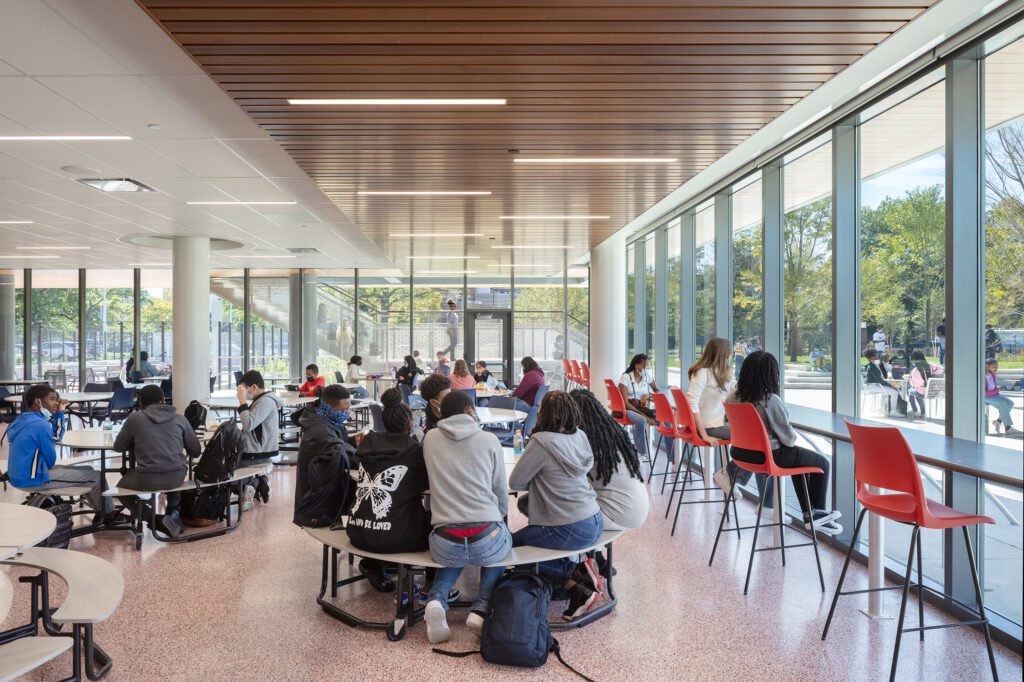
For architects, specifiers, and district facility planners, the case for classroom acoustic performance was once rhetorical. It has since become measurable. Decades of research connect speech intelligibility to student comprehension, teacher vocal fatigue, and the disproportionate impact poor acoustics have on students with hearing loss, learning disabilities, and English language learners. The decision in front of a school district is not whether acoustic performance affects learning. It is what level of investment in acoustic specification delivers the best return for student outcomes within the budget constraints the project actually has.
This piece covers what the research says about classroom acoustics and learning, how acoustic standards translate into specification decisions, and the role ceiling systems play in delivering classrooms that support how students actually learn.
What the Research Establishes
Speech intelligibility in a classroom depends on two primary factors: the signal-to-noise ratio between the teacher’s voice and the room’s background noise, and the reverberation time of the space. When either factor falls outside recommended thresholds, students lose access to portions of what is being said. The loss is not uniform across students. It is heaviest for students who are already working harder to hear:
Students with hearing loss, even mild bilateral or unilateral loss, experience compounding intelligibility loss in poorly performing classrooms.
Students with learning disabilities or attention disorders use more cognitive resources to filter speech from noise, reducing the resources available for comprehension and retention.
English language learners depend more heavily on phonemic clarity to disambiguate language, and lose more comprehension when the acoustic environment degrades the signal.
Students with normal hearing and English fluency lose meaningful intelligibility when signal-to-noise ratios drop below recommended thresholds, but they have more buffer than students in the categories above.
Teacher vocal health is a measurable consequence of poor classroom acoustics. Teachers in spaces with high background noise or long reverberation raise their voices throughout the day. Vocal fatigue, hoarseness, and chronic voice problems are documented occupational hazards in poorly performing learning spaces.
Standards That Translate Research into Specification
ANSI/ASA S12.60, the American National Standard for Classroom Acoustics, codifies the research into specification thresholds. The standard sets background noise at or below 35 dBA in unoccupied core learning spaces and reverberation time (RT60) at or below 0.6 seconds in rooms under 10,000 cubic feet. These thresholds are calibrated to support speech intelligibility for the full range of students and to protect teacher vocal health.
ANSI compliance is referenced by LEED v4 and v4.1 in the Acoustic Performance credit, by the New York City School Construction Authority’s Design Standards, and by an increasing number of state and district specifications.
In Texas, the Texas Education Agency (TEA) sets performance guidelines for public school facilities that emphasize cost-effective specification, with the expectation that performance requirements and lifecycle cost are balanced. For Texas K-12 specifiers, the implication is that acoustic specification is not optional but does need to be defended on lifecycle terms. A ceiling system that delivers ANSI-compliant acoustic performance, durability matched to Texas school environments, and certification documentation aligned with funding requirements clears the specification process more efficiently than a system that performs on one dimension but underdelivers on another.
Why Ceiling Systems Are the Lever
Walls, floors, furniture, and occupants all contribute to classroom acoustics. The ceiling is typically the largest available absorptive surface and the most direct lever for acoustic performance. A high-NRC ceiling does not guarantee ANSI compliance on its own (background noise control through HVAC specification matters too), but a low-NRC ceiling makes compliance functionally unreachable in most standard classroom configurations.
Three considerations frame ceiling specification in classrooms designed to support learning outcomes:
NRC across the relevant frequency range. Speech intelligibility depends on consonants, which are higher-frequency. Ceiling systems should be specified with NRC values that perform across the mid- and high-frequency bands, not just at averaged values that may mask weaker performance at the frequencies that matter most for speech.
RT60 in the actual room configuration. Modeled RT60 values may differ from delivered RT60 if assumptions about wall finish, furniture, and occupant absorption are off. Specifications should reference target RT60 values and verify performance at completion.
Durability and finish stability over time. Acoustic performance can degrade as ceiling finishes wear, dust accumulates, or replacement panels are sourced from different production batches. Long-term performance matters more than installation-day performance for student outcomes that compound across years of building use.
Aluratone and Linear in Learning-Focused Specifications
Rulon Aluratone delivers documented mid- and high-frequency absorption suited to core learning spaces, lecture halls, and corridors. The wood veneer system pairs an acoustically absorptive core with a hardwood face, available in slotted, perforated, and scored profiles, and is specified where the visual warmth of wood is required alongside measured acoustic control. Aluratone holds ASTM E84 Class A and Indoor Advantage Gold certifications.
Rulon Linear systems deliver high acoustic performance in a wood-finish format suited to libraries, learning commons, and high-design classrooms. Linear systems support the biophilic and material warmth strategies that contribute to occupant wellbeing and learning environment quality. Linear holds ASTM E84 Class A, FSC Chain of Custody, and Indoor Advantage Gold certifications.
At Benjamin Banneker Academic High School in Washington, D.C., the design team specified Rulon systems to deliver acoustic performance aligned with strict urban-school standards while supporting the building’s broader commitment to occupant wellness. The project illustrates that meeting acoustic standards in a flagship academic environment is achievable through coordinated specification (ceiling, mechanical, structural, partition assemblies) rather than any single product decision, and that the investment in acoustic and material quality directly supports the academic program the school exists to deliver.
Specification Takeaways
For architects, specifiers, and district facility planners working on K-12 and higher ed projects with student outcomes as the priority:
Specify to ANSI S12.60 thresholds at minimum, with attention to actual delivered performance rather than nameplate compliance.
Coordinate ceiling acoustic specification with mechanical specification. ANSI compliance requires both background noise control and reverberation control.
Specify NRC at frequencies relevant to speech, not just averaged values. Consonant-frequency performance drives intelligibility.
Document acoustic performance at the assembly level rather than relying on product-level NRC alone, particularly in spaces with non-standard geometry or finish configurations.
Plan for long-term performance with specifications that hold up under the maintenance environment the district actually has.
Related Resources:
For the full pillar context: Acoustic Ceiling Systems for Schools covers the broader specification framework for K-12 and higher ed acoustic projects.
For multipurpose space acoustics: How to Reduce Echo in Educational and Multipurpose Spaces addresses the high-volume environments where reverberation control is the dominant specification challenge.